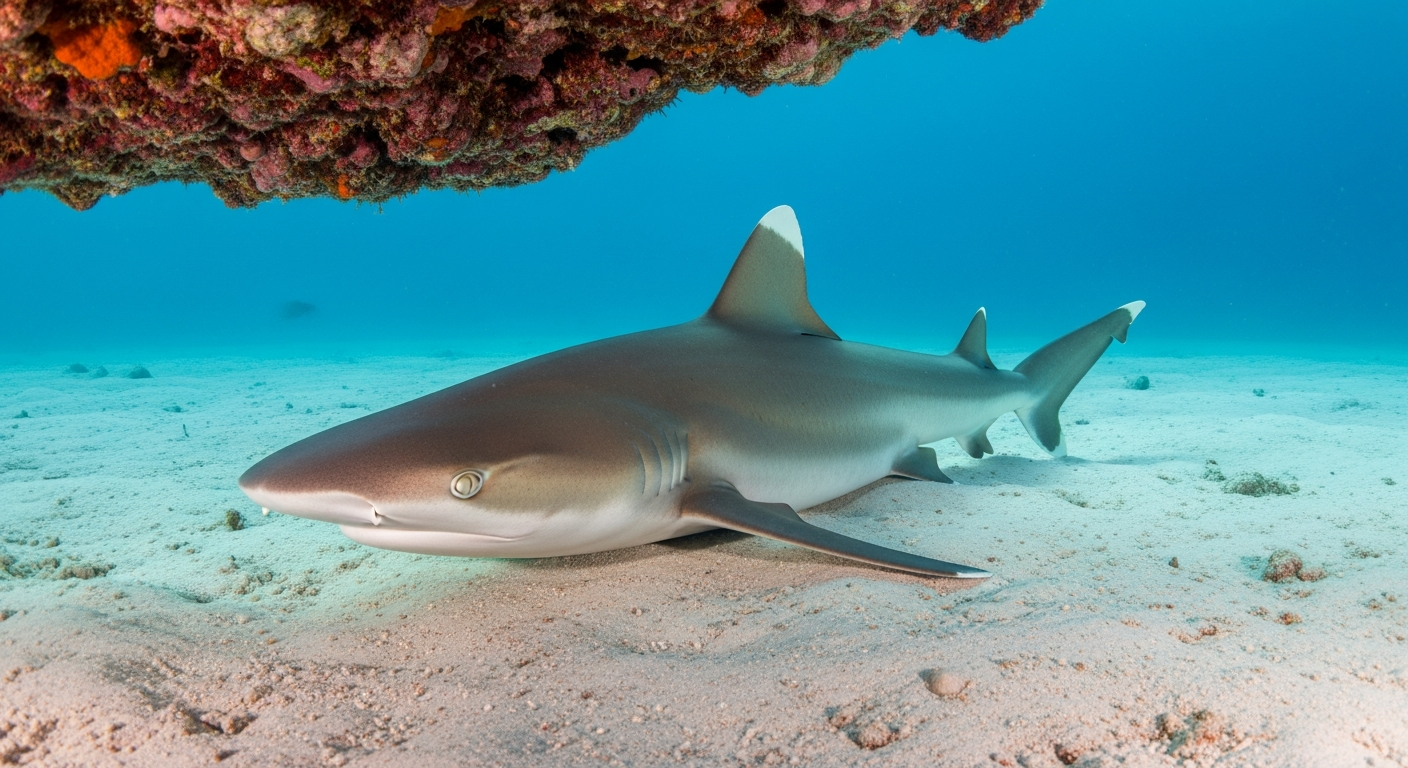
Triaenodon obesus
Whitetip Reef Shark
The most reliably encountered reef shark in the Red Sea. White Tip Reef Sharks are a creature of habit, returning to the same coral overhangs and cave systems day after day.
Whitetip reef sharks are slender, slow moving requiem sharks built for life close to the reef structure. The distinctive white-tipped dorsal and caudal fins make identification straightforward even at depth. Adults typically reach 1.6 metres, occasionally touching 2.1 metres in mature individuals. The body is grey-brown above and pale below, often marked with small dark spots along the flanks.
During daylight hours, whitetips rest in groups beneath table corals, inside caverns, or wedged into crevices along the reef wall. This resting behaviour is not lethargy. They are conserving energy before the night hunt. After dark, groups coordinate to flush reef fish and octopus from the reef matrix, a hunting strategy that is genuinely cooperative in character. In the Red Sea, these nocturnal hunts are observed regularly at sites like Ras Mohamed and the Brothers Islands, where reef architecture concentrates both prey and sharks.
The Red Sea population is considered stable relative to many Indo-Pacific regions, partly because significant stretches of Egyptian reef remain protected within national park boundaries and partly because the species benefits from a degree of cultural protection in Egyptian dive tourism. Shark feeding was banned in Egyptian waters, and enforcement has improved at key sites over the past decade. That said, pressure from unregulated fishing outside park boundaries and longline bycatch continues to affect population recruitment.
Whitetips are one of the few sharks that can remain stationary on the seabed and pump water across their gills without ram ventilation. This physiology allows the extended rest periods divers observe. It also means they are particularly susceptible to decompression style injuries if lifted rapidly in nets, which contributes to post release mortality in fisheries bycatch scenarios.
Approach slowly and maintain a relaxed, horizontal profile. Whitetips resting on the seabed are not alarmed by divers who keep a respectful distance of two metres or more and avoid positioning themselves between the shark and open water. Hovering above a resting group at mid water and allowing the animals to become accustomed to your presence before moving closer is standard practice. Do not corner animals inside caves or overhangs. In enclosed spaces, a resting shark that feels blocked from its exit route will become agitated and may pass very close at speed. Give it a clear line to open water.
Night dives at sites like Ras Mohamed and the Brothers Islands offer the best opportunity to observe active hunting behaviour. Keep torches angled slightly downward rather than sweeping directly at the animals. Whitetips in active hunting mode move with purpose and are less interested in divers than in prey, but erratic torch movements and sudden illumination of the shark at close range can interrupt the hunt and stress the animal. Stay calm, move slowly, and treat the encounter as an observation, not an interaction.
The standard encounter. A whitetip resting on sand or ledge, or moving slowly along the reef wall, poses no meaningful risk to a calm diver maintaining reasonable distance. Observe from two metres or more, avoid direct eye contact at very close range, and do not position yourself between the shark and open water. These animals are habituated to divers at most major Red Sea sites.
A whitetip that begins making tight passes, arches its back, or drops its pectoral fins is signalling stress. This posture is most likely if the animal has been cornered in an overhang or approached too aggressively. Back away slowly without turning. During night feeding activity, multiple sharks moving quickly through the same water column can result in close-range accidental contact. Keep fins and hands tucked, reduce lateral movement, and let the feeding activity pass before repositioning.
Triaenodon obesus is listed as Vulnerable on the IUCN Red List, having been reassessed from Near Threatened in 2020 following evidence of population declines across multiple Indo-Pacific ranges. The species is slow to reproduce, with females reaching sexual maturity at around eight years and producing small litters on a biennial cycle. This life history makes populations slow to recover from targeted or incidental fishing pressure. In the Red Sea, the primary threats are longline fisheries operating in international and Yemeni waters, gill-net fishing along the Sudanese and Eritrean coasts, and localised spearfishing pressure at unprotected sites.
Within Egyptian territorial waters, the national park system at Ras Mohamed and the protected reef network around the Brothers Islands, Daedalus, and Elphinstone provide meaningful refuge. Egyptian law prohibits the removal of sharks from these protected zones, and live-aboard operators working these sites generally enforce a no-touch, no-feed policy. The situation outside these boundaries is less consistent. Regional coordination between Egypt, Saudi Arabia, Sudan, and Eritrea on shared shark populations remains limited, and there is no Red Sea-specific management plan for the species. The gap between protected Egyptian reefs and unmanaged offshore fishing grounds is the central conservation challenge.
Atlas Position
We document whitetip reef sharks at sites across the Egyptian Red Sea because reliable, repeated encounters with this species are part of what defines diving here. That familiarity carries a responsibility. A shark that returns to the same overhang every day is not a tame animal. It is a wild predator that has chosen to tolerate human presence. The Atlas holds that this tolerance is worth protecting through informed, restrained diver behaviour and through sustained pressure on regional governments to extend and enforce meaningful protection across the full range of Red Sea reef shark habitat.
Sign in to share a sighting, behaviour note, or encounter.
No verified sightings yet. Be the first Atlas member to log an encounter.
Keep reading, and open the whole Atlas.
A free account unlocks every dive site guide and map, the marine life library, member reports, and the full incident log. Free to join.
Join free to keep reading