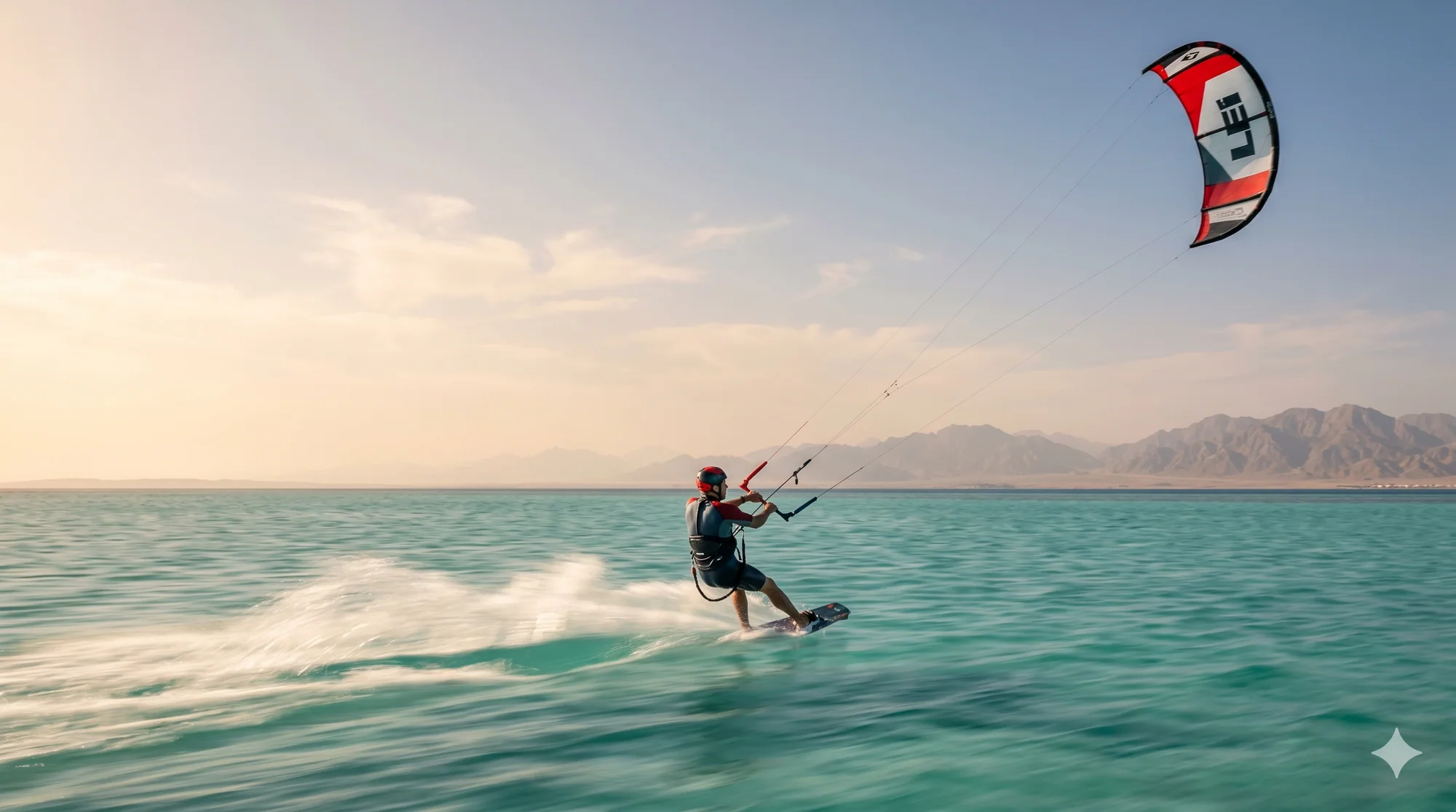
The Red Sea Wind, Why It Blows, Where It Blows
The Red Sea's prevailing NNW wind is among the most consistent on earth. A guide to the meteorology behind it, pressure systems, mountain channeling, the Gulf of Aqaba funnel effect, and a regional breakdown of Dahab, El Gouna, Safaga and Hurghada.
The Red Sea has a wind problem, in the best possible sense. The prevailing NNW wind blows with a consistency and regularity that meteorologists describe as exceptional. Not exceptional for a desert coast, or exceptional for this time of year, but exceptional by global standards. Kitesurfers know this. Windsurfers have known it for longer. International competition circuits came here because the wind is simply more reliable than almost anywhere else on earth.
Understanding why the wind blows the way it does, and where and when it is at its best, is the foundation of planning any wind sports session in Egypt. This guide covers the meteorology, the regional breakdown, the seasonal patterns and how to read conditions before you launch.
The meteorology, why the wind blows
The Red Sea's prevailing wind is driven by a persistent pressure gradient. From spring through autumn, a thermal low pressure system establishes itself over the heating landmass of the Arabian Peninsula and the Sahara. To the north and northwest, higher pressure sits over the Mediterranean and North Africa. Air flows from high to low: the result is a consistent, sustained northerly to NNW airstream being drawn down the length of the sea.
The Red Sea's geography amplifies this. The sea is a narrow rift valley, between 300 and 350 kilometres wide at most, running roughly 1,900 kilometres from the Suez Canal in the north to the Bab-el-Mandeb Strait in the south. On both sides, the land rises steeply: the Eastern Desert and the Sinai massif to the west and east of the northern half, the Hejaz and Asir mountains to the east in the south. This topography does what any narrow valley does to moving air, it channels and accelerates it. The further south you go, the more consistent the acceleration effect becomes.
There is also a thermal component that operates on a diurnal cycle. During the day, the desert heats rapidly and the land-sea temperature differential intensifies, sea breeze circulation reinforces the synoptic flow. By mid-morning, the wind is building. By noon to 14:00, it is typically at its peak. As the land cools after sunset, the thermal component diminishes and wind speeds drop, often significantly. This pattern is most pronounced in the hot months (April through September). In winter, the synoptic pressure gradient is stronger and more persistent, producing wind that is more consistent through the day and into the evening.
"The Red Sea is a 1,900 kilometre wind tunnel between two mountain ranges. The laws of fluid dynamics do the rest."
The Gulf of Aqaba, Dahab and the funnel effect
Dahab sits at the top of one of the most effective wind funnels on the planet. The Gulf of Aqaba is a secondary rift arm that branches northeast from the main Red Sea at Sharm el-Sheikh, running approximately 160 kilometres to the port of Aqaba. It is narrow, rarely more than 20 kilometres wide, and flanked by the Sinai mountains on the west and the mountains of Saudi Arabia on the east. The prevailing NNW wind enters this channel from the south and accelerates as it travels northward.
For kitesurfers and windsurfers based in Dahab, the practical consequence is simple: the wind blows harder here, more consistently, and for more months of the year than in the wider Red Sea to the south. Wind speeds of 20–35 knots during the peak season (November through March) are routine. The kite and windsurf lagoon north of town offers shallow, flat water sheltered behind a reef, one of the most technically ideal training environments in the region. Outside the lagoon, the open Gulf provides choppier water for those who want more challenge.
In 2024, Dahab recorded approximately 250 windy days, a figure that reflects both the funneling geometry and the year-round character of the Gulf of Aqaba wind. Local instructors call it the "Habibi wind", it arrives like a daily appointment rather than an unpredictable weather event. The wind in Dahab is almost exclusively northerly and side-onshore at the main lagoon spots, which is a significant safety advantage. The reef to the east provides a natural backstop. Riders should understand, however, that the wider Gulf is exposed open water and conditions can change rapidly, particularly in winter when strong synoptic depressions pass through the region.
El Gouna, lagoons and competition
El Gouna sits approximately 22 kilometres north of Hurghada, built across a series of islands and lagoons within a reef system on the main Red Sea coast. It is the most developed wind sports destination in Egypt and one of the most internationally recognised kitesurfing venues in the world. The GKA Kite World Cup has been held here; the EFPT (European Freestyle Pro Tour) has run events at the site.
The appeal is straightforward: the reef system creates a network of flat-water lagoons with consistent side-offshore and side-onshore windows depending on exact location. The main kite beach sits within one of these lagoons. Wind is predominantly NNW, side-onshore at this spot. Speeds of 18–28 knots are typical during October through April. In the hotter months, the thermal afternoon build still fires reliably, El Gouna can be ridden year-round, though summer sessions require managing the extreme heat as much as the wind.
El Gouna also hosts the only dedicated wakeboarding cable park in the region, Sliders El Gouna, a full-size two-tower cable circuit that operates within the protected lagoon water. This has made El Gouna the single most diverse wind and water sports hub on the Egyptian coast.
Safaga, the consistent corridor
Safaga sits about 60 kilometres south of Hurghada and is regarded by many experienced wind sports riders as the most consistently windy location on the Egyptian Red Sea coast. The fetch, open water to the north, is longer here than at El Gouna, and the local topography does not interrupt the flow. Wind is predominantly northerly to NNE, and speeds routinely exceed those further north.
The main kite and windsurf beach at Safaga is a long sandy stretch with deep water relatively close to shore, which makes it a preferred location for wave riding and freestyle. It is less developed than El Gouna in terms of infrastructure but draws a more technically accomplished crowd. The EFPT has staged events here. Those who make the trip south typically find less crowding and more reliable conditions than in the more tourist-oriented northern spots.
Seasonal guide, when to go and where
Reading the forecast, what to look for
A wind forecast for the Red Sea has some specific characteristics worth understanding. Windy.com and Windguru are the tools most used by local riders; both use ECMWF and GFS model data and are generally reliable for 48-hour forecasts. Beyond 72 hours, treat forecasts as directional indicators rather than precise predictions, the timing of synoptic systems can shift significantly.
Look at the pressure pattern, not just the speed reading. Close isobars over the eastern Mediterranean and a deepening low over the Arabian Peninsula equals strong, sustained northerlies within 24–48 hours. A flat pressure chart in October or November usually means the thermal season is transitioning to the synoptic season, conditions will be variable for a few days before settling into the winter pattern.
At a local level, the most important variable is wind direction relative to your launch beach. The difference between a sideshore northerly and an offshore northerly at a given location on the coast can mean the difference between a manageable session and a dangerous one. Know your beach, know your exit points, and never launch from a beach where the wind is directly offshore without experienced local knowledge and a boat on standby.
"The difference between 20 knots sideshore and 20 knots offshore is not a condition difference, it is a life-or-death difference. Check direction before speed."
Hurghada, a different proposition
Hurghada is the largest tourist hub on the Egyptian Red Sea coast and has a significant kite and windsurf scene, but it is a more complex environment than El Gouna or Dahab. The main kite areas sit within or near the city, alongside heavy boat traffic from dive operations, ferry services and glass-bottom boats. The wind is consistent and predominantly NNW, with reliable thermal afternoon builds in summer. The challenge is the crowded water, not the wind itself.
Several kite schools operate out of designated launch zones with boat safety cover. Using a licensed center here is strongly recommended, not only for instruction but for access to the safety infrastructure that makes riding possible in a busy maritime environment. Independent launching in unmanaged zones around Hurghada carries real risk from boat collision.
The Khamsin, when not to go
The Khamsin is the main weather hazard for anyone planning a spring trip to the Red Sea. A hot, dry, south-to-southwesterly wind originating over the Sahara and Arabian deserts, it is driven by low-pressure systems forming ahead of cold fronts crossing the Mediterranean and typically strikes Egypt between mid-March and May. A Khamsin event usually lasts one to three days, brings visibility close to zero from suspended sand and dust, and can exceed 60 kilometres per hour on the coast. All water sports operations close during a Khamsin. The frequency is roughly four to six events per year, which is why March and April, despite their intermittent strong northerlies, are considered variable transition months rather than reliable kite season. If you are planning a spring trip, build buffer days into the schedule.
Competition, why the circuits come here
International kite and windsurf competitions have been drawn to the Egyptian Red Sea for the same reason everyone else comes: the wind is simply more reliable than almost anywhere else accessible to European and international competitors. El Gouna has hosted GKA (Global Kitesports Association) Kite World Tour events, including the GKA Youth Freestyle World Cup Egypt, and the annual El Gouna Water Sports Festival brings over 150 competitors across kitesurfing, wakeboarding, windsurfing and sailing disciplines. Kitemania Dahab, running for over a decade, with the most recent iteration incorporating the Egyptian Kitesurfing Nationals, has built Dahab's profile in the international freestyle kite community from the inside. Safaga has deeper roots still: it hosted the Red Sea World Windsurfing Championships in 1993, and the ION Club has operated there continuously since 1991, making it one of the longest-established wind sports centres in the region.
The Atlas documents wind conditions on the Red Sea as factual reference for riders planning sessions. We do not endorse specific operators or schools. We do recommend that riders, particularly those new to the region, use established local centers for their first sessions at any Red Sea location, as local knowledge of wind direction, boat corridors and exit points is not something a forecast can replace.
NNW, consistent year-round, strongest Oct–Apr when synoptic pressure gradient is sharpest.
Dahab (Gulf of Aqaba funnel), El Gouna (flat lagoon), Safaga (strongest consistent corridor).
October through April, synoptic winds dominate, consistent all day. November–February most reliable.
May–September: winds build from ~11:00, peaking 13:00–16:00, easing after sunset.
July–August sessions are viable but heat (40°C+) and gusty afternoon thermals make them experienced-rider territory.
Member Comments
Leave a comment
Keep reading, and open the whole Atlas.
A free account unlocks every dive site guide and map, the marine life library, member reports, and the full incident log. Free to join.
Join free to keep reading