Overfishing the Red Sea, What the Data Actually Shows
The commercial fishing catch from the Egyptian Red Sea represents two percent of Egypt's national marine production. The fishing pressure it creates runs at ten to twenty times the sustainable rate. A data-led investigation into what has been lost, what is still being taken, and what the 2024 bans actually mean.
The commercial fishing catch from the Egyptian Red Sea coast accounts for approximately two percent of Egypt's total national marine catch. Two percent. Not a cornerstone of the national food supply. Not a significant employer by comparison with tourism. Not an industry that could not be managed differently. And yet the fishing pressure it represents is running at somewhere between ten and twenty times the rate the Red Sea can sustain.
That figure, the sustainable ceiling versus the actual catch, is the central fact of Red Sea fisheries, and almost nobody outside the scientific and conservation community knows it. The dive industry, which generates roughly a thousand times more economic value per kilogram of live fish than the fishing industry does, largely moves past it. Divers notice that there are fewer sharks than there used to be, fewer large grouper, fewer Napoleon wrasse. They assume it is climate change, or ocean acidification, or just the way things are. It is not. The primary driver of fish stock collapse in the Egyptian Red Sea is fishing pressure, and it is measurable, documented and, in principle, reversible.
This article assembles what the peer-reviewed science actually says about the state of Red Sea fisheries, what the documented incidents of illegal fishing show, and why the connection between an emptying sea and a degrading reef is more direct than most people realise.
The numbers that define the problem
Prof. Mahmoud Hasan Hanafy, marine ecologist at Suez Canal University and scientific adviser to HEPCA and the Red Sea Governor, has put the sustainable catch for the Egyptian Red Sea coast at between 900 and 2,000 tonnes per year. The actual catch runs at approximately 20,000 tonnes. That is not a rounding error. It is an order-of-magnitude gap between what the fishery can produce indefinitely and what is currently being taken from it.
The FAO peak catch figure for the Red Sea and Gulf of Suez was approximately 50,000 tonnes in 1993. By the late 2000s that had fallen to around 25,000 tonnes, a fifty percent collapse within fifteen years, despite a fleet that grew by more than forty percent in the same period. More vessels catching less fish is the clearest possible signal that stocks are being depleted, not that fishing effort is being optimised.
A 2023 study published in Regional Environmental Change (Soliman et al.) tracked Egypt's full marine fishing fleet from 2000 to 2019 and found that catch per unit effort, the standard measure of fishing productivity, fell from 283 kg per horsepower to 108 kg per horsepower. A 62 percent productivity collapse, across two decades, despite substantial improvements in vessel technology, engine power, navigation electronics and sonar capability. The fleet became dramatically better at finding fish and still caught far less of them per unit of effort because the fish were no longer there in the same abundance.
The same study estimated the Red Sea fleet at 36 percent above the optimum number of vessels and calculated that returning to Maximum Sustainable Yield would require reducing fishing effort by approximately 40 percent. A 2024 assessment published in Fishes (MDPI) evaluated population dynamics and exploitation status across 55 commercial species using ten years of landing data from eight Egyptian Red Sea ports. The conclusion, stated plainly: most of the analysed stocks are overexploited.
Fishing down the food web
When a fishery begins to collapse, it does not simply produce fewer fish. It produces different fish, progressively smaller, lower-value species as the larger, more commercially desirable ones are removed. Fisheries scientists call this "fishing down the food web." The mean trophic level of Egyptian Red Sea catches has been declining for decades, meaning that fishers are targeting lower and lower positions in the food chain because the higher ones have been depleted.
The most striking data point illustrating this process comes from sea cucumbers. FAO country data records sea cucumber landings in the Red Sea at zero tonnes in 1999. By 2002, three years later, annual landings had reached 2,300 tonnes. A species that had not been commercially targeted at all became one of the most heavily extracted in the space of three years, because the preferred species above it in the food chain had already been depleted to the point where the economics of targeting them no longer worked. That is not a sustainable fishery responding to market demand. That is sequential extraction moving systematically through whatever remains.
The Napoleon wrasse (Cheilinus undulatus) is listed as Endangered on the IUCN Red List and in CITES Appendix II. Its global population has declined by more than fifty percent over thirty years. It is slow-reproducing and vulnerable even to light fishing pressure. Groupers, which represented 47 percent of total biomass and 55 percent of potential revenue in the Hurghada fish market in a 2021–2022 study, show a characteristic pattern of overexploitation: markets dominated by undersized individuals and smaller species as larger animals are removed faster than they can reproduce. A Hurghada market study published in the Journal of Fish Biology (Wiley, 2023) concluded that the data indicated "potentially overfished reefs due to the high occurrence of smaller species and undersized individuals of higher priced serranid species."
The sharks: what has already been lost
Shark populations in the Red Sea are estimated to have declined by up to 80 percent since the 1970s. A 2016 peer-reviewed study published in Biological Conservation, "Ongoing decline of shark populations in the Eastern Red Sea", found catch per unit effort estimates for sharks "several orders of magnitude lower" than comparable reef systems globally, and concluded that "most shark populations in the Red Sea have collapsed." The study did not hedge. It did not frame this as a risk or a trend. It described a collapse that had already happened.
The oceanic whitetip (Carcharhinus longimanus) is the most emblematic case. Classified as Critically Endangered by the IUCN in 2019 following a global population reduction estimated at greater than 98 percent over three generation lengths, the species retains one of its last significant strongholds in Egyptian waters, particularly at the Brothers Islands, Daedalus Reef and Elphinstone. Dr Elke Bojanowski's Longimanus Project has been building a photo-identification catalogue of individual oceanic whitetips in the Red Sea since October 2004, drawing on 41,922 photographs from 1,115 contributors, identifying 1,159 individuals. The data records a sharp decline in sighted individuals in 2011, the year political unrest led to a breakdown in coastal enforcement, followed by partial recovery at key sites in 2012 as conditions stabilised.
Despite a 2006 national decree banning shark fishing across the Egyptian Red Sea and Gulf of Suez, and Egypt being named "Shark Guardian of the Year 2006" by the international conservation community, enforcement has been inconsistent. Shark meat has continued to appear in Egyptian fish markets. HEPCA's 2010 Stop Shark Sales campaign successfully pressured Carrefour Egypt to withdraw shark meat stocks. The most commonly cited economic argument for keeping sharks alive rather than in a net: a single medium-to-large reef shark generates approximately $200,000 annually in dive tourism revenue over its lifetime. A shark taken from the water generates that figure once, in meat and fin value, measured in hundreds of dollars.
Why the reef follows the fish
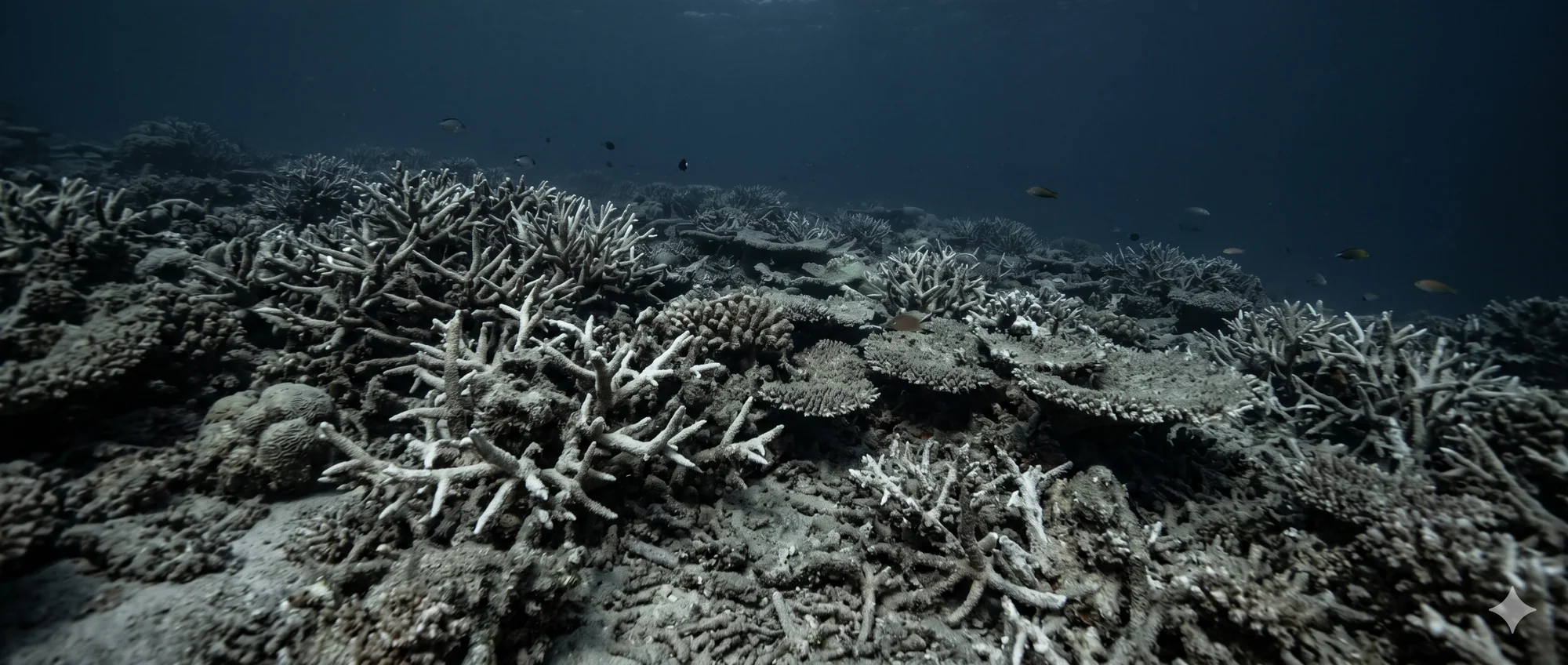
The connection between overfishing and reef degradation is not abstract. It operates through specific, well-documented ecological mechanisms.
Parrotfish are reef herbivores. They graze the algae that would otherwise smother coral recruits and prevent new coral growth. Research by Scripps Institution of Oceanography quantified what happens when they are removed: excluding large parrotfish from reef sections causes algal dry mass to increase four times faster than on unfished reef. Excluding both large and medium parrotfish causes algae to grow ten times faster. A 2009 peer-reviewed study on seven parrotfish species at Egyptian Red Sea reefs, the first to quantify bioerosion rates for this group in Egypt, identified Sparisoma ghobban as the most ecologically significant bioeroder by abundance. When parrotfish disappear from a reef, the consequences are not subtle and they are not slow. A reef that has been heavily fished can look structurally intact, coral present, water clear, while its ecological function has already collapsed. Age structures skewed toward juveniles. No large herbivores. Algae advancing on coral that no longer has anything grazing it back.
The removal of apex predators operates through a different mechanism but produces the same kind of cascading damage. Prof. Hanafy has described it plainly: removing the top predator from a food chain leads to what scientists call a trophic cascade, population explosions at lower trophic levels, collapse of prey management, and destabilisation of the entire community structure. The Egyptian Centre for Economic and Social Rights made the connection explicit in a 2022 position paper: the depletion of shark prey through overfishing creates conditions in which sharks are forced into coastal foraging, and cited the July 2022 fatal shark attacks at Sahl Hasheesh as a consequence of a food chain that had been disrupted beyond its ability to self-regulate.
What the law says and what has changed
Egypt has had fisheries legislation and marine protected area laws in place since the early 1980s. Law 102 of 1983 established Ras Mohamed as the country's first marine reserve and criminalised fishing in protected areas. Law 124 of 1983 established spawning ground protections. The Environmental Law of 1994 prohibits the killing or capture of aquatic creatures without permit, with penalties of LE 5,000 to LE 50,000 and the possibility of imprisonment. The 2006 shark fishing ban was a national decree backed by the Red Sea and South Sinai governorates.
The Hurghada Declaration, signed in June 2009 by HEPCA, the Red Sea Governorate, South Sinai Governorate, Suez Governorate, and the Ministries of Agriculture and Environment, proposed banning all net fishing and trawling south of the Gulf of Suez, establishing no-take zones, and restricting commercial fishing to rod-and-line only. It was a declaration of principles. As of the most recent HEPCA documentation, it remains "still awaiting legislation."
The most significant legislative action in the history of Egyptian Red Sea fisheries came in April and May 2024. A package of decrees, described by HEPCA as a major victory, prohibited commercial fishing using shanshula nets and trawl methods in the Red Sea, Gulf of Suez, and Gulf of Aqaba for five years. All recreational fishing and competitions were suspended for five years from 1 May 2024. Trade in Red Sea fish was prohibited in markets, restaurants and shops from 15 April to 15 July 2024, the breeding season. Net fishing on coral reefs in the Gulf of Aqaba was banned. A dedicated enforcement committee was established.
Whether five-year bans translate into five years of actual enforcement is a question the data cannot yet answer. The track record of the gap between legislation and implementation in Egyptian fisheries is long and well-documented. HEPCA's Amr Ali has said it plainly: "Laws and regulations do exist, some of them ratified more than 20 years ago; but, the lack in enforcement is a major cause of the unsustainable stock depletion we face today." The 2024 decrees are real. Their legacy will depend on what follows them.
The two percent argument
The Egyptian Red Sea commercial catch represents approximately two percent of Egypt's total national marine production. It is not a pillar of national food security. It does not employ a significant fraction of the national workforce. The dive tourism industry that depends on the same body of water, that depends on the presence of sharks, Napoleon wrasse, grouper and a functioning reef ecosystem, generates economic value that dwarfs the fishing catch by any reasonable calculation.
HEPCA has made this argument directly: "In time, the Red Sea would resemble nothing more than an ugly, empty lake, and all this for just a 2% catch." It is not a rhetorical flourish. It is the central economic case for a fundamentally different approach to managing what is, when intact, one of the most valuable marine ecosystems on the planet.
A 2024 artisan fishers survey published in Ocean and Coastal Management found that 43 percent of Egyptian Red Sea artisanal fishers did not expect to still be fishing in ten years. That is not a workforce confident in the future of what it is doing. It is a community that understands, at an operational level, that the resource it depends on is running out.
The Red Sea is worth more alive than empty. That is not a conservation slogan. It is the output of any honest economic analysis of what the dive tourism industry generates versus what the commercial fishing industry extracts from the same body of water. The Atlas supports the 2024 trawl and net bans and believes their enforcement should be documented publicly. We support catch-and-release sport fishing as a legitimate recreational activity and the work of organisations like Bluefin Fishing Academy in building a tagging and release culture among Egyptian anglers. We will continue to document the condition of the reef and its fish populations honestly, including when the evidence is uncomfortable.
An estimated 20,000 tonnes caught annually against a sustainable ceiling of 900–2,000 tonnes, per Prof. Hanafy / HEPCA.
2016 Biological Conservation study. Oceanic whitetip classified Critically Endangered (IUCN 2019), 98%+ global decline.
Catch per unit effort fell from 283 kg/HP to 108 kg/HP between 2000 and 2019, despite fleet technology improvements.
Ras Mohamed National Park legally protected since Law 102/1983. Enforcement capacity has lagged legislation throughout.
Decrees in April–May 2024 banned shanshula nets, trawling, and commercial fishing during the breeding season.
Bluefin Fishing Academy, IGFA's first MENA strategic partner, completed the first bluefin tuna tag in Red Sea history.
Leave a comment
Keep reading, and open the whole Atlas.
A free account unlocks every dive site guide and map, the marine life library, member reports, and the full incident log. Free to join.
Join free to keep reading