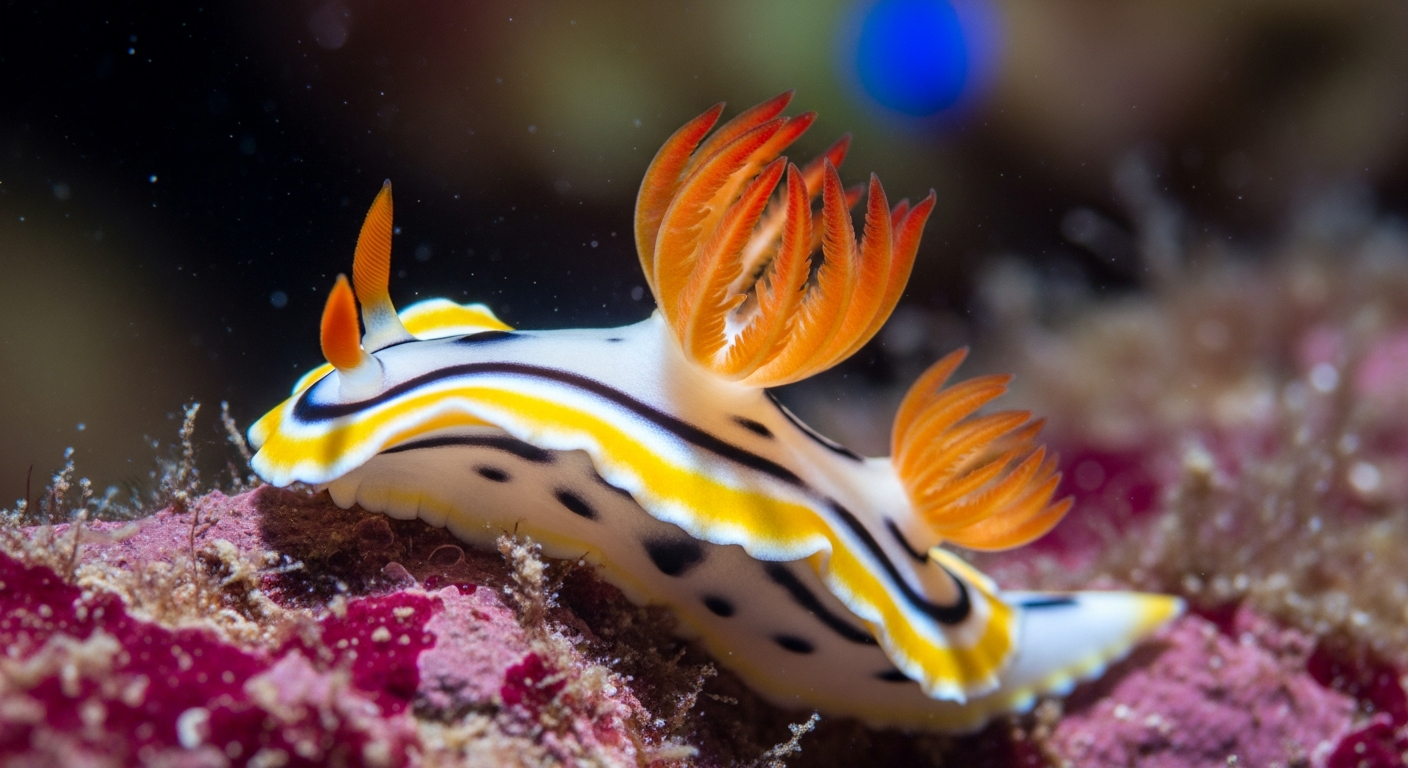
Order Nudibranchia
Nudibranch
Soft-bodied sea slugs that trade the protection of a shell for an arsenal of chemical defenses and some of the most elaborate coloration in the ocean. The Red Sea hosts a rich and still-expanding checklist of species, many photographed here before being formally described.
Nudibranchs are shell-less gastropod molluscs belonging to the order Nudibranchia. The name translates from Latin as 'naked gills,' a reference to the exposed gill plumes, or cerata, that many species carry on their dorsal surface. They are found in every ocean and at virtually every depth, but the warm, nutrient-rich reefs of the Red Sea support a diversity that consistently surprises researchers. Estimates suggest the Red Sea hosts well over 300 nudibranch species, though the true number is almost certainly higher. New records are still being added through citizen science photography and dedicated scientific surveys.
They are almost entirely carnivorous, and their diets are often highly specialised. Different species target sponges, hydroids, bryozoans, tunicates, corals, and even other nudibranchs. Some aeolid nudibranchs, which carry finger-like cerata rather than a central gill plume, can sequester the stinging nematocysts from their hydroid prey and incorporate them into their own tissues as a secondary defense. Dorid nudibranchs, the rounded and often more vividly patterned group, typically sequester toxic or distasteful compounds from sponges. The coloration you see is not decoration. It is a direct warning to predators.
In the Red Sea specifically, the genus Chromodoris produces some of the most consistently photographed animals on the reef. Species such as Chromodoris annae and members of the Hypselodoris genus appear reliably on hard coral walls and rubble slopes from Sinai south to the Sudanese border. The aeolid Phyllodesmium species, which mimic soft corals with remarkable precision, are regularly encountered at sites with strong soft coral growth. Conditions across the Red Sea, particularly the slightly elevated salinity and the prevalence of sponge-encrusted walls, appear to suit a wide cross-section of nudibranch families.
Lifespans are short, typically between a few weeks and around one year depending on species. Most nudibranchs are simultaneous hermaphrodites, meaning each individual carries both male and female reproductive organs and can mate with any conspecific it encounters. Eggs are laid in characteristic spiral or ribbon-like masses, often matching the coloration of the parent. Their populations fluctuate seasonally and are sensitive to shifts in prey availability, water temperature, and reef condition. The long-term health of Red Sea nudibranch communities is therefore a reasonable proxy for broader reef health.
Nudibranchs are slow, deliberate animals. They will not move away from you, which makes them easy to observe but also easy to damage accidentally. The primary risk in any nudibranch encounter is not behavioural on their part. It is physical contact from fins, hands, or poorly controlled buoyancy. A nudibranch dislodged from its substrate in open water is effectively dead. Maintain neutral buoyancy before you approach, and approach horizontally where possible so your fins are not working behind you over the reef.
For photographers, resist the temptation to reposition an animal for a cleaner shot. Many nudibranchs are feeding when you find them, and moving them removes them from their food source. Natural light or a wide-angle snoot will serve the animal better than a direct strobe that causes other divers to crowd in. At sites like Marsa Shagra or the shallower sections of the Canyon, rubble slopes and coral bases reward slow, methodical searching at the end of a dive rather than the beginning. Your eyes adjust to small-scale detail as narcosis clears and adrenaline from descent fades.
Most nudibranch encounters in the Red Sea are entirely passive. The animal continues feeding or moving slowly across substrate. Observe from 15 to 20 cm, match your breathing to maintain position, and photograph without touching. Some aeolid species can deliver a mild skin irritation if handled, but this is not a significant risk in normal dive conditions.
The only meaningful hazard in a nudibranch encounter is the diver's own body position. If you find yourself hovering above a nudibranch with rising buoyancy, abort the approach rather than kick down to correct. A fin strike on a nudibranch, or on the sponge or hydroid colony it feeds on, causes direct harm. At deeper sites where nudibranchs appear on vertical walls, be aware of your position relative to other divers below you before stopping to photograph.
Nudibranchs are not assessed individually by the IUCN at any meaningful scale, largely because the taxonomy of the order remains incomplete. Undescribed species are still being photographed and submitted for formal description from Red Sea sites. This creates a genuine conservation problem: it is not possible to protect what has not been named. Several species documented in the northern Red Sea and Gulf of Aqaba appear to have very restricted ranges, which would make them inherently vulnerable to localised reef degradation, even if no formal threat assessment exists.
The principal threats to nudibranch populations in the Red Sea are the same as those facing the reef ecosystems they depend on. Coastal development along the Egyptian Riviera and the Saudi Red Sea coast is reducing the quality of nearshore reef habitat. Bleaching events, while less severe in the Red Sea than in many other regions, do reduce sponge and coral cover that underpins nudibranch prey availability. There is no targeted protection for nudibranchs in any Red Sea jurisdiction, and collection for the aquarium trade, while not large-scale, occurs. The most practical conservation lever available is reef protection at the site level, which is why several of the most nudibranch-rich sites we cover fall within established marine protected areas.
Atlas Position
We treat nudibranchs as a meaningful indicator group for Red Sea reef health. Their specificity of diet, their sensitivity to substrate change, and the ongoing incompleteness of their taxonomy make them worth tracking carefully. We encourage divers using this Atlas to photograph nudibranchs with species identification in mind, to submit records to iNaturalist or to Sea Slug Forum-successor databases, and to treat encounters with the same care they would give to any protected species. The number of formally described Red Sea nudibranchs has increased substantially through diver-submitted photography over the past two decades. That record should continue.
Sign in to share a sighting, behaviour note, or encounter.
No verified sightings yet. Be the first Atlas member to log an encounter.
Keep reading, and open the whole Atlas.
A free account unlocks every dive site guide and map, the marine life library, member reports, and the full incident log. Free to join.
Join free to keep reading