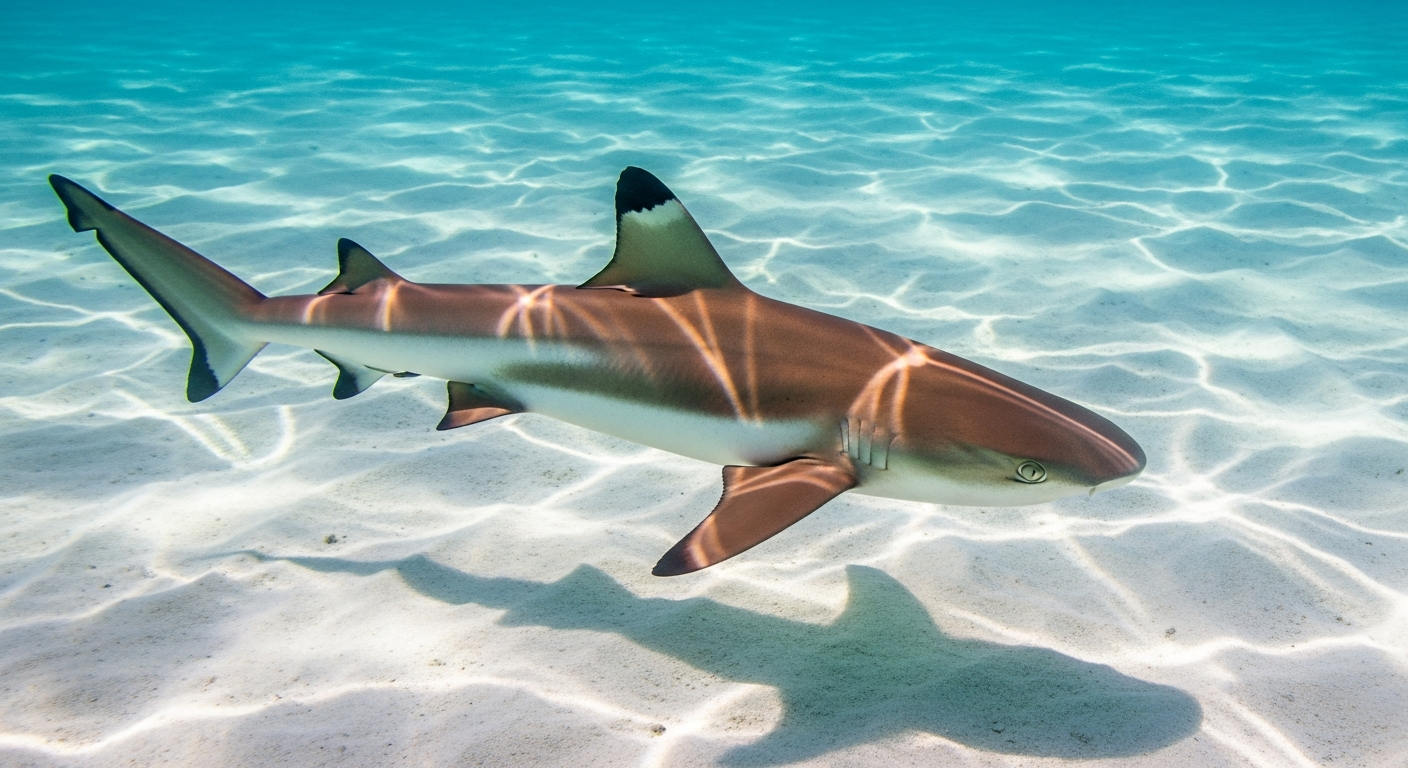
Carcharhinus melanopterus
Blacktip Reef Shark
The most reliably encountered reef shark in the Red Sea, the blacktip is a creature of the shallows, defined by its nervous energy and those unmistakable fin tips cutting the surface.
Carcharhinus melanopterus is a slender, medium sized requiem shark built for life in shallow reef environments. It reaches around 1.8 meters at most, with a streamlined body and distinctively marked fins. Every fin carries a black tip bordered by white, and the first dorsal fin is particularly tall and prominent. In the Red Sea, you learn to recognize this shark by its silhouette long before you see the markings clearly.
Blacktips are viviparous, giving birth to two to five live pups after a gestation of around eight to eleven months. Pups are born in shallow nursery areas, often in very warm, protected water. In the Red Sea this means lagoons and reef flats, where the adults are less present and the young can develop with some shelter from larger predators. Growth is slow and sexual maturity arrives late, which makes population recovery from fishing pressure a lengthy process.
In the Red Sea, blacktip reef sharks are present year round but their behaviour shifts with season. During summer months they are frequently seen in very shallow water along reef edges, sometimes with their dorsal fins breaking the surface. They tend to patrol defined territories and the same individuals are often observed at the same sites over multiple years. At sites like Ras Mohamed and the Straits of Tiran, resident populations have been studied informally by dive operators for decades.
The Red Sea population benefits from relatively low coastal development compared to Indo-Pacific reef systems, but it is not under no pressure. Artisanal fishing, shark fin demand, and habitat degradation along the Egyptian and Saudi coastlines all affect numbers. Populations that were once dense in certain areas have thinned noticeably over the past two decades, according to longterm observers working out of Hurghada and Sharm elSheikh.
Blacktip reef sharks are wary animals. They will approach out of curiosity, but they are not bold sharks and they rarely hold their ground when a diver moves toward them. The standard encounter in the Red Sea involves the shark making one or two passes at a distance of five to fifteen meters before retreating to deeper water or continuing along the reef edge. Kneeling on sand and remaining still will extend the encounter considerably. Chasing, cutting off, or cornering a blacktip produces rapid flight and achieves nothing useful.
The one context where behaviour changes is feeding stimulation. If fish scraps or bait are present in the water, blacktips become visibly more agitated. Their swimming pattern shortens and tightens, and they will approach much closer than usual. In this state, accidental contact with a hand or foot is a realistic possibility. We advise divers to keep arms close to the body, avoid dangling equipment, and exit the water calmly if a blacktip's behaviour shifts from curious to competitive. Unprovoked bites are extremely rare, but this shark has been responsible for minor incidents when feeding dynamics are involved.
A blacktip passing along a reef edge or making slow passes around a stationary diver is normal behaviour. Remain still, keep your profile low, and observe without pursuing. These encounters are low-risk and the shark will typically disengage on its own terms.
If fish blood, bait, or a speared fish is present in the water, blacktips may close the distance and move in tight, accelerating patterns. Keep arms tucked in, do not handle food in the water, and exit calmly if the shark begins making close repeated passes. Do not thrash or swim rapidly to the surface.
The blacktip reef shark is listed as Vulnerable on the IUCN Red List, a status that reflects documented declines across its Indo-Pacific range. In the Red Sea, the principal threats are targeted fishing for fins and meat, bycatch in demersal fisheries, and the slow attrition of nursery habitats through coastal construction and sedimentation. The species' late maturity and small litter sizes mean that populations do not recover quickly once they are reduced.
Egypt's national park protections at Ras Mohamed and the Tiran and Sanafir islands provide some sanctuary for resident populations, and the remoteness of offshore reefs like Daedalus and the Brothers offers a degree of natural protection. However, enforcement of no take rules across the broader Egyptian coastline is inconsistent, and Saudi Red Sea waters are subject to increasing development pressure. No species specific management plan exists for blacktip reef sharks in the Red Sea basin. Regional coordination between Egypt, Saudi Arabia, Sudan, and Yemen on shark conservation remains limited.
Atlas Position
The blacktip reef shark is, for many divers, their first real shark encounter in the Red Sea. That familiarity can create a false sense that the species is abundant and secure. We do not share that confidence. Population data from the Red Sea is thin, and the trend lines from comparable Indo-Pacific systems are not encouraging. We document sightings, support photographic identification efforts where they exist, and advocate for expanded marine protected areas that cover the shallow reef habitats this species depends on for breeding and nursery functions.
Sign in to share a sighting, behaviour note, or encounter.
No verified sightings yet. Be the first Atlas member to log an encounter.
Keep reading, and open the whole Atlas.
A free account unlocks every dive site guide and map, the marine life library, member reports, and the full incident log. Free to join.
Join free to keep reading