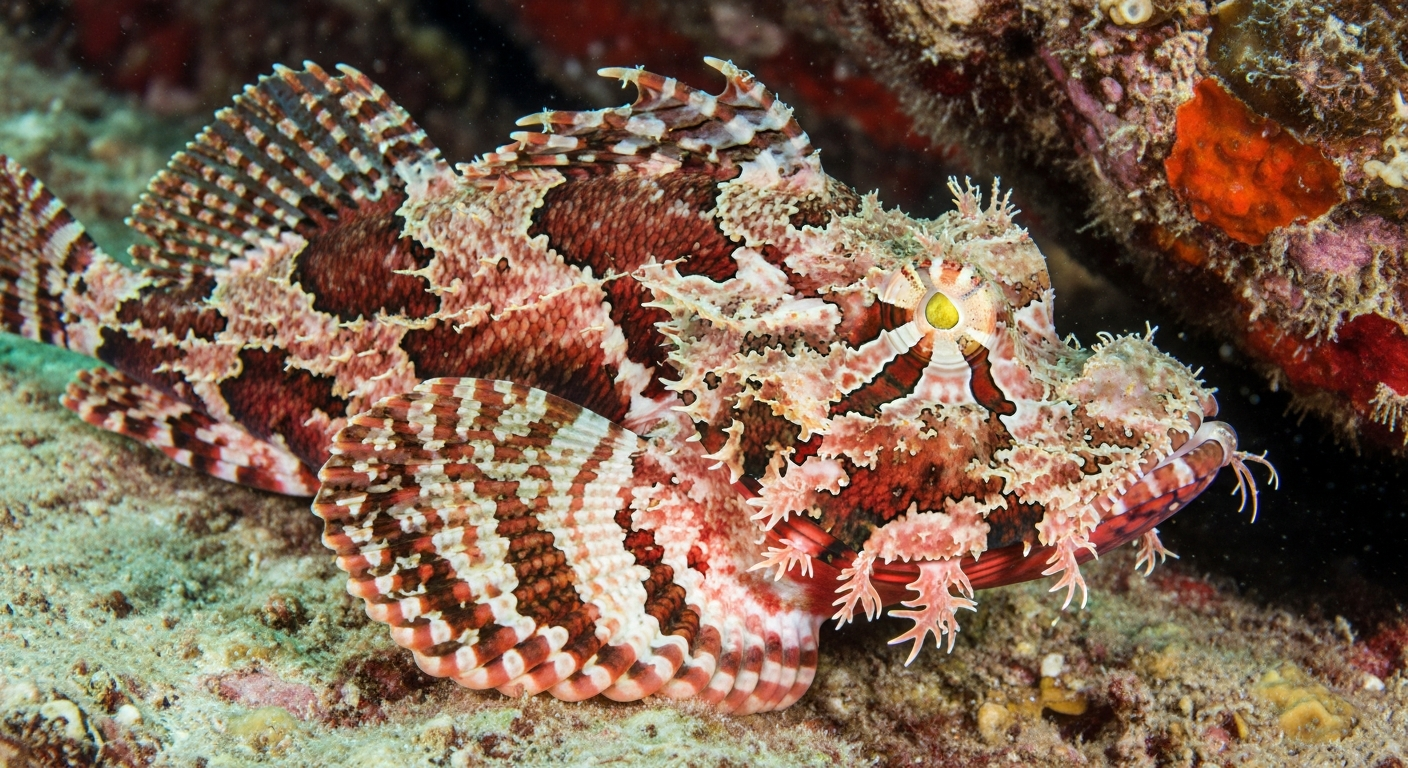
Scorpaena scrofa / Scorpaenopsis oxycephala
Scorpionfish
The Red Sea's master of concealment, scorpionfish are everywhere and almost never seen. Venom and patience define them.
Scorpionfish belong to the family Scorpaenidae, a group defined by cryptic coloration, sedentary ambush behaviour, and venomous dorsal spines. In the Red Sea, Scorpaenopsis oxycephala, commonly called the tassled scorpionfish, is the species most frequently encountered by divers. It is a reef-associated predator that hunts by waiting, not chasing. Its entire body plan is an investment in invisibility.
These fish can match coral rubble, encrusted rock, and algae-covered substrate with remarkable fidelity. Skin flaps, irregular body contours, and shifting coloration allow them to sit motionless on a reef for hours. When prey comes within range, they strike in milliseconds. The lunge is one of the fastest feeding strikes recorded among bony fish. Between hunts, they simply sit. This is not laziness. It is strategy.
In the Red Sea, scorpionfish are found throughout Egyptian, Saudi, and Sudanese waters. They favour the reef margins and rubble slopes between two and thirty metres, though they can occur deeper. Sites with complex hard substrate, particularly those with mixed rubble and live coral, tend to hold more individuals. Population density is difficult to assess because detection rates are so low relative to actual abundance.
Their IUCN status is Least Concern globally, and there is no indication that Red Sea populations are under significant pressure from fishing or habitat degradation specifically. However, reef health matters. Scorpionfish depend on structurally complex reefs to conceal themselves and ambush prey. Coral bleaching events and destructive anchoring, both documented across the Red Sea, erode the habitat complexity these animals rely on.
The rule with scorpionfish is simple. Look before you touch or place anything. On Red Sea reefs, these animals sit on ledges, in rubble channels, at the base of coral heads, and occasionally in the open on sand patches that offer even minimal concealment. Many divers pass within centimetres of them without any awareness. The fish typically holds its position unless directly threatened. It does not pursue divers.
If you spot one, maintain a comfortable distance and observe without hovering immediately overhead. Scorpionfish that feel cornered or harassed may flare their gill covers as a warning. Take that seriously and back off. Do not attempt to touch, prod, or photograph from centimetres away by bracing against the reef with your hands. Buoyancy control is essential here, not just for your safety but for the reef's integrity. Accidental contact with a dorsal spine causes immediate, intense pain and requires prompt medical attention. Keep fins clear of rubble zones where these fish commonly rest.
A stationary scorpionfish observed from thirty centimetres or more presents no threat. It will remain still, occasionally shifting its gaze. This is a normal encounter. Hover calmly, photograph carefully, and move on without disturbing its position.
Envenomation occurs when spines are contacted under pressure, most often by an unaware diver placing a hand or knee on a camouflaged fish. If stung, exit the water calmly, immerse the affected area in hot water as hot as tolerable for 30 to 90 minutes to break down the protein-based venom, and seek medical evaluation. Do not ignore a sting. Pain can be severe and secondary infection is a real risk.
Globally, scorpionfish are classified as Least Concern by the IUCN. They are targeted in some Red Sea artisanal fisheries but are not a primary commercial species in most areas. Their populations do not appear to be in decline, though robust survey data specific to the Red Sea is limited. The indirect threats matter more than direct fishing pressure here.
Habitat degradation is the meaningful concern. Scorpionfish depend on structurally complex reefs to survive as ambush predators. When coral cover degrades through bleaching, anchor damage, or runoff, the rubble and crannies these fish rely on for concealment are compromised. Several Egyptian reef systems have experienced repeated bleaching events since 1998. Protected areas like Ras Mohamed National Park provide some buffer, but enforcement capacity across Red Sea nations remains inconsistent. Continued investment in marine protected area management and anchor buoy infrastructure at key sites directly benefits species like scorpionfish.
Atlas Position
We treat scorpionfish as an indicator of reef habitat quality as much as a species in their own right. Their presence in meaningful numbers suggests structural complexity and healthy invertebrate prey populations. When we document them at a site, we note substrate type and depth, not just the sighting. Divers who learn to find scorpionfish develop better reef-reading skills overall, and we think that education dividend is worth emphasising. Respecting these animals means respecting the reef they depend on.
Sign in to share a sighting, behaviour note, or encounter.
No verified sightings yet. Be the first Atlas member to log an encounter.
Keep reading, and open the whole Atlas.
A free account unlocks every dive site guide and map, the marine life library, member reports, and the full incident log. Free to join.
Join free to keep reading