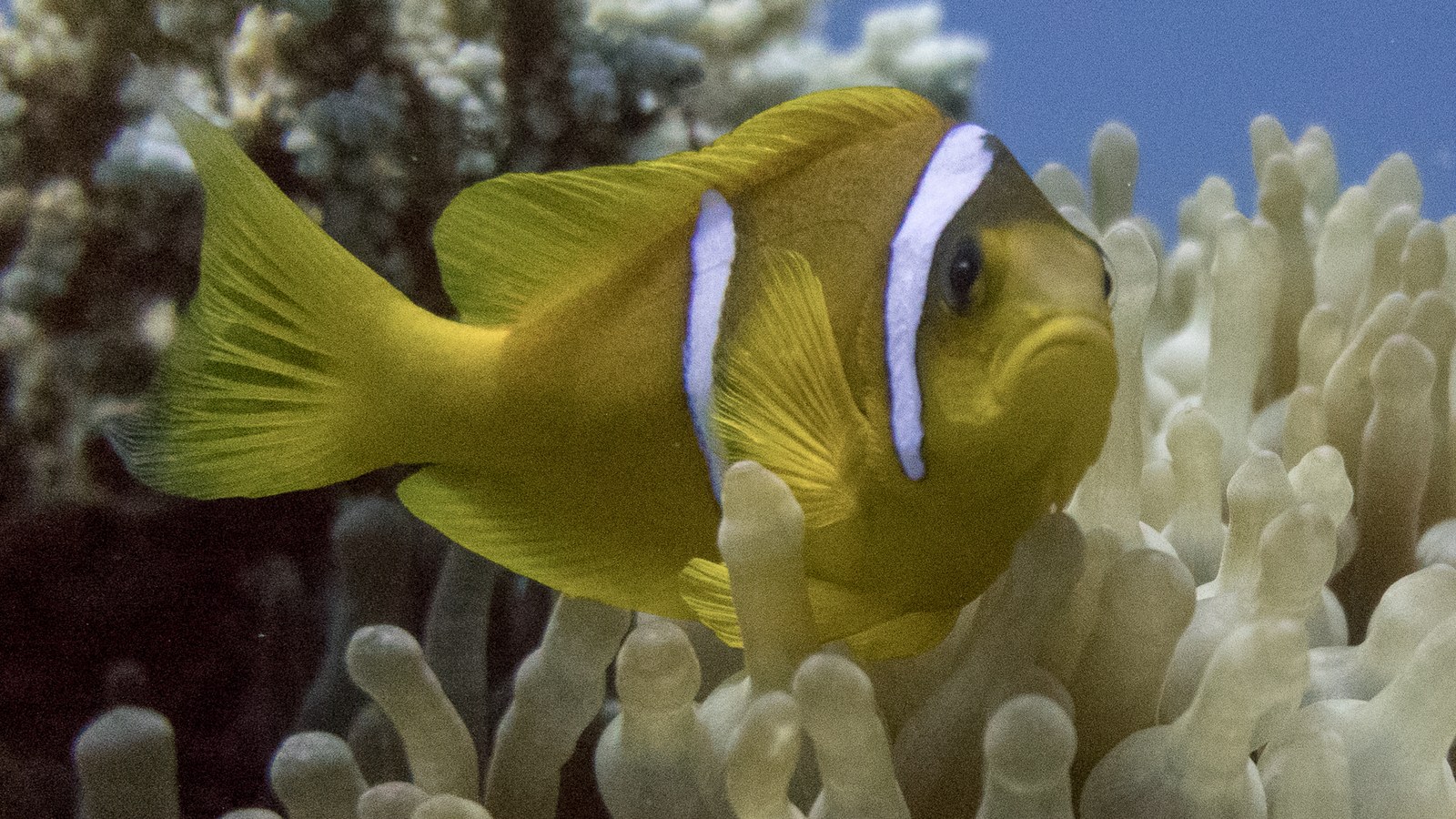
Amphiprion bicinctus
Clownfish
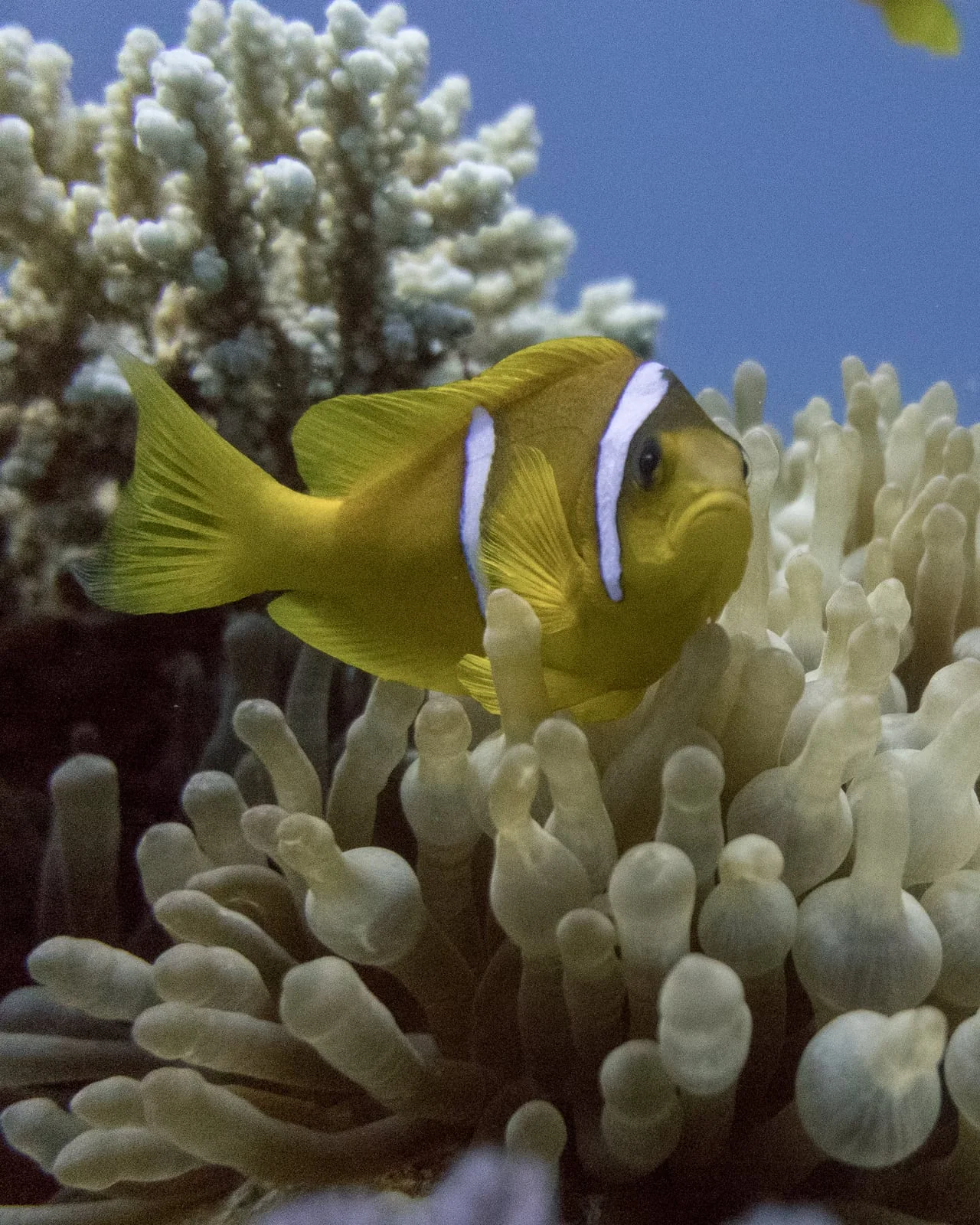
The Red Sea's only native clownfish species, Amphiprion bicinctus lives in an intimate partnership with sea anemones across the region's shallow reefs. Two white bars on an orange body make it unmistakable, and its territory makes it fearless.
Amphiprion bicinctus is the sole clownfish species endemic to the Red Sea and Gulf of Aden. Unlike the Indo-Pacific assemblage of dozens of Amphiprion species, Red Sea divers encounter only this one, which gives it a particular significance in local reef ecology. It lives exclusively within the tentacles of host anemones, primarily Entacmaea quadricolor and Heteractis magnifica, and will spend its entire adult life within a few metres of a single host.
The relationship between this fish and its anemone is genuinely mutualistic. The clownfish gains protection from predators within the stinging tentacles, while the anemone benefits from the fish's aggressive territorial behaviour, which deters butterflyfish that would otherwise feed on the anemone's tissue. The fish also improves water circulation around the anemone through its constant fin movement, and its waste provides nutrients directly to the host.
All clownfish are born male. Social hierarchy within an anemone determines sex: the dominant individual becomes female, the second-ranked male becomes her breeding partner, and any remaining juveniles are reproductively suppressed. If the female dies, the dominant male transitions to female. This sequential hermaphroditism is a well-documented adaptation to life tied to a fixed territory. In the Red Sea, a single anemone typically hosts one breeding pair and up to four smaller juveniles.
Red Sea populations appear stable across monitored sites. The species benefits from its restricted habitat requirements, which paradoxically provide some protection. Where anemone cover remains healthy, clownfish densities hold. The greater concern is anemone bleaching during thermal stress events, which have increased in frequency across the northern and central Red Sea. A bleached or dying anemone leaves its resident clownfish exposed and highly vulnerable to predation.
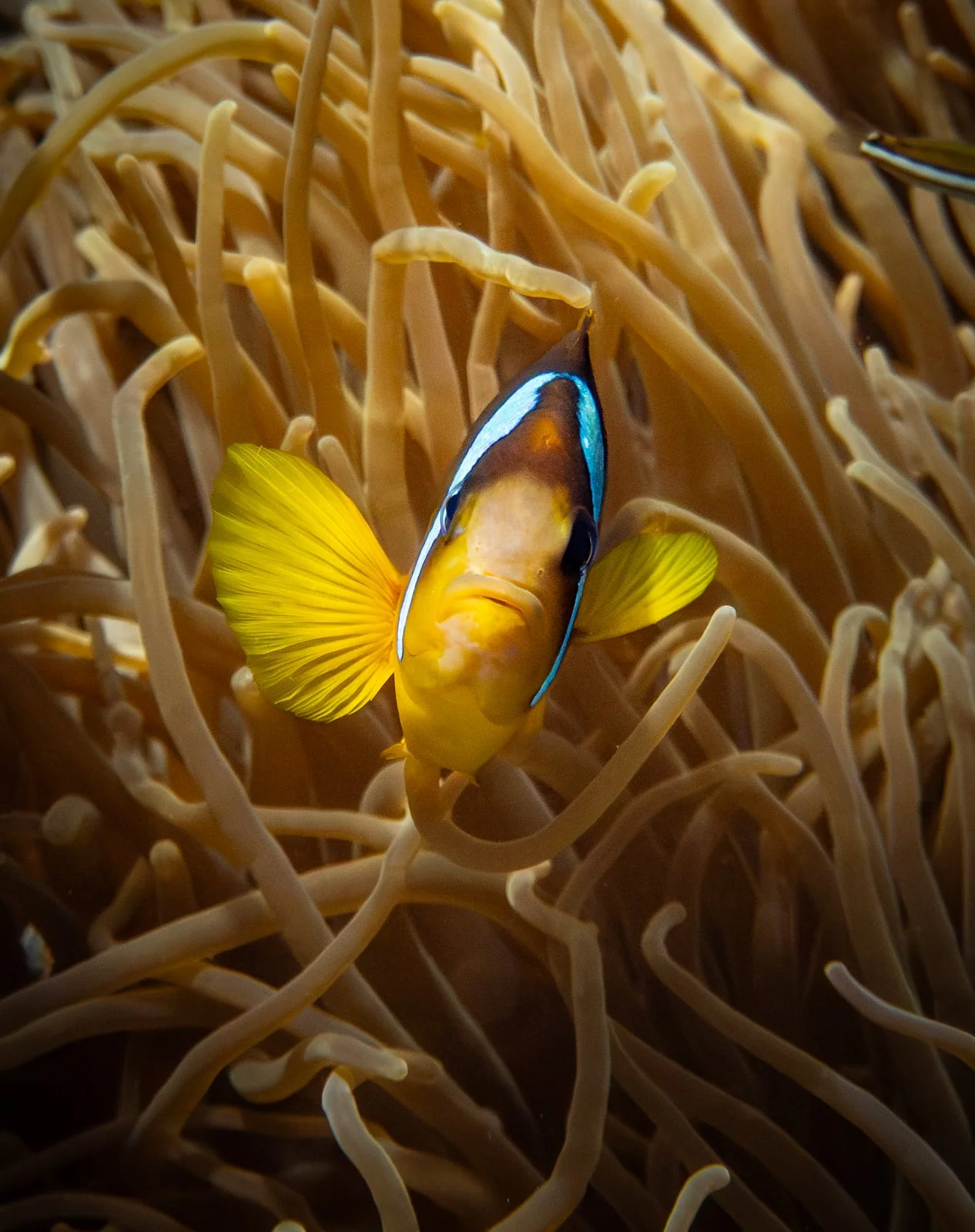
Approach slowly and at the same depth as the anemone rather than from above. Coming down vertically over the host triggers a stronger defensive response. Most clownfish in well-dived sites are habituated to divers and will hold their ground or make short, repetitive lunges that stop well short of contact. Let the fish set the distance. If it is repeatedly charging toward your mask or hand, you are too close to the anemone and should back off by half a metre.
Do not touch the anemone. Beyond the obvious risk of damaging the host, physical contact disrupts the mucus layer that makes the clownfish immune to its own anemone's sting. Reaching into an anemone is also one of the few ways a clownfish will actually make contact with skin, delivering a bite that is harmless but unnecessary. Keep your fins clear of the surrounding substrate. Silting up the area around an anemone during close observation is a more common source of damage than direct contact.
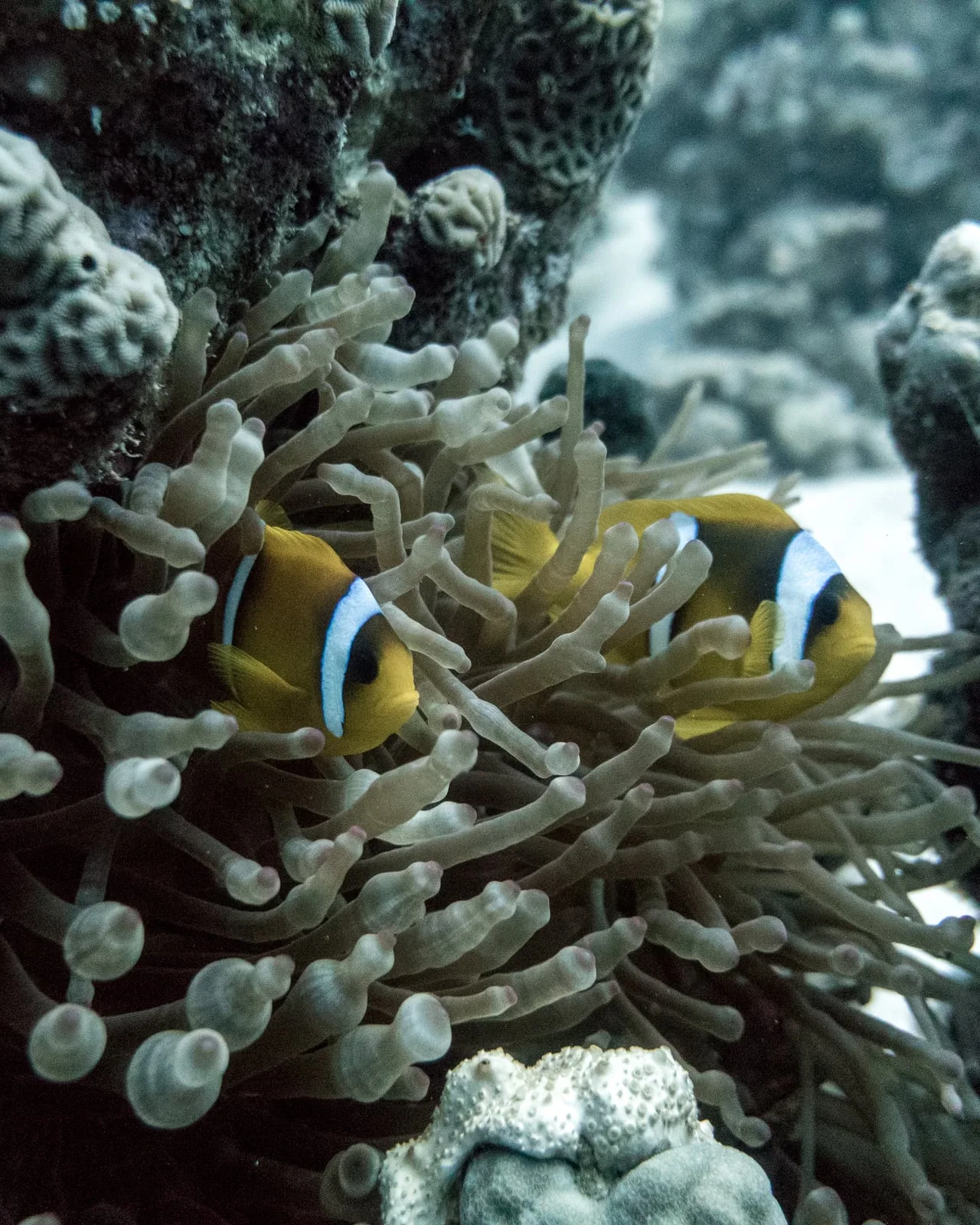
Approach at reef level, maintain a comfortable 50 to 60 cm from the anemone, and the fish will typically display without escalating. Habituated individuals at popular sites often ignore divers entirely after an initial assessment. This is a normal, safe encounter and requires no special action.
During active spawning periods, typically correlated with warmer months between April and September, breeding pairs become significantly more aggressive. The male, which guards the egg clutch laid on a cleared substrate surface near the anemone base, will charge repeatedly and with greater commitment. Give the nest a wider berth than usual, at least one metre, and avoid hovering over the site. The bite itself is trivial, but repeated stress to a guarding pair during incubation can cause nest abandonment.
Amphiprion bicinctus is currently assessed as Least Concern by the IUCN, and Red Sea populations do not show evidence of systemic decline. However, the species is closely tied to anemone health, and that dependency is its primary vulnerability. Bleaching events driven by elevated sea surface temperatures have caused widespread anemone mortality across parts of the Red Sea, and displaced clownfish rarely survive long enough to locate a new host in degraded reef environments.
The aquarium trade has historically targeted clownfish globally, and while Red Sea collection pressure is lower than in some Indo-Pacific regions, it has not been eliminated entirely. Egypt's marine protected area network, including Ras Mohamed National Park, provides meaningful habitat protection where enforcement is active. Outside protected boundaries, reef degradation from coastal development, anchor damage, and unregulated diving activity continues to reduce quality anemone habitat. We regard thermal stress as the dominant long-term threat to this species in the Red Sea, not direct collection.
Atlas Position
Amphiprion bicinctus is a species whose familiarity can work against it. Because it is small, common, and associated with one of the most recognisable pop-culture images in marine biology, it is easy to underestimate its ecological role and the precision of the conditions it requires. We document it with the same rigour we apply to apex predators, because the health of an anemone patch is a reliable indicator of broader reef condition, and the presence of a thriving clownfish pair is one of the clearest signals a shallow reef site gives us.
Sign in to share a sighting, behaviour note, or encounter.
No verified sightings yet. Be the first Atlas member to log an encounter.
Keep reading, and open the whole Atlas.
A free account unlocks every dive site guide and map, the marine life library, member reports, and the full incident log. Free to join.
Join free to keep reading