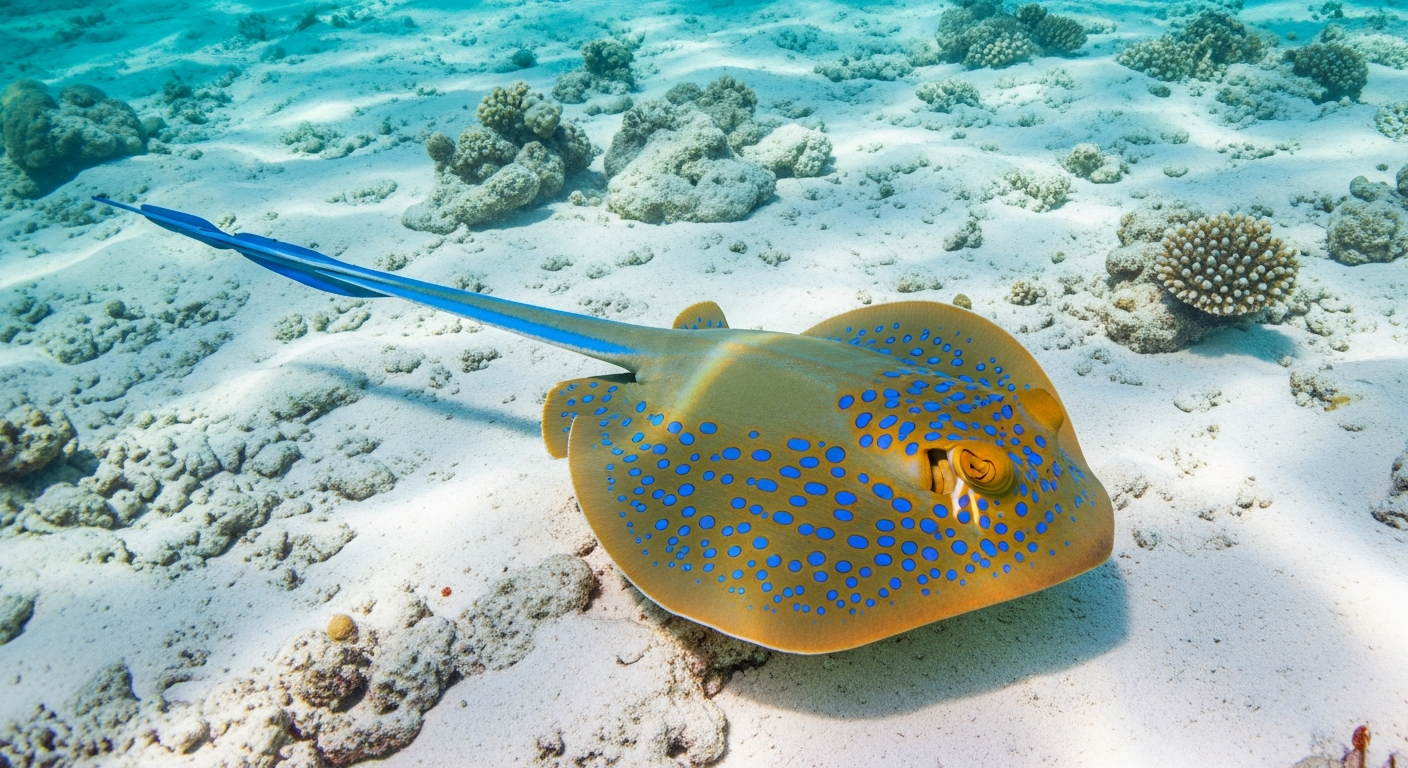
Taeniura lymma
Blue Spotted Stingray
One of the most recognisable rays in the Red Sea, the blue-spotted stingray is defined by its electric-blue ocelli and its preference for shallow reef flats where divers encounter it daily. It is not a deep-water rarity. It is part of the furniture.
Taeniura lymma is a ribbontail ray in the family Dasyatidae, distributed across the Indo-Pacific from the Red Sea to the central Pacific. In the Red Sea it is one of the most frequently encountered elasmobranch species, present year-round from the intertidal zone down to around 30 metres. Its vivid blue spots are not decorative. They are a warning signal, advertising the presence of two venomous tail spines that can cause serious injury if the animal is harassed or cornered.
The species is benthic and largely solitary outside of seasonal aggregations. It spends much of its time partially buried in sand or resting beneath coral ledges. At night, or during tidal movement, it becomes more active, moving across reef flats and sandy channels to forage. Its diet centres on small molluscs, worms, shrimps, and small crabs, which it locates using electroreception and excavates by jetting water from its spiracles into the substrate.
In the Red Sea, blue-spotted stingrays are a constant presence at sites with mixed sand and coral habitat. Ras Mohamed, the straits of Tiran, and the shallow reef margins around Marsa Alam all support healthy populations. They are not schooling animals, but it is common to see several individuals in a single dive when conditions and habitat are right. The species tolerates proximity to divers reasonably well, though it will relocate if repeatedly disturbed.
Globally, Taeniura lymma is assessed as Least Concern by the IUCN, supported by its wide range and apparent resilience. In the Red Sea, localised fishing pressure and habitat degradation from coastal development are relevant concerns, though the species has not shown the sharp declines seen in some larger ray species. Long-term population data specific to the Red Sea remains limited, which is a gap worth noting.
Give this ray space and it will typically ignore you. The standard guidance applies: approach slowly from the front or side, stay low to avoid casting a sudden shadow overhead, and do not chase it if it moves away. Most negative encounters happen when a diver follows a ray into a confined space under a ledge, or when someone reaches toward it for a photograph. Neither is necessary and both are provocations the animal has no obligation to tolerate.
In the Red Sea specifically, blue-spotted stingrays on shallow reef flats near popular resorts have become accustomed to diver presence. This familiarity does not mean they welcome contact. A ray that holds its position while you approach is not being friendly. It is simply not alarmed yet. Maintain at least a metre of clearance, keep movements slow and predictable, and resist the instinct to hover directly above the animal. On sandy sites like Abu Dabbab or Jackfish Alley, rays are often partially buried and easy to miss. Watch where you put your hands and knees.
The ray rests on sand or beneath a ledge. Approach slowly from the side, maintain at least one metre of distance, and observe without hovering overhead. The animal may relocate calmly. This is normal and should not be followed up with pursuit.
A ray that cannot move away, particularly one trapped under a ledge with a diver blocking the exit, may strike defensively with its tail. The spines are venomous and capable of causing deep lacerations and significant pain. If a ray appears cornered, back away immediately and open an exit route. Do not attempt to handle or restrain the animal under any circumstances. If envenomation occurs, immerse the affected area in hot water as soon as possible and seek medical attention.
The IUCN lists Taeniura lymma as Least Concern based on its broad distribution and the absence of evidence for major population-level declines. It is taken as bycatch in artisanal and commercial fisheries across its range, and in some regions it is targeted directly for its meat and for the curio trade. In the Red Sea, bycatch from nearshore fishing activity represents the most consistent human pressure on the species. Habitat loss through coastal construction, particularly in the Egyptian and Saudi Red Sea coastal zones, affects shallow reef flat environments that this species depends on.
There is no dedicated monitoring programme for Taeniura lymma in the Red Sea that we are aware of. Most population data derives from broader reef health surveys. The species benefits indirectly from marine protected areas such as Ras Mohamed National Park and the protectorates along the Egyptian coast, but enforcement of these protections is uneven. The global Least Concern status should not be read as an assurance that local populations are under no pressure. It reflects data at a scale that can obscure regional trends.
Atlas Position
We regard the blue-spotted stingray as a species that warrants more structured attention than its Least Concern status tends to invite. It is among the most-seen rays in the Red Sea and one of the first elasmobranchs that many divers encounter here. That familiarity is an asset for conservation communication, and we think it should be used. Documenting sightings, noting behavioural changes at repeatedly visited sites, and reporting suspected bycatch incidents all contribute to a data picture that currently has too many gaps. This species does not need alarm. It needs consistent, considered observation.
Sign in to share a sighting, behaviour note, or encounter.
No verified sightings yet. Be the first Atlas member to log an encounter.
Keep reading, and open the whole Atlas.
A free account unlocks every dive site guide and map, the marine life library, member reports, and the full incident log. Free to join.
Join free to keep reading