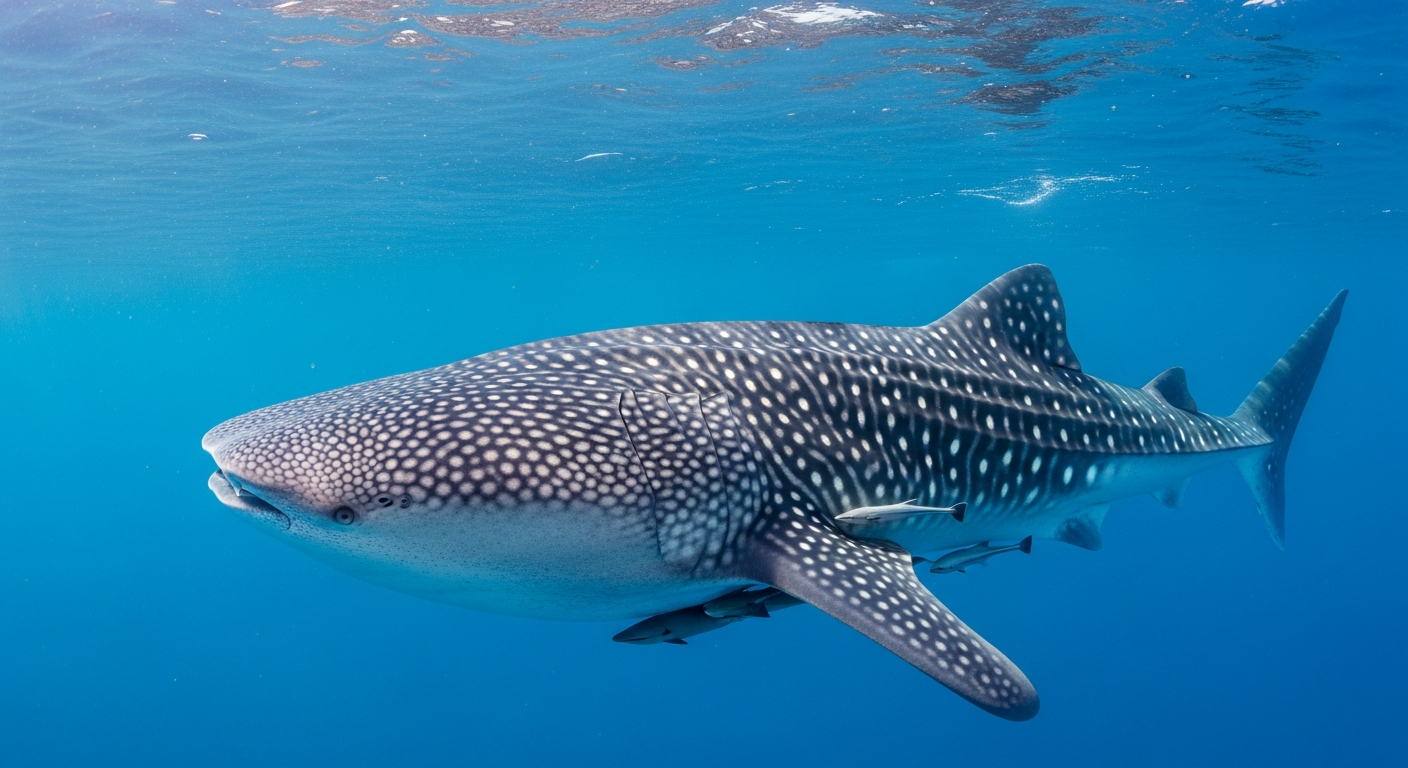
Rhincodon typus
Whale Shark
The largest fish on Earth passes through Egyptian waters on its own schedule. When it appears, everything else stops.
Whale Sharks are the largest extant fish, reaching confirmed lengths of 12 meters and unconfirmed reports beyond 18. Despite that scale, it is a filter feeder, sustaining itself on plankton, fish eggs, small crustaceans, and juvenile fish concentrated near the surface. The mouth can span 1.5 metres and filter hundreds of cubic meters of water per hour. The species is found around the globe in tropical and warm temperate seas, but individual populations show strong site fidelity and seasonal aggregation patterns tied to plankton blooms and spawning events.
In the Egyptian Red Sea, whale sharks are seasonal and genuinely unpredictable. Late spring and summer, roughly May through August, is the window when encounters become possible. The southern reefs, including Daedalus and the Brothers, see open water passes by individuals moving along the outer wall or near the surface offshore. Sha'ab El Erg, north of Hurghada, has produced notable encounters in the May to July window, likely linked to plankton concentrations in the area. Neither location reliably produces sightings year to year. A whale shark encounter in the Red Sea is an event, not a product.
The Red Sea population forms part of the broader Indo-Pacific genetic group. Photo-identification work, using the unique spot patterns behind the gills, has confirmed that some individuals return to the same regions across years. However, the Egyptian Red Sea lacks a longterm dedicated monitoring program comparable to those in the Maldives or Western Australia. Most records here are incidental, reported by dive operators and liveaboard crews rather than through structured scientific effort.
Globally, the species is classified as Endangered by the IUCN, with population declines driven primarily by directed fisheries in South and Southeast Asia, vessel strikes, and entanglement. The Red Sea sits outside the heaviest fishing pressure zones, but international shipping lanes cross the region and surface-swimming whale sharks are genuinely vulnerable to strike. Water temperature increases linked to climate change are altering plankton distribution, which may affect where and when the species appears in this sea.
When a whale shark appears, the instinct to chase it is strong and almost always counterproductive. These animals move deceptively fast for their size. Chasing with fins creates noise and pressure disturbance that causes the shark to sound or change direction. The correct approach is to enter the water quietly, position ahead of the animal at an angle, and wait. Let the shark come to you, or let it pass. If it is feeding at the surface, maintain a minimum of three metres from the body and at least four metres from the tail. The tail generates enough force to cause serious injury.
The CDWS guidelines that govern responsible encounters here are clear and we endorse them without qualification. Do not touch the animal. Do not ride it. Do not position directly in front of the mouth during active feeding. Do not chase the animal if it moves away. Keep lateral distance and match depth passively rather than pursuing. When a whale shark dives, the encounter is over. Attempting to follow it down serves no purpose and causes stress. A good encounter here is brief, calm, and conducted entirely on the shark's terms. That restraint is what makes the next encounter possible.
The shark is moving slowly at or near the surface, possibly feeding. Enter the water ahead of its path, stay to the side, keep three metres of clearance, and move passively. No fin bursts near the animal. Observe the direction it is travelling and do not obstruct it. This is the safest and most rewarding type of encounter.
A whale shark's caudal fin sweeps a wide arc with considerable force. Divers who position behind or below the tail during feeding runs risk being struck. If the shark accelerates or changes direction unexpectedly, increase distance immediately rather than trying to keep pace. Do not swim underneath a feeding animal.
Rhincodon typus was uplisted from Vulnerable to Endangered on the IUCN Red List in 2016, reflecting an estimated population decline of more than 50 percent over 75 years. The primary driver is targeted fishing, concentrated in parts of South and Southeast Asia where whale shark meat, fins, and oil remain commercially valuable. Bycatch in largescale net fisheries adds additional mortality. Vessel strikes are a documented and underreported cause of death, particularly in busy shipping corridors. The Red Sea sits between the Suez Canal and the Indian Ocean, carrying significant commercial traffic through waters where whale sharks surface to feed.
Egypt offers legal protection to whale sharks in its waters, and interaction rules are codified through CDWS operator guidelines. Enforcement at sea is uneven, and there is no coordinated tagging or photo ID programme operating consistently in Egyptian waters. The broader Arabian Sea and Red Sea population remains poorly understood relative to aggregation sites in the Indo-Pacific. What data exists relies heavily on opportunistic reporting from the dive industry, which means effort bias is high and absence of sightings does not equal absence of animals.
Atlas Position
We treat whale shark encounters as rare events that carry real responsibility. We do not rank any site in the Egyptian Red Sea as a reliable whale shark destination. To do so would be misleading to divers and harmful to the animal, since aggregations of expectant swimmers near feeding areas change animal behaviour and compress the space these sharks need. When a sighting is reported, we note it in context. Our position is that the value of a whale shark encounter lies precisely in its unpredictability, and that protecting that unpredictability means never manufacturing certainty around it.
Sign in to share a sighting, behaviour note, or encounter.
No verified sightings yet. Be the first Atlas member to log an encounter.
Keep reading, and open the whole Atlas.
A free account unlocks every dive site guide and map, the marine life library, member reports, and the full incident log. Free to join.
Join free to keep reading