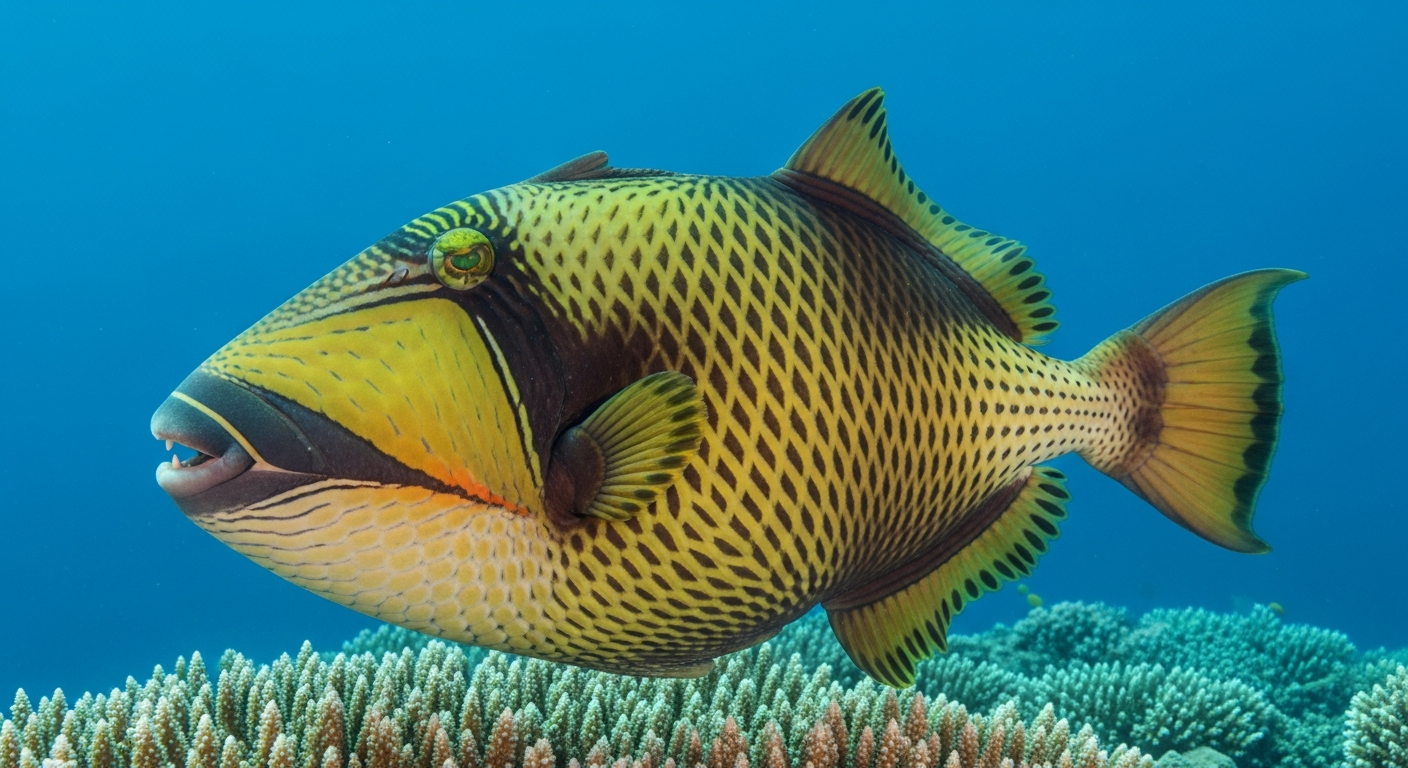
Balistoides viridescens
Titan Triggerfish
The largest triggerfish in the Red Sea and one of the few animals here capable of drawing blood from a diver without warning. Territorial, intelligent, and entirely indifferent to your presence until it isn't.
Balistoides viridescens is a substantial fish. Adults commonly reach 70 centimetres and occasionally push past 75. The body is the compressed, oval shape typical of triggerfishes, driven by undulating dorsal and anal fins rather than tail propulsion. Colouration is a mosaic of dark edged scales over a greenish yellow base, with a pale yellow patch behind the mouth and a dark band across the snout. The teeth are fused into a beak like structure strong enough to crack echinoderm tests and bite through coral. This is not incidental anatomy. The Titan feeds heavily on sea urchins, hard coral, molluscs, and encrusting invertebrates, and its feeding excavations visibly reshape reef substrate over time.
In the Red Sea, Titan Triggerfish are present year round on virtually every developed reef system from the Gulf of Aqaba south through the Straits of Tiran and along the Egyptian coast to the Sudanese border. They are not schooling fish. Adults are solitary and territorial, patrolling defined home ranges across reef flats and the upper slope, typically between the surface and 50 meters. Juveniles are shyer and often found deeper or in more sheltered microhabitats. The species is diurnal, sheltering in crevices at night and resuming patrols shortly after dawn.
Nesting occurs during warmer months, roughly April through September in the northern Red Sea, with some variation by latitude. Females excavate a shallow depression in sandy substrate, often on the reef flat or at the base of a coral head, and deposit a clutch of adhesive eggs. The male fertilizes the clutch and largely moves on. The female then enters a period of aggressive nest defense that defines nearly every safety-relevant encounter between this species and divers. She fans the eggs with her fins to oxygenate them, chases off any animal she perceives as a threat, and will charge a diver repeatedly and without obvious escalation cues.
Population trends in the Red Sea are not well-documented at the species level, but anecdotal evidence from dive operators and survey data from reef monitoring programs suggest stable numbers across most Egyptian sites. The species is taken incidentally by artisanal fishers and occasionally targeted for the live reef fish trade in parts of its Indo-Pacific range, but Red Sea populations appear relatively unfragmented. The primary pressure here is indirect: reef degradation from bleaching events and anchor damage reduces the sandy, sheltered microhabitats the species uses for nesting.
Most encounters with Titan Triggerfish are uneventful. Outside nesting season, adults will often hold their ground, eye you with that unsettling lateral gaze, and eventually move off if you maintain distance and avoid any movement toward the nest site or the fish itself. The animal is not aggressive by default. It is territorial by function. The problem arises when a nesting female is present, and the problem is geometric.
The defended territory is not a flat circle around the nest. It is an inverted cone, with the nest at the apex and the cone widening as it rises toward the surface. This means that ascending puts you deeper inside the defended zone, not outside it. The instinct to fin upward when a large triggerfish charges is exactly wrong. The correct response is to swim horizontally away from the nest site, staying low, keeping your fins oriented toward the fish so that a bite lands on rubber rather than exposed skin. Maintain that horizontal escape vector until you are well clear of the area, then ascend normally at a distance. If you are on a reef flat and a Titan makes a fast, direct approach with the dorsal spine erect, treat it as a defensive charge and move away laterally immediately. Bites are not venomous but the teeth are powerful and wounds to hands, forearms, and fins are well-documented at Red Sea sites. Wetsuits provide minimal protection from a determined bite.
Outside nesting season, a Titan Triggerfish will typically observe divers from a distance or continue feeding. Keep at least two to three metres of lateral space, avoid reaching toward it or blocking its path, and do not attempt to handle or feed it. The fish will usually move on without incident. This is the majority of Red Sea encounters with this species.
If a Titan makes a fast, directed charge with dorsal spine raised, assume a nest is nearby and you are inside its defended territory. Do not ascend. The territory is shaped like an inverted cone rising from the nest toward the surface, so going up takes you further into the zone. Swim horizontally away from the fish, staying low and level, with your fins pointed toward it to absorb any bite. Continue that horizontal exit until you are clearly outside the area, then ascend at distance. Bites cause genuine wounds. Treat any approach as serious and exit immediately.
Triggerfish are assessed as Least Concern on the IUCN Red List, a status that reflects its wide Indo-Pacific distribution and apparent population stability rather than any particular abundance. The species is not a primary target of commercial fisheries in the Red Sea, though it is caught incidentally in reef-associated artisanal operations and occasionally taken for aquariums when juvenile. Its ecological role is more significant than its conservation profile might suggest. The Titan is an active bioeroder. Its feeding on urchins and coral helps regulate urchin populations that would otherwise overgraze algae cleared surfaces, and its excavations contribute to sediment cycling on reef flats.
In the Red Sea specifically, the species faces pressure from the same structural threats affecting all reef associated fish: coral bleaching episodes that reduce habitat complexity, physical reef damage from vessel anchoring and coastal development, and the gradual loss of sandy reef-flat habitat used for nesting. There are no Red Sea specific management measures targeting this species, and it falls outside the scope of most marine protected area enforcement regimes focused on larger commercially important fish. Monitoring is sparse. We consider the current Least Concern status reasonable but note that localized population data from the northern Red Sea is insufficient to detect meaningful declines at the site level.
Atlas Position
We regard the Titan Triggerfish as one of the defining animals of a Red Sea reef dive, not for rarity but for presence. It is large, purposeful, and structurally important to the reefs it inhabits. The safety dimension of encountering a nesting female is real and has been poorly communicated in dive briefings for years. We treat accuracy here as a primary responsibility. Beyond safety, we believe this species deserves recognition as an ecological actor rather than a hazard to be managed around, and we support any reef monitoring effort that includes population tracking for large bodied reef fish of this kind.
Sign in to share a sighting, behaviour note, or encounter.
No verified sightings yet. Be the first Atlas member to log an encounter.
Keep reading, and open the whole Atlas.
A free account unlocks every dive site guide and map, the marine life library, member reports, and the full incident log. Free to join.
Join free to keep reading