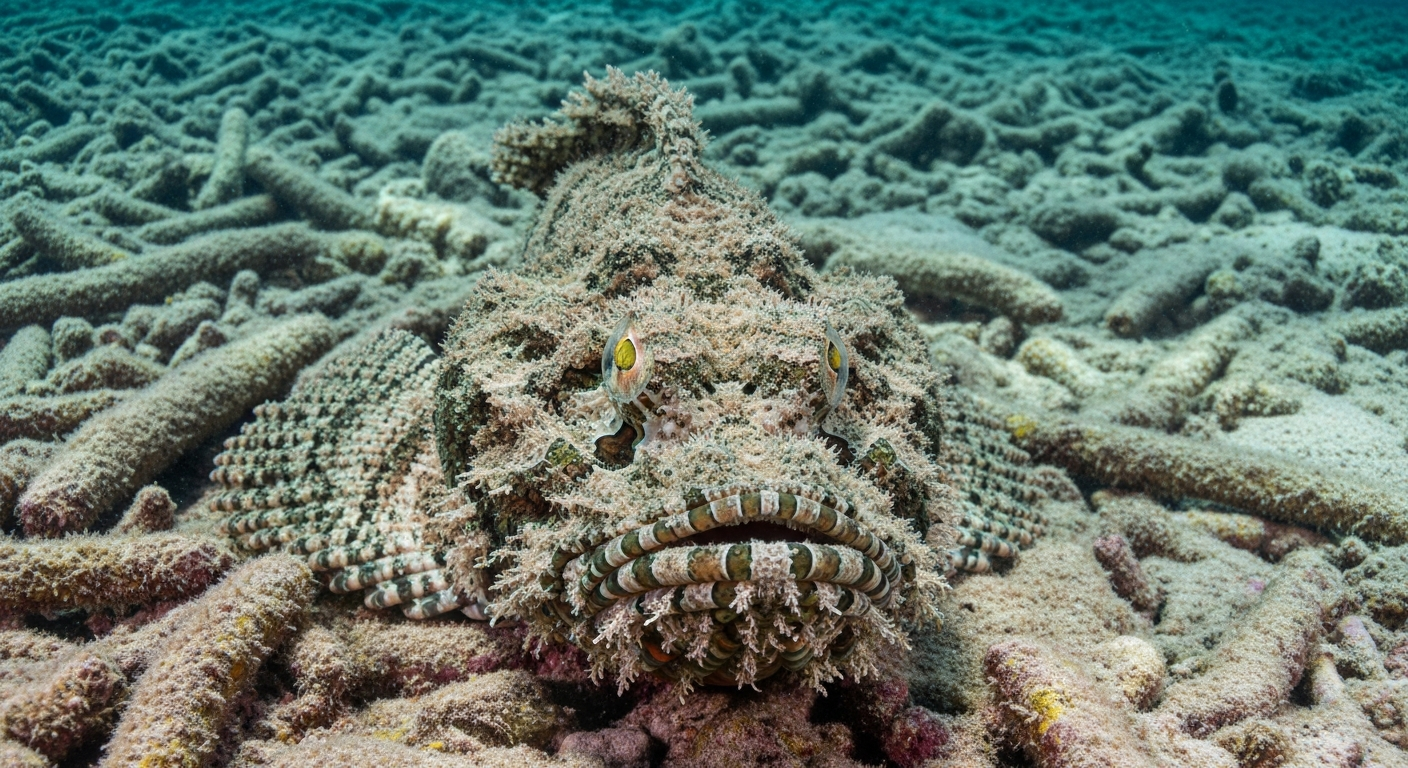
Synanceia verrucosa
Stonefish
One of the most venomous fish in the world lives on the reef flats and rubble zones of the Red Sea, motionless and nearly invisible. Most encounters happen because a diver or wader did not look carefully enough.
The stonefish is not a rare animal in the Red Sea. It is a common resident of shallow reef margins, sandy rubble, seagrass beds, and intertidal rock flats from the Gulf of Aqaba south through the Egyptian coast. Its range extends across the Indo-Pacific, but Red Sea populations are well established and frequently encountered at popular dive sites, often without divers realising it.
Synanceia verrucosa earns its reputation through an extraordinary combination of camouflage and weaponry. The body is covered in warty, irregular skin that accumulates algae, sediment, and encrusting organisms over time, making the fish look indistinguishable from the surrounding substrate. It lies completely still on the bottom for hours, waiting for small fish and crustaceans to pass within striking distance. The strike itself is among the fastest recorded in any vertebrate predator.
The thirteen dorsal spines are the defensive mechanism. Each spine is connected to a venom gland, and when pressure is applied, venom is driven upward through grooves in the spine into the wound. The pain is immediate and severe. Without treatment, envenomation can cause tissue necrosis, temporary paralysis, and in rare cases cardiac complications. Antivenom exists and is effective, but access to it matters greatly. In the Red Sea, the risk is primarily to waders and snorkellers on reef flats rather than to scuba divers at depth.
As a species, stonefish show little complex social behaviour. They are solitary, sedentary, and territorial in a passive sense, returning to the same resting spots repeatedly. Reproduction involves broadcast spawning. The female releases eggs onto a hard surface and the male fertilises them externally. Juveniles are cryptic from an early age. Growth is slow and lifespan can exceed a decade under favourable conditions.
When you encounter a stonefish in the Red Sea, the animal is almost certainly already aware of you. It will not move. That stillness is its entire strategy. Do not touch it, do not attempt to handle it for photography, and do not place your hands or knees on rubble or mixed substrate without looking first. The animal poses no threat to a diver who maintains awareness and physical distance. Give it space and observe the camouflage properly. It is one of the more instructive animals on the reef for understanding how predators exploit perception.
The real risk in the Red Sea is shore entry and reef walking. Intertidal flats around Dahab, Hurghada, and Marsa Alam can hold stonefish in ankle-deep water. Always wear reef shoes or fins during water entry and exit, and never stand on rubble or weed-covered rock if you can avoid it. If you are photographing one at close range underwater, fin trim is essential. An accidental brush with a knee or hand against a resting stonefish is the most common cause of envenomation in recreational diving contexts.
A resting stonefish observed from 30 cm or more presents no danger. Keep your body trim, avoid touching the substrate near the animal, and observe calmly. The fish will remain still and may blink or adjust a pectoral fin. This is normal behaviour and does not indicate agitation.
If a spine penetrates skin, exit the water immediately. Immerse the affected area in hot water, as hot as can be tolerated without scalding, for 30 to 90 minutes. Heat degrades the protein-based venom and significantly reduces pain. Seek medical attention promptly and inform staff that stonefish antivenom may be required. Do not cut the wound or attempt to suck out venom. In the Egyptian Red Sea, antivenom is available at hospitals in Hurghada and Sharm El Sheikh. Know your nearest medical facility before diving remote sites.
Synanceia verrucosa is listed as Least Concern by the IUCN, and the assessment reflects genuine population stability across its Indo-Pacific range. In the Red Sea, there is no directed fishery pressure on stonefish of significance. The species is occasionally taken as bycatch and is consumed in some coastal communities, but commercial exploitation is minimal. Habitat degradation is the primary indirect threat: stonefish depend on structurally complex reef margins and rubble zones, and coastal development, anchor damage, and sedimentation from construction all reduce suitable habitat.
Within the Red Sea specifically, marine protected areas such as Ras Mohamed National Park provide incidental protection. Enforcement of no-take zones and restrictions on physical reef contact benefit stonefish alongside the rest of the benthic community. There are no stonefish-specific monitoring programmes we are aware of in the region, and population data remains sparse. The species is not in immediate peril, but that assessment should not be read as a reason for complacency about reef health.
Atlas Position
We treat the stonefish as one of the Red Sea's most important animals for diver education. It is not a monster and it is not seeking conflict. It is a sedentary predator doing exactly what it evolved to do. The harm it causes to humans is almost entirely the result of inattention. We advocate for accurate information about venom first aid at every Red Sea dive centre, for mandatory reef shoe policies at shore diving sites, and for treating encounters with stonefish as an opportunity to understand benthic ecology rather than a hazard to be avoided or sensationalised.
Sign in to share a sighting, behaviour note, or encounter.
No verified sightings yet. Be the first Atlas member to log an encounter.
Keep reading, and open the whole Atlas.
A free account unlocks every dive site guide and map, the marine life library, member reports, and the full incident log. Free to join.
Join free to keep reading