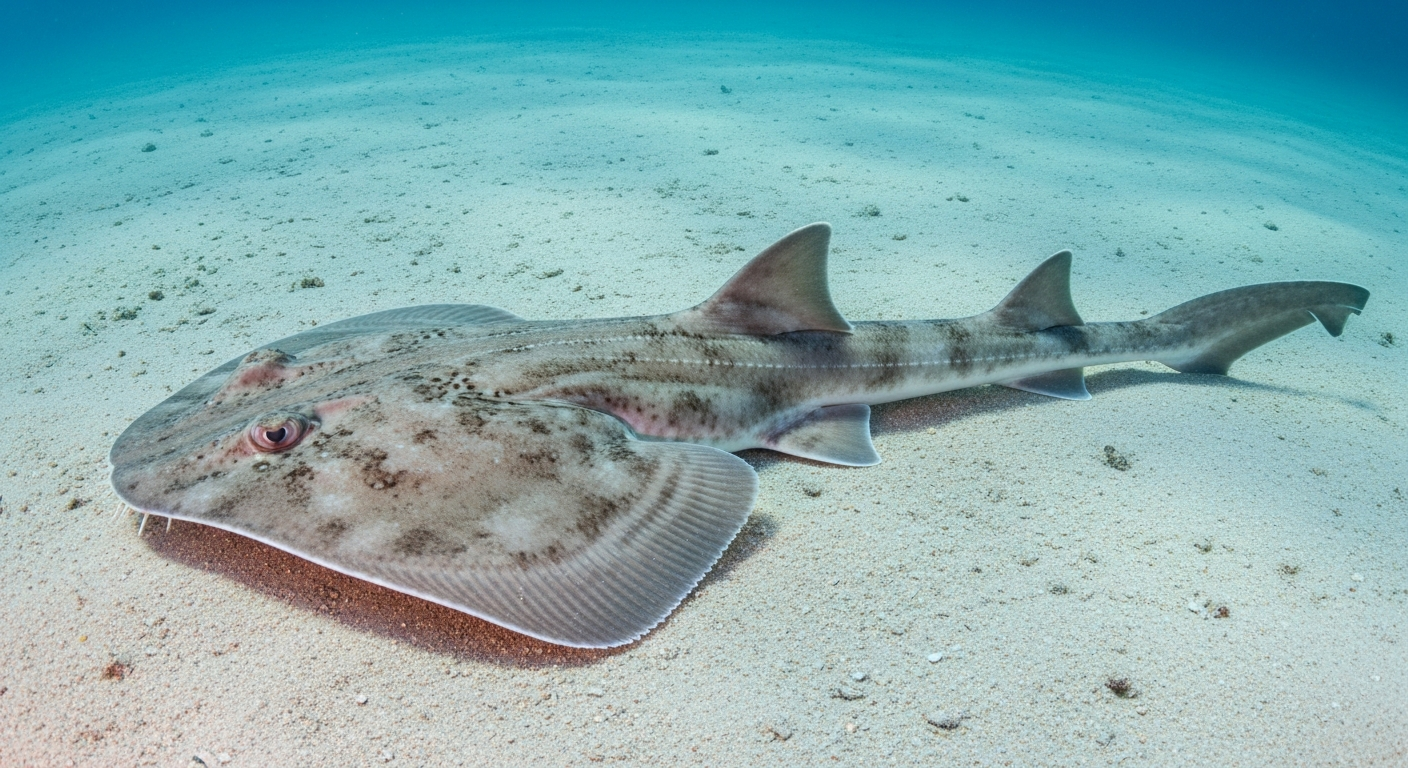
Rhinobatos schlegelii / Glaucostegus typus (Giant Guitarfish)
Guitar Shark
Built like a shark, related to a ray, and vanishing from reefs faster than most divers realise. The guitarfish is one of the Red Sea's most imperilled bottom-dwellers.
The giant guitarfish, Glaucostegus typus, occupies the evolutionary middle ground between sharks and rays. Its body plan tells that story plainly. The pectoral fins fuse into a flattened rostrum, the tail drives it forward like a true shark, and the eyes sit topside while the mouth and gill slits open beneath. It is neither pretending to be one thing nor the other. It is exactly what it is, and it has been for a very long time.
In the Red Sea, guitarfish favour shallow sandy habitats, seagrass beds, and the sandy margins of coral reef structures. Abu Dabbab and Marsa Shagra in the Egyptian Red Sea represent classic habitat. The species rests motionless on sand through the day, often partially buried, before becoming more active at dusk. It hunts benthic invertebrates, crustaceans, and small fish by pressing its underside against the substrate and using electrosensory organs to detect prey hidden beneath the sand.
Populations across the Indo-Pacific have declined sharply over the past three decades. The Red Sea is no exception. Guitarfish are caught as bycatch in artisanal and commercial fisheries throughout the region, and their large pectoral fins command a significant price in the shark fin trade. Coastal habitat degradation, particularly in the northern Red Sea and around heavily developed coastlines, compounds the pressure. What was once a reasonably common sighting at sandy sites is now a notable event.
The IUCN lists the giant guitarfish as Critically Endangered globally. Regional assessments for the Red Sea reflect the same trajectory. We include this species not to alarm, but because honest representation of its status matters. Divers who encounter guitarfish here are meeting an animal under serious pressure, and that context shapes every interaction.
Guitarfish encountered on the sand at sites like Abu Dabbab or Marsa Shagra are almost always resting. Approach slowly and stay low. Fin movements that disturb sand plumes or rapid descents from above will cause the animal to bolt before you get a proper look. Come in from the side, not from directly overhead. A calm, unhurried approach on the same horizontal plane as the fish is consistently the most productive. Keep at least two metres of distance unless the animal is visibly relaxed and shows no sign of tensing its pectoral muscles.
Do not attempt to touch, ride, or position yourself in front of the rostrum. This applies everywhere but it matters here because guitarfish are increasingly stressed animals, not display creatures. If a resting guitarfish lifts its head and begins sculling its pectoral fins, it is about to leave. Back off gently and let it settle. Many of the best encounters we know of in the Egyptian Red Sea lasted ten minutes or more simply because the diver gave the animal space at the outset.
A guitarfish lying still on a sandy bottom is behaving normally and poses no risk. Approach from the side at a slow, steady pace. Maintain at least two metres of distance. These are non-aggressive animals and the vast majority of encounters proceed without incident.
If a guitarfish is approached too quickly or boxed in against a reef structure, it will make a rapid escape movement. This is not aggression but it can result in accidental contact with a large, powerful animal. Give it a clear exit route at all times, and if it begins to move, hold your position and let it pass rather than attempting to redirect or follow it.
The giant guitarfish is listed as Critically Endangered by the IUCN, placing it among the most threatened elasmobranch groups on the planet. The primary drivers are overfishing and bycatch. Their large, valuable pectoral fins make them a target in the shark fin trade, and their shallow coastal habitat overlaps almost perfectly with the areas most intensively fished by artisanal fleets throughout the Red Sea region. Slow reproductive rates, late maturity, and small litter sizes mean populations recover very poorly once depleted.
Within the Red Sea specifically, protections are inconsistent. Egyptian marine protected areas such as Ras Mohamed National Park provide some coverage, but enforcement in broader coastal zones remains limited. Saudi Arabian and Yemeni waters have received less systematic assessment. There is no Red Sea-wide management framework for guitarfish as a species group. Citizen science sighting data, including records submitted through platforms like this one, is increasingly used by researchers to map residual distribution and estimate trend. Every verified sighting with location and depth data has genuine scientific value.
Atlas Position
We regard the guitarfish as a bellwether species for the health of Red Sea shallow-water ecosystems. Its decline is measurable, documented, and continuing. We support the expansion of no-take zones around key sandy habitats, stronger bycatch monitoring across Red Sea fisheries, and the inclusion of guitarfish in national species protection lists throughout the region. Divers have a role here. Responsible encounters, accurate sighting records, and pressure on operators to enforce non-contact guidelines all contribute to a baseline of awareness that precedes any meaningful policy response.
Sign in to share a sighting, behaviour note, or encounter.
No verified sightings yet. Be the first Atlas member to log an encounter.
Keep reading, and open the whole Atlas.
A free account unlocks every dive site guide and map, the marine life library, member reports, and the full incident log. Free to join.
Join free to keep reading