
Can You Take a Ferry Between Hurghada and Sharm El-Sheikh?
The two biggest destinations on the Red Sea sit directly opposite each other, separated by water rather than desert. So why is there no easy way to cross between them? As of 2026 there is no scheduled passenger ferry between Hurghada and Sharm El-Sheikh. The route existed, came back twice, and never held. What happened to it, and how people actually make the journey now.
Look at the northern Red Sea on a map and the geography is almost funny. Hurghada sits on the Egyptian mainland. Sharm El-Sheikh sits on the tip of the Sinai peninsula, more or less across from it. What separates the two is not desert. It is water, and not a great deal of it, roughly eighty kilometres of open sea across the mouth of the Gulf of Suez.
On a clear day you can see it. From Hurghada, and from El Gouna just up the coast, the Sinai mountains sit on the horizon as a low blue line. They look like somewhere you could reach before lunch. Instead, getting from one town to the other regularly costs a traveller an entire day, a night bus, or a connecting flight through Cairo.
Which leads to the question almost every Red Sea visitor asks eventually, usually while looking at that horizon. If Hurghada and Sharm are right across the water from each other, why can you not just take a ferry? The short version is that you cannot, at least not right now. The longer version is one of the stranger pieces of Red Sea transport history.
The ferry that used to exist
This is not a route somebody once proposed. A passenger ferry between Hurghada and Sharm El-Sheikh has genuinely operated, more than once, under more than one operator, across different periods. It carried foot passengers between two of the largest tourism destinations in Egypt, and it turned a day of driving into a morning.
The crossing itself is short. Port to port it is a little over forty nautical miles, and depending on the vessel the Hurghada to Sharm ferry typically took somewhere between an hour and a half and two hours. For anyone who has done the land alternative, that number is the whole story.
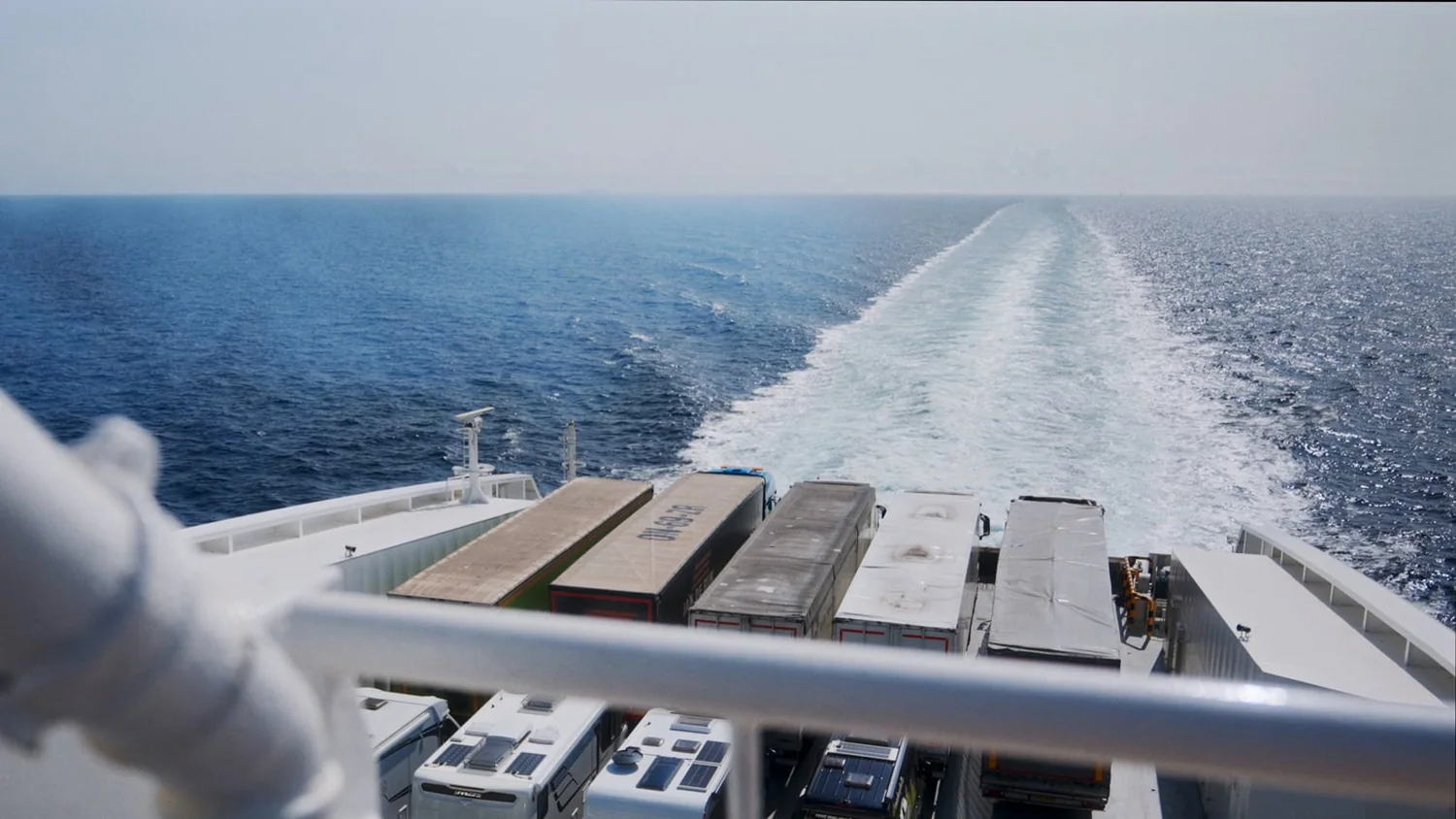
What the route never had was continuity. It ran, it stopped, it was announced again, it ran for a while, it stopped again. In June 2016 the Ministry of Transport relaunched the Sharm to Hurghada ferry after years of suspension, and that relaunch was itself reported as the return of something that had been gone for the better part of a decade. Within a couple of years the line was inactive again.
Why did it disappear?
There is no single published explanation, and it would be easy to invent one. What can be said honestly is that a passenger ferry on this route has to survive several pressures at once, and that the service never lasted long enough to prove it could.
Operating costs come first. A fast passenger ferry burns a lot of fuel, needs crew, port fees and continuous maintenance, and those costs arrive whether the vessel sails with twenty passengers or two hundred. A crossing that only fills in one direction, or only on certain days, is a hard thing to keep afloat financially.
Then there is demand, which is less obvious than it looks. Both cities are resort destinations built around package holidays and charter flights. Most visitors land in one of them, stay in one of them, and fly home from the same airport. The traveller who actually needs to cross the water, the diver combining a Sinai week with a mainland week, the Egyptian visiting family, the person chasing better wind, is a real customer but not a large one.
Flights compete directly. When a domestic hop between the two airports is running, it beats the ferry on time even after check-in, and airlines can add or drop that route in a season without owning a ship.
Seasonality does the rest of the damage. Red Sea tourism swings hard between winter and summer, and Egyptian tourism as a whole has been through several sharp downturns over the past two decades. A ferry needs steady year-round volume to justify the vessel. This coast delivers volume in bursts.
Administration sits underneath all of it. Every restart of the line has needed approvals, port arrangements and operator agreements, and each of those is a place where a service can stall. What is visible from the outside is only the pattern, not the paperwork behind it.
None of this adds up to a villain. It adds up to a route that was never quite stable enough for long enough, and that is the whole of the honest answer.
The attempted return
The clearest recent chapter is October 2019. A test crossing was run on the Hurghada to Sharm line, the vessel made the passage without incident, and the trip was reported as taking less than ninety minutes. Official approval to operate followed, and for a period there were published schedules and ticket prices circulating for the Red Sea ferry.
For a moment it looked settled. It was not. The service did not turn into a permanent transport link, the pandemic arrived shortly afterwards and removed the tourist traffic any passenger line depends on, and the crossing quietly went back to being something people remember rather than something people book.
So can you take the ferry today?
As of 2026, there is no regularly operating passenger ferry between Hurghada and Sharm El-Sheikh. No reliable scheduled service is available to tourists on this route.
This is worth stating plainly, because the internet says otherwise. Search for a Hurghada to Sharm ferry and you will find booking sites with timetables, comparison pages with prices, and travel guides describing departures four days a week. The route sits in ferry databases that were never cleaned up, and it is a popular enough search that pages keep being written for it.
Travellers go on hunting for tickets every year, which is how most people end up asking the question in the first place. If you do find the Sharm to Hurghada ferry advertised somewhere, treat it as unconfirmed until someone can name the vessel, the operator and an actual departure date. Ask locally before building a trip around it.
How do people travel between them instead?
The fastest way to get from Hurghada to Sharm El Sheikh is to fly, when a direct flight exists. It is a short hop, well under an hour in the air. The catch is availability: direct services between the two airports have come and gone, and schedules change from season to season. When there is no direct, the routing goes through Cairo, and a forty minute flight becomes most of a day with a connection in the middle. Check current schedules rather than assuming a daily link.
The road option is the one most people end up taking, and it is the reason the ferry question keeps coming up. Because there is no crossing, the route goes the long way around the Gulf of Suez: north from Hurghada along the mainland coast to Suez, across, then all the way back south down the Sinai coast to Sharm. It is around eight hundred kilometres of driving to cover eighty kilometres of water.
Scheduled buses run it, and private cars and transfers do it too. Allow roughly eight to ten hours door to door once traffic and checkpoints are accounted for, and more if the timing is unlucky. Overnight departures are common for exactly that reason. It works, it is affordable, and it is the least pleasant part of an otherwise easy piece of Red Sea transport.
There is a third group of people crossing this water regularly, and they are all divers. Liveaboard itineraries run north from Hurghada through the Gubal Strait to the wrecks, and on to Tiran and the Sinai side, so hundreds of visitors cross the northern Red Sea by boat every season. They are not travelling, though. They are living aboard a dive vessel on a fixed itinerary that happens to end up on the other side.
It is an odd situation when you sit with it. The sea between Hurghada and Sharm is busy with boats, and none of them will take a passenger across.
The Atlas note
For a region built entirely around the sea, it remains strangely difficult to cross it. Every industry on this coast, diving, fishing, sailing, kiting, depends on boats. The one boat that would help an ordinary traveller is the one that does not run.
The distance between Hurghada and Sharm El-Sheikh is measured in kilometres. The journey between them is measured in hours. Until someone runs the crossing again and keeps running it, that is simply how the northern Red Sea works, and it is worth planning around rather than hoping otherwise.
Leave a comment
Keep reading, and open the whole Atlas.
A free account unlocks every dive site guide and map, the marine life library, member reports, and the full incident log. Free to join.
Join free to keep reading