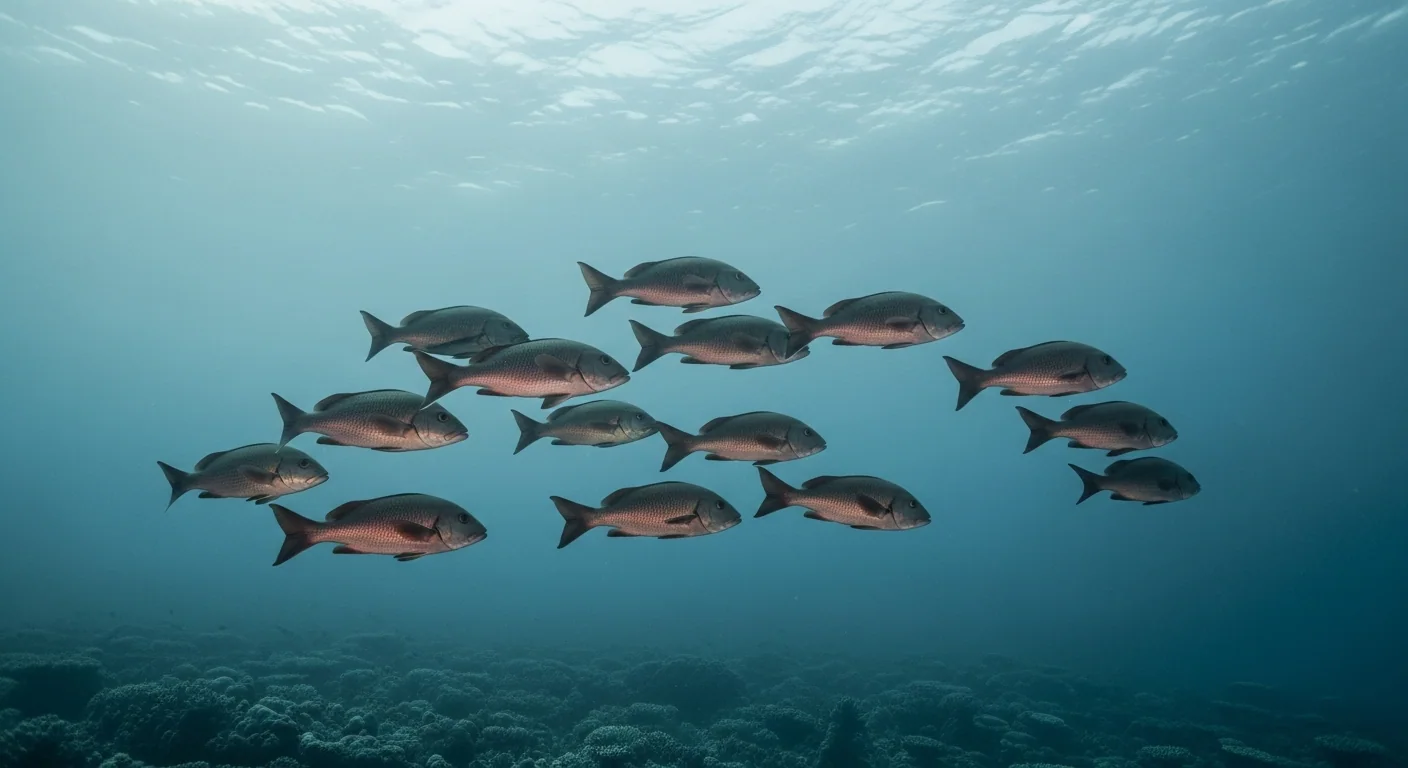
Lutjanus bohar
Two-spot Red Snapper
One of the most prized reef fish in the Egyptian Red Sea. A deep-bodied red predator of the outer reef wall, to 90cm. Known as the Bohar across the Red Sea coast.
Lutjanus bohar, known universally on the Egyptian coast as the Bohar, is the apex snapper of the Red Sea reef system and one of the most commercially significant reef fish in the Egyptian Red Sea fishery. The name Bohar is the standard Arabic identification for this species across Egypt, Sudan and throughout the northern Red Sea, it requires no translation or elaboration among Red Sea fishermen.
The fish is immediately distinctive: a deep-bodied, laterally compressed predator with a steep forehead, large mouth, and vivid red colouration that deepens with age and size. Juveniles carry two white spots near the tail base that give the species its English common name, the two-spot red snapper, but these fade in adults, leaving a uniformly rich red-crimson body with pale margins on the scales that give a reticulated appearance in good light. Adults reach 90 centimetres and 12 kilograms.
The Bohar is a mid-water predator of the outer reef wall and offshore structure, typically encountered at 10 to 70 metres. It hunts fish and cephalopods on the reef edge and over drop-offs, often in loose aggregations that gather around pinnacles and reef features with reliable current. Unlike the inshore snappers that feed over seagrass and sandy flats, the Bohar is consistently associated with healthy outer reef structure, it is an indicator species for reef quality in a meaningful sense.
For divers, encounters with large adult Bohar are a regular feature of well-protected outer reef sites. They are confident fish and do not flee at diver approach, often holding position and circling with the characteristically unhurried movement of a predator with no natural threat.
Bohar snappers are opportunistic predators. They hunt by ambush and by active pursuit, using the reef structure to funnel prey. Large adults are often observed hovering in the current at reef corners and channel mouths, where tidal flow concentrates baitfish. They are capable of rapid acceleration and the strike is decisive, the large mouth engulfs prey with a snap that is audible underwater at close range.
Aggregation behaviour is a notable feature. Bohar form loose groups around offshore pinnacles and outer reef corners, particularly at sites with strong current. These aggregations can number in the dozens at productive sites and represent a genuine spectacle on the outer walls of Ras Mohamed, the Brothers, and Elphinstone. The aggregations are most consistent in the morning hours before surface winds build.
The species is long-lived, individuals over 50 years old have been documented in the Indo-Pacific, and slow to reach maturity, typically not breeding until around five years old. This life history makes large individuals irreplaceable on any relevant human timescale and makes the population highly vulnerable to fishing pressure targeting the large adults.
Bohar are an important target for spearfishing throughout the Red Sea. In areas where spearfishing is practised on outer reef walls, the very large individuals that should serve as the reproductive core of the population are consistently the first to disappear.
Lutjanus bohar is assessed as Vulnerable by the IUCN, with the primary threat being targeted fishing pressure. The species is highly prized as a food fish, and its combination of large size, approachable behaviour, and presence on the outer reef makes it accessible to both commercial line fishing and spearfishing.
The slow maturation and long lifespan that make Bohar desirable, large, old fish are the most prized, also make the population inherently vulnerable. Removing the largest adults does not simply reduce population size; it removes the most productive and genetically established breeding individuals while leaving juvenile fish that have not yet reached breeding condition.
In well-protected areas, Ras Mohamed National Park most notably, Bohar populations are healthy and large individuals are regularly encountered. The comparison with unprotected reef walls in the same region, where large snappers have been largely eliminated, illustrates the conservation value of no-take zones for this species specifically.
Atlas Position
The Bohar is the fish that tells you immediately whether a reef is protected or not. On a healthy, no-take outer reef, large adults hold position in the current within a few metres of a diver without concern. On a reef with active fishing pressure, you will see juveniles at best. The Red Sea Atlas regards the Bohar as a meaningful indicator of reef governance, its presence in numbers is evidence that protection is real. Its absence from accessible sites is evidence that it is not.
Sign in to share a sighting, behaviour note, or encounter.
No verified sightings yet. Be the first Atlas member to log an encounter.
Keep reading, and open the whole Atlas.
A free account unlocks every dive site guide and map, the marine life library, member reports, and the full incident log. Free to join.
Join free to keep reading