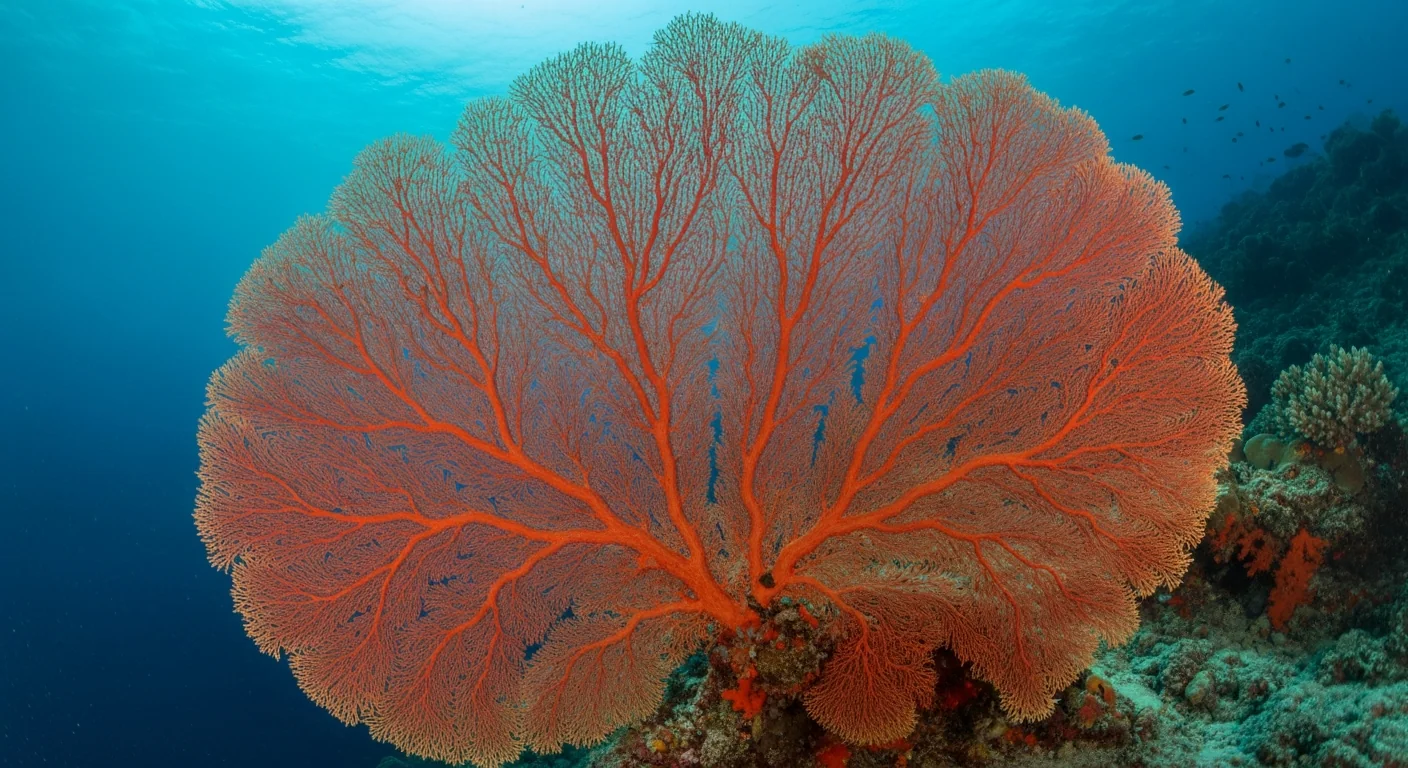
Subergorgia mollis
Gorgonian Fan Coral
The most photographed structure on the Red Sea reef wall. A single colony can spread two metres wide, filtering the current for two centuries.
Gorgonian fan corals are among the most recognisable structures on any Red Sea wall dive. They grow perpendicular to the prevailing current, maximising the area of their branching network exposed to passing plankton. A large colony can span two metres across and represents decades to centuries of incremental growth, roughly one to two centimetres of new skeleton per year in optimal conditions.
The Red Sea holds exceptional diversity of gorgonian species. Subergorgia mollis is the most common of the large fans, identifiable by its warm orange-yellow colouring and the intricate, lace-like texture of its surface. Colonies begin as a single polyp attaching to hard substrate and develop outward in a single plane, always orientated to maximise contact with water flow. They are most commonly found on walls and slopes between 15 and 40 metres, where current is reliable and sedimentation low.
Each branch is covered in tiny polyps, the individual feeding animals that make up the colony. At night, or when currents are strong, the polyps extend their tentacles and the fan appears to come alive with texture. During slack water the tentacles retract and the fan surface appears smooth and waxy. The orange or red colouring comes not from pigment in the coral tissue but from sclerites, tiny crystalline structures embedded in the outer layer.
Several species of pygmy seahorse are found exclusively on gorgonians in the Indo-Pacific, though the Red Sea endemic gorgonian fauna supports fewer cryptic species than the Coral Triangle. Hawkfish (Oxycirrhites typus) are a consistent resident, a small red-and-white fish that perches motionless on the fan surface and uses it as a hunting platform.
Gorgonians are sessile, they do not move. Their behaviour, in the usual sense, is the behaviour of the colony in relation to water flow and light. The colony always grows in a single plane aligned perpendicular to the dominant current direction; where current direction varies seasonally, this can produce a twisted or irregular form that records the current history of the site.
Feeding is passive. The polyps extend their eight-armed tentacles into the current and trap zooplankton, bacteria and fine organic particles. Feeding activity is highest at night and during peak tidal flow. In very strong current, polyps retract to reduce drag.
The longnose hawkfish that lives permanently on gorgonian fans is worth understanding. It is not simply resting there: it uses the fan as a hunting platform, clinging with modified pectoral fins and launching short rapid attacks on small fish and crustaceans that pass within range. It almost never leaves the fan and will position itself on the upstream edge where its view is best. It is one of the more approachable fish on the wall, it freezes rather than fleeing when approached, relying on its camouflage against the fan surface.
Gorgonian fans are sensitive to sediment and siltation. A colony that has been buried or smothered by suspended sediment will bleach and die over a period of weeks. This makes them useful indicators of reef health: a wall with large, healthy, densely packed gorgonians is a wall with consistent, clean current.
Gorgonian fan corals pose no hazard to divers. They do not sting, bite or defend themselves.
Colonies are extremely fragile. Fin contact or accidental touch can break branches representing decades of growth. Maintain buoyancy control before approaching.
Gorgonians face no direct targeted exploitation in the Red Sea. The threats are indirect: coral bleaching events driven by elevated sea temperatures, physical damage from diver contact and anchor chains, and the longer-term consequence of reef degradation from reduced water quality.
Physical damage is the most immediate concern for individual colonies. A large gorgonian fan is fragile relative to its size, a diver making accidental contact with a colony can break branches that took decades to grow. The branching structure does not regenerate quickly; a damaged section may take years to regrow or may die entirely if the break is at a main trunk.
Bleaching in gorgonians follows the same mechanism as hard coral bleaching: elevated water temperatures cause the coral to expel its symbiotic zooxanthellae, turning white. Unlike some hard corals, large gorgonians can recover from moderate bleaching events if temperatures normalise within a few weeks. Extended bleaching or repeat events within short intervals typically result in colony death.
The Red Sea has shown greater thermal resilience in its coral communities than most tropical reef systems, a consequence of the natural thermal variability of the sea and the high temperatures that Red Sea corals have always had to tolerate. Whether this resilience extends to continued warming at the rates currently projected is an open question.
Atlas Position
The gorgonian fan coral is, for many divers, the image that defines a Red Sea wall: a vast orange structure anchored to vertical rock, current pushing past it, a hawkfish motionless at its edge. It is also one of the most fragile structures you will encounter, a colony that took a century to build can be broken in a moment by a misplaced fin. The Red Sea Atlas asks all divers to treat it accordingly: maintain buoyancy, keep distance, and do not touch.
Sign in to share a sighting, behaviour note, or encounter.
No verified sightings yet. Be the first Atlas member to log an encounter.
Keep reading, and open the whole Atlas.
A free account unlocks every dive site guide and map, the marine life library, member reports, and the full incident log. Free to join.
Join free to keep reading