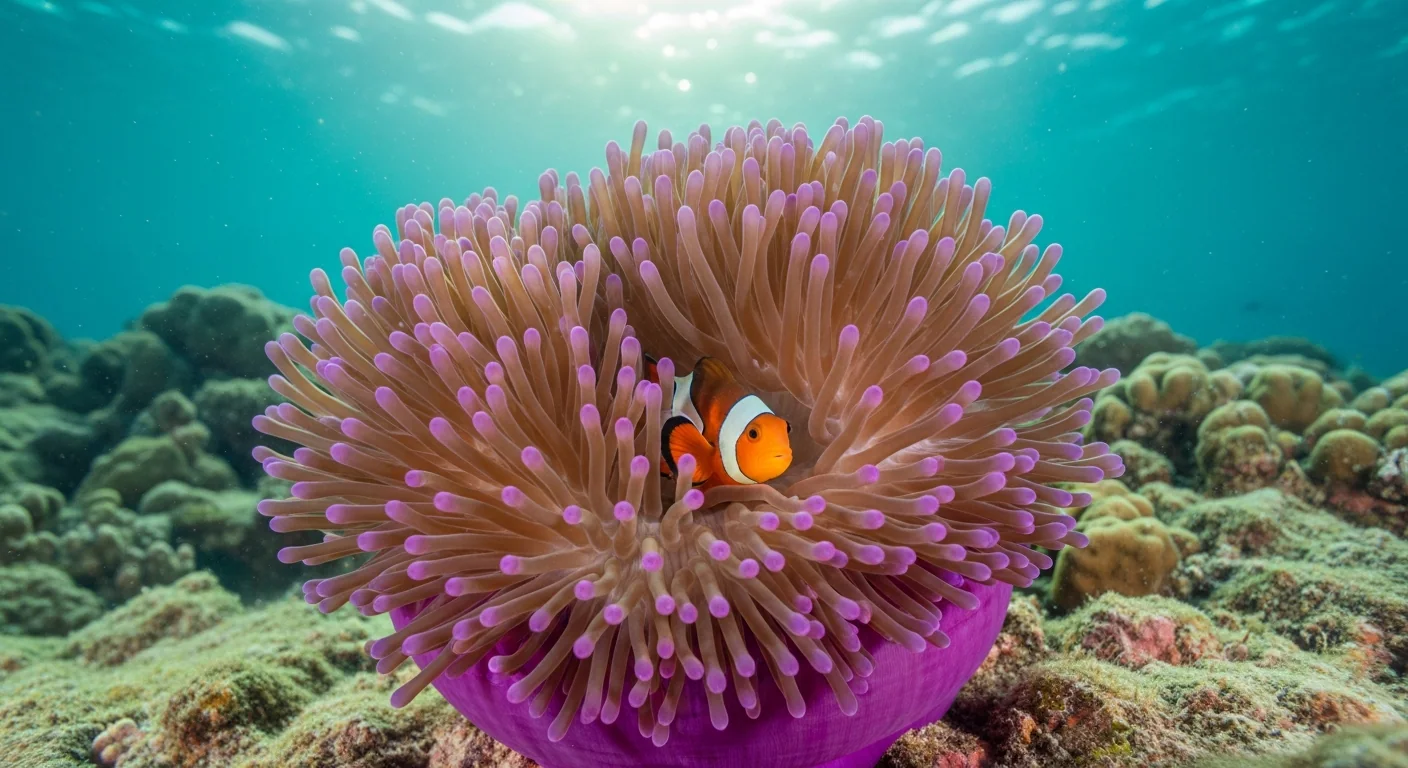
Heteractis magnifica
Magnificent Sea Anemone
The host of the clownfish. A single anemone can live for a century, and the partnership it maintains with its resident fish is one of the most studied relationships in marine biology.
The magnificent sea anemone is the most recognisable anemone in the Red Sea and one of the largest in the world, with its column and tentacles sometimes spreading a full metre in diameter. It is the primary host for clownfish in the Red Sea, the orange-and-white fish that hover within the tentacles, immune to the stings that would paralyse any other animal their size.
Anemones are not corals, though they belong to the same phylum (Cnidaria). They have no skeleton. The body is a soft, muscular column anchored by a basal disc to hard substrate, topped by a crown of stinging tentacles. Each tentacle is covered in cnidocytes, cells that fire a coiled, venom-loaded thread on contact, used to stun and capture passing zooplankton. The stinging cells that line the tentacles are the same fundamental mechanism used by jellyfish, coral polyps, and sea nettles across the phylum.
Individual anemones are widespread throughout the Red Sea on shallow and mid-depth reefs, typically in open, sunlit areas where photosynthesis by their symbiotic zooxanthellae can supplement filter feeding. Cleaning stations built around host anemones are a consistent feature at virtually every productive reef site from the Gulf of Aqaba to the deep south, Ras Mohamed, the Straits of Tiran, Sha'ab El Erg, Erg Abu Ramada, Giftun and dozens of other locations all support resident anemone populations with their attendant clownfish communities.
These animals live extraordinarily long lives. Individual specimens maintained in aquaria have survived for over a century. In the wild, large magnificent sea anemones on stable reefs are very likely older than any diver who visits them.
The clownfish relationship is the defining behavioural feature of this species. The two-banded clownfish (Amphiprion bicinctus), the Red Sea's endemic clownfish, covers its body in the anemone's own mucus over a period of days or weeks, gradually developing immunity to the stinging cells. Once acclimated, it moves freely among the tentacles without triggering a sting.
The relationship is mutualistic: the clownfish chases away butterfly fish that would otherwise eat the anemone's tentacles, and the waste it produces provides nitrogen fertiliser that benefits the anemone's zooxanthellae. The anemone, in turn, provides the clownfish with shelter that no predator is willing to enter. The clownfish also fans the tentacles with its fins, increasing water circulation and oxygen supply.
Clownfish are protandrous hermaphrodites, all individuals are born male. In a resident group of two to ten fish on a single anemone, the dominant fish is the breeding female. If she dies, the dominant male changes sex to become the new female. The remaining males move up the hierarchy. This is the mechanism that the film Finding Nemo's premise reverses: in biological reality, Nemo's father would have become his mother.
Anemones contract when disturbed or when light drops at night, pulling their tentacles inward into a dense mass. During retraction they expel water and reduce dramatically in size. A large anemone that appears to have disappeared may simply be contracted, it will re-expand within hours.
Anemone tentacles sting on direct contact. The sting is mild for most people, similar to a nettle. Avoid touching, particularly if you have skin sensitivities.
Resident clownfish are territorial and may nip at fingers held near the anemone, but the nip is harmless.
Magnificent sea anemones are not directly targeted by fisheries. The primary threats are reef degradation from bleaching, reduced water quality, and the collection trade for marine aquaria.
Bleaching in anemones follows the same mechanism as coral bleaching: thermal stress causes expulsion of symbiotic zooxanthellae. A bleached anemone turns white and loses its ability to supplement feeding through photosynthesis. The resident clownfish remain but the anemone is compromised. Extended bleaching typically results in death. Unlike some hard corals, anemones do not appear to recover quickly from severe bleaching.
The marine aquarium trade represents a specific pressure: clownfish and anemones are among the most sought species for home tanks. The vast majority of clownfish in the trade are now captive-bred, reducing pressure on wild populations, but anemones are harder to breed in captivity and most specimens in the trade are still wild-caught. The removal of a large anemone from a reef can be an irreversible loss, no other animal fills the same ecological role in that location.
Anemone City at Ras Mohamed operates under the full protection of the national park. The aggregation is a singular phenomenon, its protection is absolute and its management by the park authority is the best possible outcome for a site of this significance.
Atlas Position
Anemone City at Ras Mohamed is one of the most genuinely puzzling biological phenomena on the Egyptian coast. Dense aggregations of this species in other parts of the Indo-Pacific have been attributed to current patterns, substrate availability, or larval supply, none of these explanations satisfactorily account for what is present at this site. The Red Sea Atlas recommends that any diver at Ras Mohamed includes the shelf as part of the Shark Reef dive. It is a short detour and the density of life in that small area is unlike anything else in the Red Sea.
Sign in to share a sighting, behaviour note, or encounter.
No verified sightings yet. Be the first Atlas member to log an encounter.
Keep reading, and open the whole Atlas.
A free account unlocks every dive site guide and map, the marine life library, member reports, and the full incident log. Free to join.
Join free to keep reading