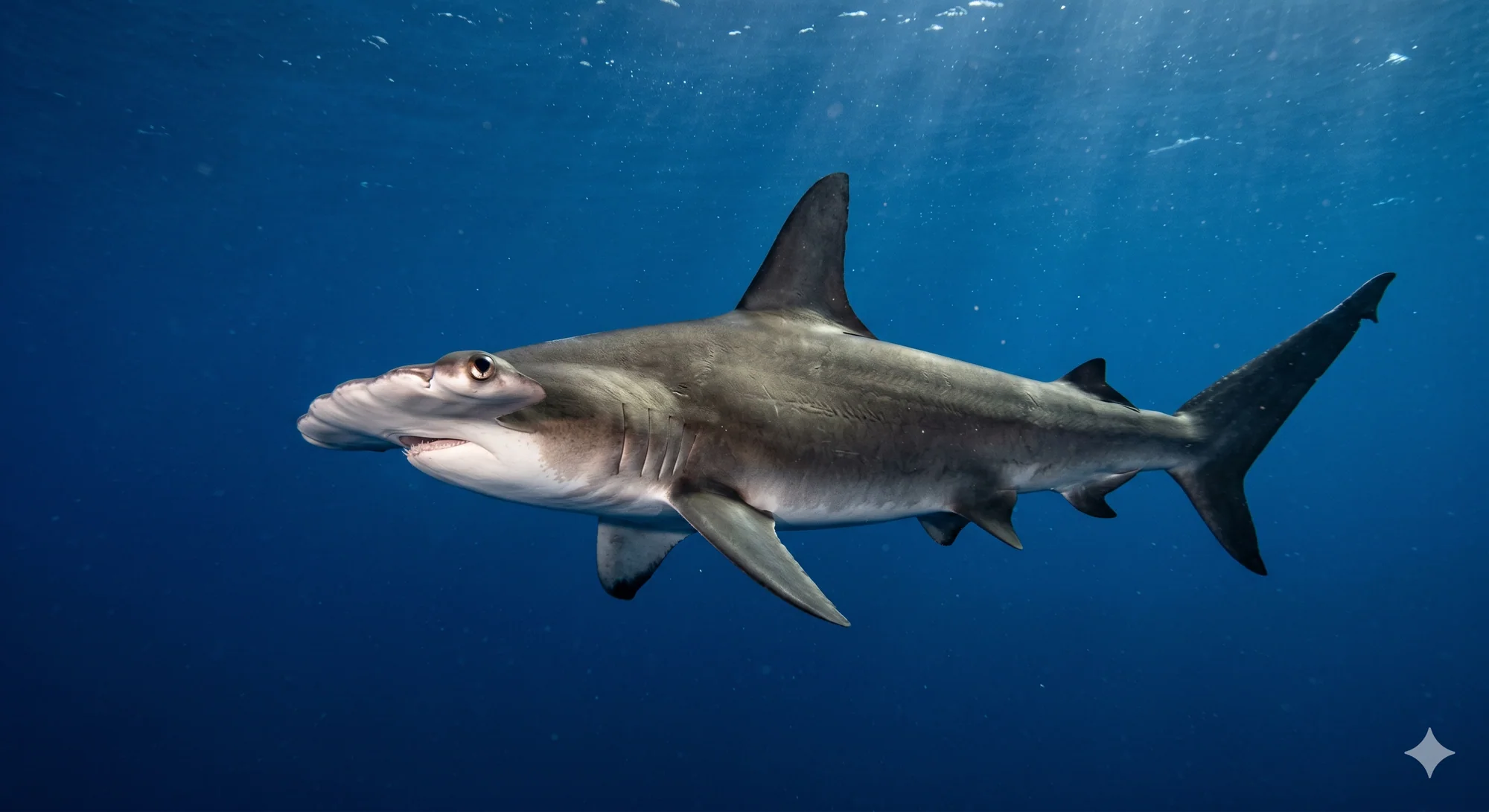
Sphyrna lewini
Scalloped Hammerhead
Jackson Reef in the Straits of Tiran is the most reliable school site in Egypt. Elphinstone's north plateau and the Brothers are the other key spots, each with their own character.
To see a school of scalloped hammerheads in formation, five, ten, fifty strong, is one of those experiences that does not diminish with retelling. The wide, sweeping cephalofoil, the slow banking turns, the way a school moves as a single entity through blue water: it is difficult to describe without sounding like you are exaggerating.
Jackson Reef, in the Straits of Tiran, is the most consistently productive school site in the Egyptian Red Sea. Schools form reliably here in the cooler months, typically patrolling the deeper water on the reef's exposed faces, more accessible than the far south sites, and well worth the early dive call.
Elphinstone Reef holds a school that congregates on the north plateau, beyond the crack, divers who reach the third plateau and hold their position at depth have the best chance of a prolonged encounter. This is a specific, localised gathering rather than open-water schooling, and it rewards divers who know the reef and commit to the right entry point.
The Brothers Islands and Daedalus are part of the picture too, solitary hammerheads and small groups are regular on both. A full school at the Brothers is less predictable, but the combination of oceanic whitetips, hammerheads, and open-ocean conditions makes the trip worthwhile regardless.
Numbers across all sites have declined significantly from historical accounts. Divers working these reefs in the 1990s describe schools that would beggar belief today, hundreds of animals stacked in columns extending beyond visibility. Those days are gone. What remains is still extraordinary. It will not remain so without active protection of the sites and the fishing practices around them.
Scalloped hammerheads school during the day for social reasons that are not fully understood. In the Red Sea they most often appear in the cooler months, October through February, when water temperatures drop and thermoclines strengthen. The combination of colder deep water rising against the wall of a reef or seamount appears to concentrate them, though the exact mechanism that determines which mornings bring schools and which do not remains unpredictable.
The best encounters are at dawn, on the first dive of the day, before boat noise and bubble trail have disturbed the water column. Schools approach from depth, often visible first as a shadow, then a shape, then suddenly twenty animals in formation at the same depth as the diver. The correct response is stillness. Hammerheads are shy for their size and will swing wide or descend if the group moves toward them. A diver who anchors to the wall and breathes slowly can watch for considerably longer than one who tries to follow.
At Elphinstone, the school positions on the north plateau, divers need to push beyond the crack to the third plateau and hold depth. The school comes in from the blue rather than rising up the wall, and patience at the right spot is the difference between seeing it and missing it entirely.
At night, hammerheads hunt individually. Solitary animals on night dives are not uncommon at the Brothers and Tiran. These encounters have a different character, purposeful, quick, and less interested in the diver entirely.
Scalloped hammerheads face the combined pressure of targeted shark fishing, bycatch in tuna and swordfish longlines, and fin trade. Their schooling behaviour, the very thing that makes them spectacular to encounter, makes them extremely vulnerable to netting, since a single set can remove an entire social group.
The Red Sea population appears to represent one of the last remaining schooling populations globally. This gives sites like Jackson Reef and Elphinstone an importance that extends well beyond recreational diving. Protecting these reefs from illegal fishing, which does occur, particularly from vessels working the outer Red Sea, is not a conservation nice-to-have. It is the difference between these encounters continuing to exist or not.
Atlas Position
Hammerhead schools are not guaranteed. Any operator or guide who promises them is either misleading you or working with conditions they cannot control. What good operators do is put you in the water at the right time of year, on the right dive, in conditions that maximise the chance. The Red Sea Atlas notes: if you go to Daedalus in November or December and make the first dive at dawn on the north plateau, you have done everything that can be done. Whether the sharks appear is their decision, not ours.
Sign in to share a sighting, behaviour note, or encounter.
No verified sightings yet. Be the first Atlas member to log an encounter.
Keep reading, and open the whole Atlas.
A free account unlocks every dive site guide and map, the marine life library, member reports, and the full incident log. Free to join.
Join free to keep reading