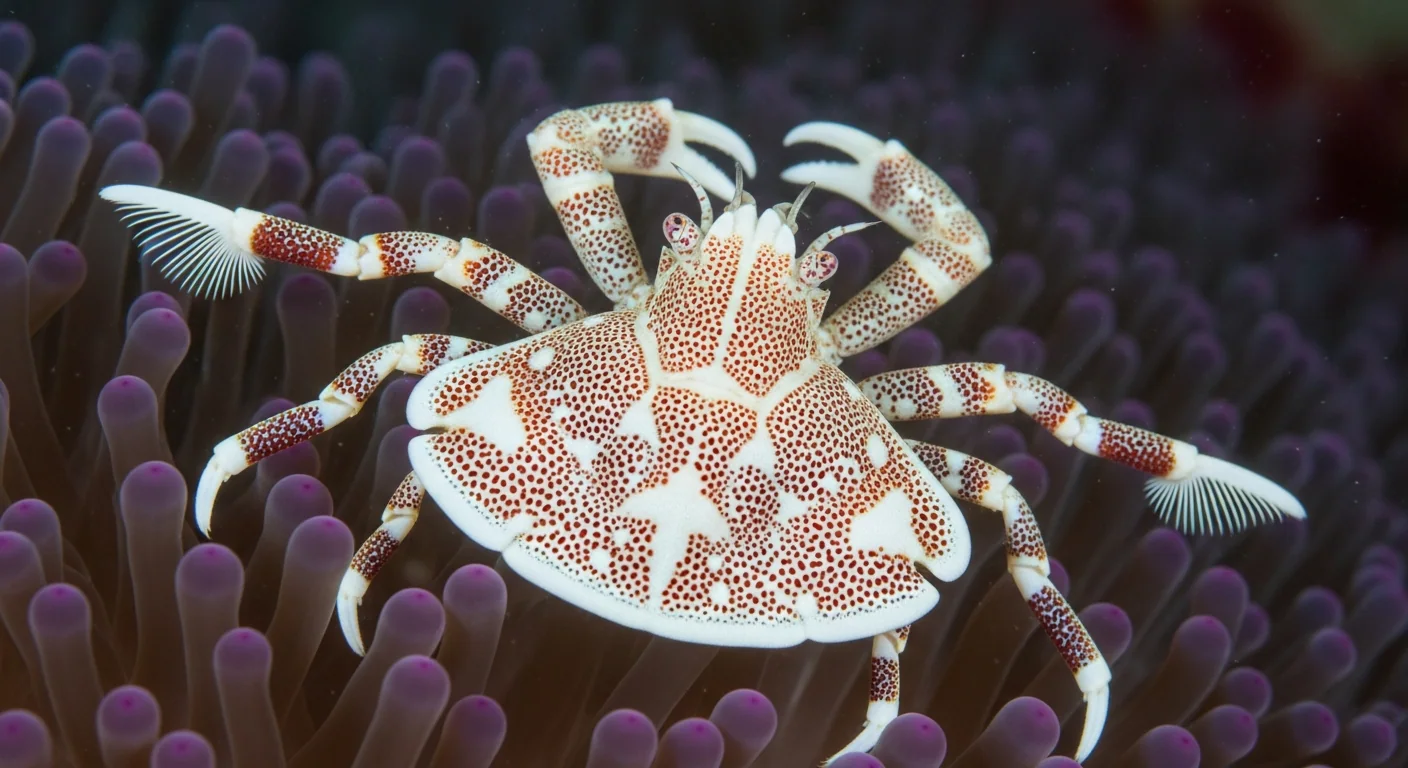
Neopetrolisthes maculatus
Porcelain Crab
A flat, white-and-red-spotted crab that lives permanently on sea anemones, filter feeding alongside clownfish, tolerated by the anemone, invisible to most divers.
Porcelain crabs are not true crabs. They belong to the family Porcellanidae, which sits within the infraorder Anomura, the same group as hermit crabs and squat lobsters, rather than Brachyura, the true crabs. The distinction is visible in the body plan: porcelain crabs have a flattened, nearly circular carapace, a tail that folds under the body rather than being vestigial, and three pairs of walking legs rather than the four pairs of true crabs. The common name comes from the fragility of the exoskeleton, which breaks easily when the animal is under stress, and from the smooth, almost ceramic appearance of the white carapace.
Neopetrolisthes maculatus is the species most commonly found on sea anemones in the Red Sea. It is white or cream with irregular red-brown spots, typically two to three centimetres across, and it lives in constant association with sea anemones, most commonly the magnificent sea anemone (Heteractis magnifica) that also hosts clownfish. On any anemone that has resident clownfish, a careful look at the base of the anemone, where the column meets the substrate, will typically reveal one or two porcelain crabs pressed flat against the surface.
The crab is immune to the anemone's sting through a similar mechanism to the clownfish: a gradual acclimation to the anemone's nematocysts. This tolerance is species-specific: a Neopetrolisthes maculatus removed from its host anemone and placed on a different anemone species will be stung. Its immunity is to its specific host's chemistry.
The feeding mechanism is distinctive and worth observing. Unlike the clownfish, which forages actively, the porcelain crab is a filter feeder. It extends two large, fan-shaped mouthparts, the maxillipeds, into the water column and sweeps them back and forth, trapping plankton and fine organic particles on the fine setae covering the fans.
Porcelain crabs spend almost their entire lives on or immediately adjacent to their host anemone. They are not observed to forage far from the anemone and retreat into the tentacle mass when threatened, relying on the anemone's stinging cells for protection in the same way the clownfish does. Their tolerance of the anemone is matched by the anemone's apparent tolerance of them: the anemone does not retract its tentacles when the crab is present and does not sting it.
The filter-feeding display is visible and deliberate. The crab extends both maxilliped fans simultaneously, holds them in the current, and then sweeps them inward across the mouth in a raking motion, removing the trapped particles before extending them again. The movement is repetitive and rhythmic. On an anemone with a resident clownfish pair and one or two porcelain crabs, all three species can sometimes be observed engaged in completely different activities simultaneously, the clownfish chasing away butterfly fish, the crabs filter feeding, the anemone tentacles extended for their own food capture.
The crab is autotomous: when seized by a predator, it will shed the seized limb and escape on the remaining legs. The lost limb regenerates over subsequent moults. The characteristic fragility of the exoskeleton appears to be an adaptation to this escape strategy, the carapace breaking preferentially at specific points to facilitate release.
Porcelain crabs are not commercially exploited. As obligate anemone associates, they are entirely dependent on anemone health, which is in turn dependent on reef health and water temperature. Bleaching events that kill anemone populations eliminate porcelain crab habitat directly and simultaneously. Anemone City at Ras Mohamed is the single most important site for this species in the Egyptian Red Sea, and the national park protection that governs that site is the most direct conservation measure available.
Atlas Position
The porcelain crab is one of the animals that rewards divers who look carefully at the anemones they already found for the clownfish. Most visitors to Anemone City at Ras Mohamed see the clownfish and move on. The porcelain crabs are there, pressed flat against the column, fans extended, feeding. They are part of the same ecological community as the clownfish and the anemone, and their presence completes a picture of a functioning symbiotic system operating simultaneously at multiple levels.
Sign in to share a sighting, behaviour note, or encounter.
No verified sightings yet. Be the first Atlas member to log an encounter.
Keep reading, and open the whole Atlas.
A free account unlocks every dive site guide and map, the marine life library, member reports, and the full incident log. Free to join.
Join free to keep reading