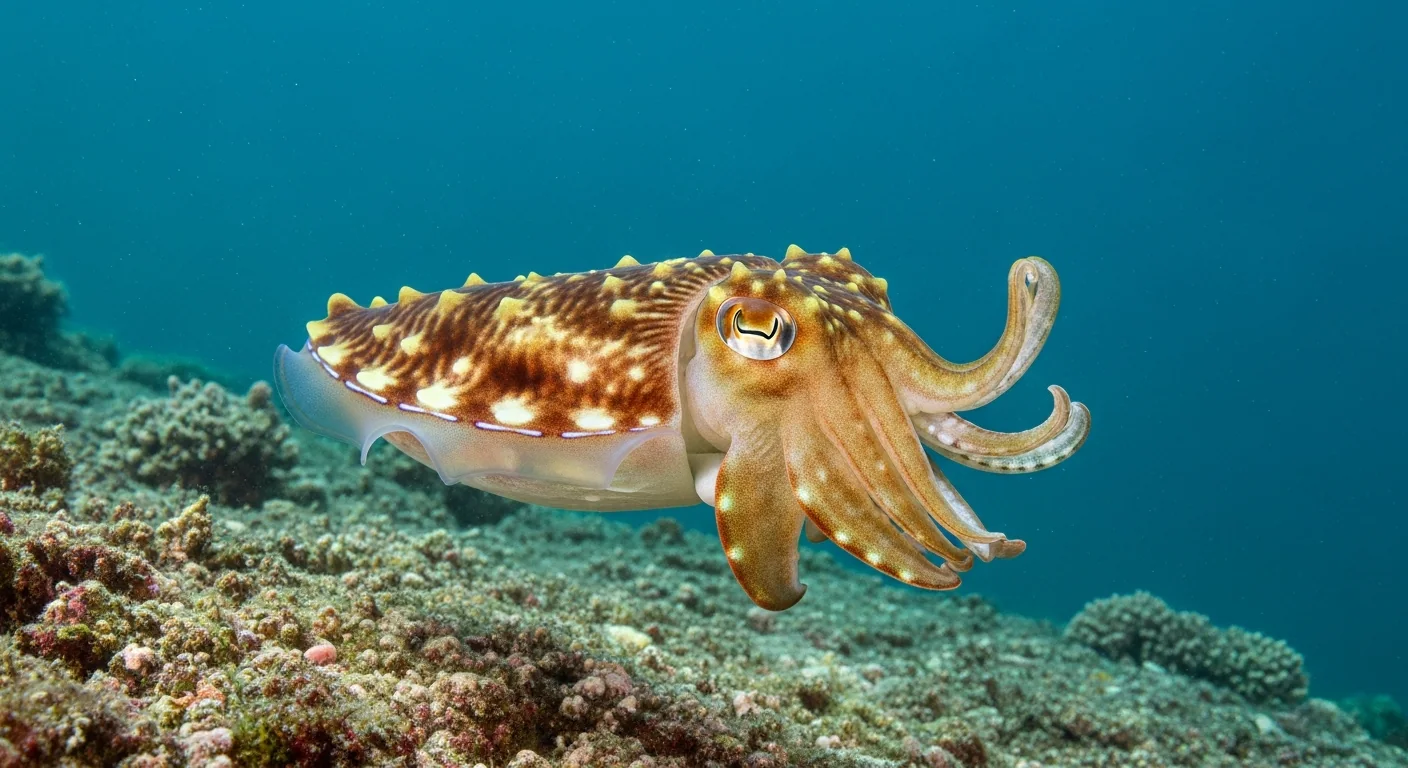
Sepia pharaonis
Pharaoh Cuttlefish
The largest cuttlefish in the Red Sea, named for this sea and the civilisation it borders. A master of camouflage with a brain-to-body ratio higher than most vertebrates.
The pharaoh cuttlefish is the dominant large cephalopod of the Red Sea and one of the most intelligent invertebrates in the ocean. The species name pharaonis is a direct reference to Egypt, this is an animal identified and named in relation to the sea it inhabits. Adult males can reach 50 centimetres in mantle length and weigh up to five kilograms, making them substantially larger than the common cuttlefish of European waters.
Like all cuttlefish, Sepia pharaonis is built around a gas-filled internal shell, the cuttlebone, that it uses for precise buoyancy control by adjusting the ratio of gas to liquid in the shell's chambers. This gives the cuttlefish an almost frictionless ability to hover at any depth, making minute position adjustments with the undulating fins along its mantle without any visible effort. The buoyancy control is more precise than that of any fish that uses a swim bladder, and it makes the cuttlefish appear to float in the water with an almost supernatural steadiness.
The chromatophore system is, as in squid, individually controlled and capable of changes in under one second. But the pharaoh cuttlefish adds a further layer: the ability to change not just colour but surface texture, producing raised papillae across the mantle that can replicate the rough texture of coral or rock. The combined colour-plus-texture camouflage can make a cuttlefish near-invisible against almost any substrate. When a cuttlefish freezes against a rock and activates its camouflage, it does not gradually blend in, it changes almost instantaneously.
Encounters with divers are typically prolonged. Cuttlefish are curious and assess threats rather than fleeing immediately, holding position and tracking the diver with their distinctive W-shaped pupils before deciding whether to maintain position, move away, or, in the case of a male during breeding season, display.
The hunting strike is one of the fastest and most precise in the ocean. When within range of prey, the cuttlefish extends two long tentacles, normally retracted inside the arms, in a strike that takes approximately 25 milliseconds. The tentacles grip the prey with suckers, pull it toward the beak, and the cuttlefish delivers a bite that injects venom. The prey is paralysed rapidly. The strike is preceded by a period of slow, careful approach during which the cuttlefish holds its arms in a specific configuration that has been shown to hypnotise fish by presenting a moving, pulsating pattern directly at eye level to the prey.
Male courtship displays are elaborate. Males adopt high-contrast zebra striping patterns and position themselves between rival males and females. As with the bigfin reef squid, dual-side display has been documented: a male will display courtship patterns toward a female and female-mimicking camouflage toward a rival simultaneously.
The W-shaped pupil of cuttlefish is not simply a distinctive feature, it is a functional adaptation. The unusual shape allows the cuttlefish to compensate for the lack of colour receptors in its eye: while cuttlefish are believed to be colour-blind based on the structure of their photoreceptors, behavioural evidence suggests they can distinguish colours. The leading hypothesis is that they use the W-shape to create chromatic aberration, different wavelengths of light focus at different distances, and use this information to infer colour.
Pharaoh cuttlefish are targeted by artisanal and commercial fisheries throughout the Indo-Pacific. In Egypt, they are caught incidentally in trawl nets and targeted by small-boat fisheries using lures and jigs. The short lifespan and annual reproductive cycle provides some resilience, but localised overfishing has reduced populations at accessible sites.
The cuttlebone trade represents an additional pressure: the internal shells wash ashore after the animal's death and are collected for the pet industry (they are sold as calcium supplements for cage birds) and for manufacturing polishing compounds. The scale of this collection is small relative to fishery pressure.
Atlas Position
The pharaoh cuttlefish is the animal most likely to hold its position and examine a diver with what can only be described as intelligence. It does not flee on approach if you move slowly. Its eye tracking you, a horizontal pupil in a mobile orbit, clearly registering your presence and assessing it, is one of those encounters that is difficult to explain to a non-diver. The Red Sea Atlas suggests approaching slowly, settling at eye level, and waiting. The animal will stay. Most divers come away having spent longer watching it than they intended.
Sign in to share a sighting, behaviour note, or encounter.
No verified sightings yet. Be the first Atlas member to log an encounter.
Keep reading, and open the whole Atlas.
A free account unlocks every dive site guide and map, the marine life library, member reports, and the full incident log. Free to join.
Join free to keep reading