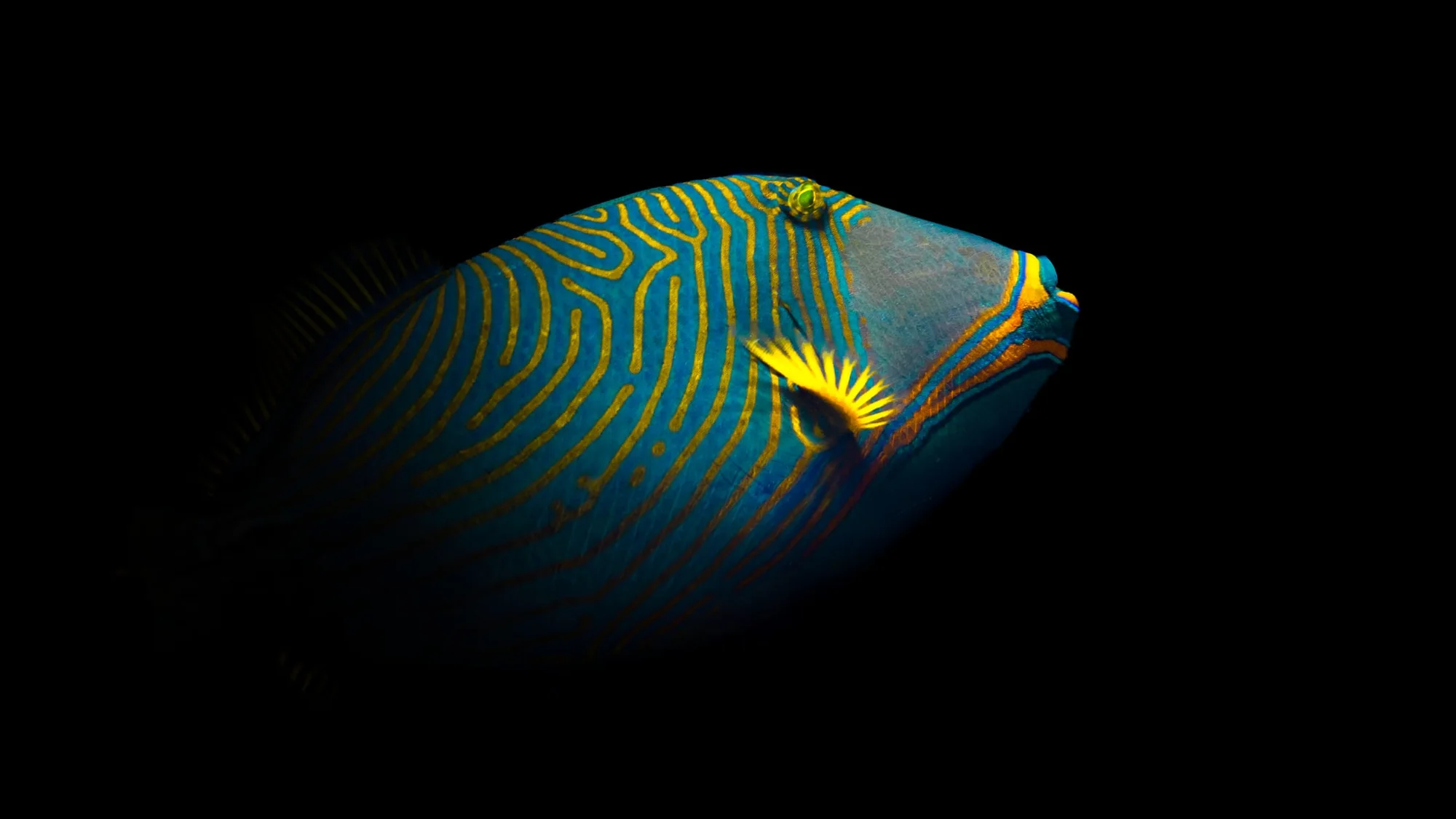
Balistapus undulatus
Orange-lined Triggerfish
A reef forager dressed in a maze of orange lines. Small, busy, and unexpectedly bold near its nest, where even a fish this size will hold its ground against a diver.
The orange-lined triggerfish is one of the most distinctive small fish on the Red Sea reef. A deep-bodied fish rarely more than 30 centimetres long, it is covered from gill to tail in curved orange lines that radiate across a dark olive-green body. The snout is plain, the lines beginning behind the eye and sweeping back in a pattern that no two individuals wear in quite the same way. Under a torch at night the green deepens and the lines seem to glow, which is how many divers first pick one out.
It belongs to the triggerfish family, Balistidae, named for the locking mechanism of the first dorsal fin. The leading spine raises and locks upright, held in place by a smaller second spine behind it. The fish uses this to wedge itself into a crevice at night, jamming the spine against the roof of the hole so that nothing can pull it out. Releasing the smaller trigger spine drops the whole structure flat again. It is a simple, effective piece of engineering, and it is the reason for the family name.
Orange-lined triggerfish are present on virtually every reef in the Egyptian Red Sea, from shallow lagoons to walls at 40 metres and beyond. They are solitary and active by day, spending the dive working over coral and rubble in search of food, and retreating to a hole at night. For most of an encounter they ignore divers entirely. The exception, and it is an important one, comes when a female is guarding a nest.
Orange-lined triggerfish feed on some of the best-defended animals on the reef. Their strong, chisel-like teeth crush sea urchins, crabs, molluscs and the calcareous tubes of worms, and they will also take algae and the occasional small fish. A common tactic is to direct a jet of water at a sea urchin to flip it over, exposing the soft underside where the spines are shortest. They move rubble, bite at coral, and leave small excavations across the reef as they forage.
The species is solitary and strongly territorial. The behaviour divers remember concerns the nest. The female lays a mass of eggs in a depression on the bottom, fans and tends it, and defends the space above it against anything that approaches, including fish many times her size, and divers. The defended territory is shaped like a cone that widens toward the surface, because the fish treats the threat as coming from above. A diver who swims upward to escape a charging triggerfish stays inside the cone. The correct response is to swim low and horizontally, away from the nest, which leaves the territory by the shortest path.
This is worth keeping in proportion. The orange-lined triggerfish is small, and its charges are usually bluff and posture rather than contact. The fish that genuinely injures divers on Red Sea reefs is its much larger relative, the titan triggerfish, which can take a piece out of a fin or a wetsuit. An orange-lined triggerfish defending a nest is a memorable encounter rather than a dangerous one, but the teeth are real, and a determined individual will follow an intruder a surprising distance before turning back.
A guarding female defends a cone-shaped territory that widens toward the surface. If one charges, swim low and horizontally away from the nest rather than upward, which only keeps you inside the defended zone. The bite is painful but rarely serious.
Away from a nest the orange-lined triggerfish is no hazard to divers. It forages over the reef and ignores you. Give a charging individual space and it will return to its eggs once you have left.
The orange-lined triggerfish is listed as Least Concern by the IUCN. It is widespread across the Indo-Pacific and the Red Sea, common on Egyptian reefs, and not a commercial fishing target. Some individuals are taken for the marine aquarium trade, but not at a level that threatens the population.
Like all reef fish, its long-term outlook is tied to the health of the reef itself. As a predator of urchins and other invertebrates, it is part of the balance that keeps algae in check and coral dominant. A reef that loses its triggerfish and other urchin predators can tip toward urchin overpopulation and the slow erosion of the reef structure. Its presence in normal numbers is a quiet sign that the reef is working as it should.
Atlas Position
The orange-lined triggerfish is easy to overlook on a reef full of larger animals, which is a shame, because it rewards attention as much as anything in the water. Watch one forage and you see the reef food web in miniature: the flipped urchin, the crushed shell, the constant rearranging of rubble. The Red Sea Atlas offers only one piece of practical advice. If one charges you near its nest, do not take it personally and do not swim up. Drop low, move off to the side, and let the fish win. It was here first, and it has eggs to mind.
Sign in to share a sighting, behaviour note, or encounter.
No verified sightings yet. Be the first Atlas member to log an encounter.
Keep reading, and open the whole Atlas.
A free account unlocks every dive site guide and map, the marine life library, member reports, and the full incident log. Free to join.
Join free to keep reading