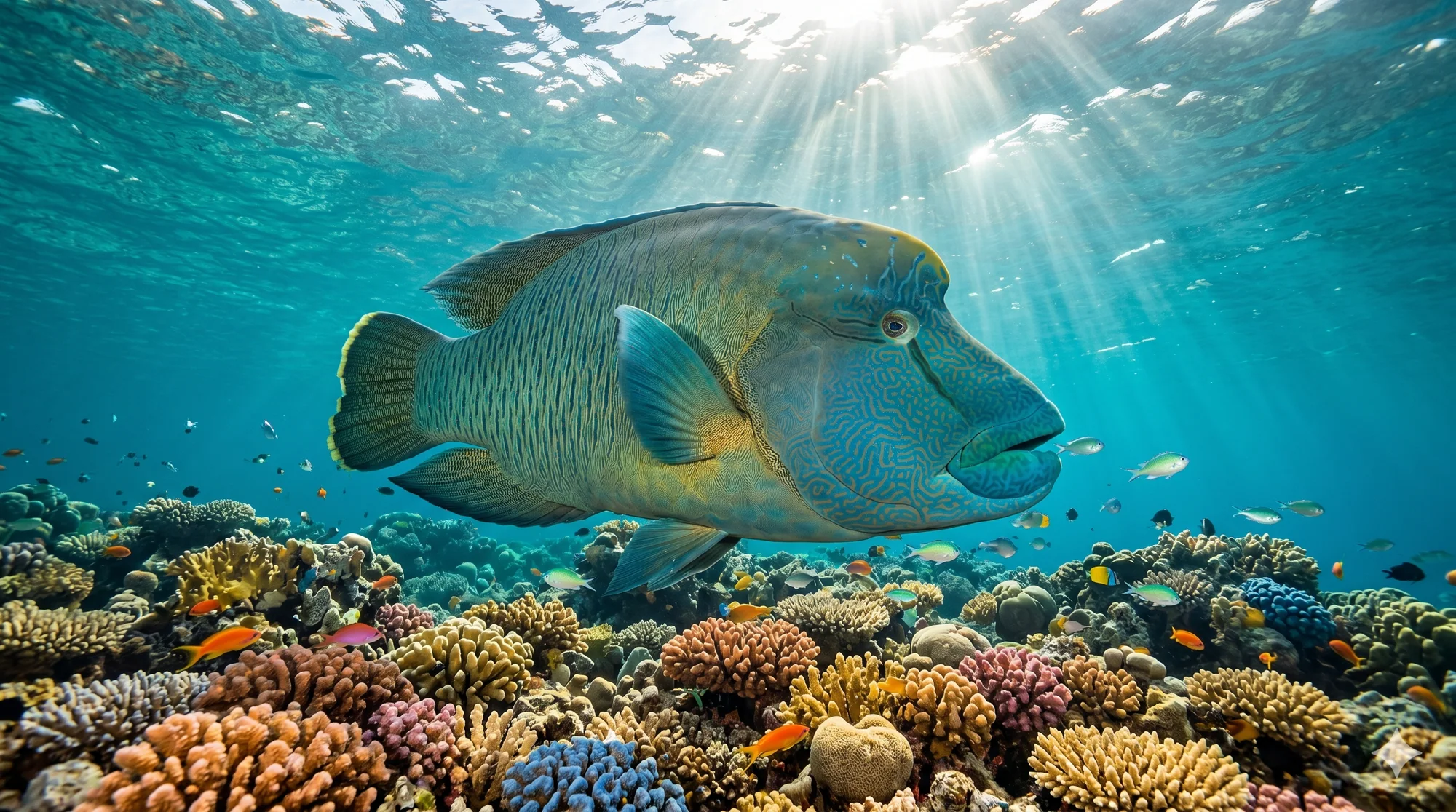
Cheilinus undulatus
Napoleon Wrasse
The largest reef fish in the Red Sea. Curious, approachable, and unmistakable, reaching two metres and 190 kilograms, with a characteristic hump above the eyes.
The Napoleon wrasse, also called the humphead or Maori wrasse, is the largest member of the wrasse family and the largest bony fish reliably encountered on Red Sea reefs. Large individuals reach 2.3 metres and approach 190 kilograms. The characteristic feature is the pronounced hump on the forehead, which increases with age and becomes most pronounced in dominant males. The body is covered in intricate, labyrinthine markings in shades of blue, green, and purple.
These are not shy fish. Napoleon wrasse have a reputation, well-earned at sites like Ras Mohamed and the Brothers, for approaching divers directly and remaining in the vicinity for the duration of a dive. This curiosity makes them one of the most rewarding encounters on any Red Sea dive. A large male circling the group at close range is an experience that does not require any particular diving skill to appreciate.
Napoleon wrasse are protogynous hermaphrodites: they are all born female and the dominant individual in a territory undergoes a sex change to male, a process driven by social cue rather than biology alone. A large Napoleon wrasse is therefore always a male. The fish that began this life as a small, brown-coloured juvenile female has, through territorial dominance and the passage of decades, become the blue-green, 150-kilogram animal that follows your dive group across the reef.
Napoleon wrasse are territorial and semi-solitary. A large male will patrol a home territory that may encompass several hundred metres of reef, moving methodically through the reef structure and investigating anything novel, including dive groups. They approach with a directness that can unsettle inexperienced divers: a two-metre fish moving toward you without apparent hesitation is a different experience from the usual reef encounter.
Their diet is ecologically significant. Napoleon wrasse are among the few animals that can eat the crown-of-thorns starfish, a corallivore whose population explosions, typically linked to nutrient run-off and the loss of predator species, cause severe coral degradation across Indo-Pacific reefs. A healthy Napoleon wrasse population is part of the reef's defence against this kind of outbreak.
They are most active during the day and rest in coral structure at night. Large individuals have predictable daily routes and can be found in the same locations on consecutive dives, dive guides at established sites often know individual animals by sight.
The Napoleon wrasse's primary threat is the live fish trade. Transported alive to restaurants in East Asia where they are kept in tanks and sold for significant sums, they are targeted by collectors using cyanide, a practice that kills surrounding reef while incapacitating the fish for collection. Even in areas where cyanide use is illegal, it is difficult to detect and harder to prosecute.
Egypt's legal protection for Napoleon wrasse prohibits targeted fishing within Egyptian waters. Enforcement is imperfect but the protection has allowed populations at Ras Mohamed and the Brothers to remain intact. These are among the healthiest Napoleon wrasse populations in the northern Red Sea.
Atlas Position
A large Napoleon wrasse following a dive group across the reef at Ras Mohamed is one of those encounters that reminds you why you dive. These animals are not performing for the group, they are doing what they have always done, which happens to include curiosity about large, noisy, bubble-producing animals in their territory. The fact that this encounter remains possible at all is a consequence of consistent legal protection applied over decades. The Red Sea Atlas supports that protection without reservation.
Sign in to share a sighting, behaviour note, or encounter.
No verified sightings yet. Be the first Atlas member to log an encounter.
Keep reading, and open the whole Atlas.
A free account unlocks every dive site guide and map, the marine life library, member reports, and the full incident log. Free to join.
Join free to keep reading