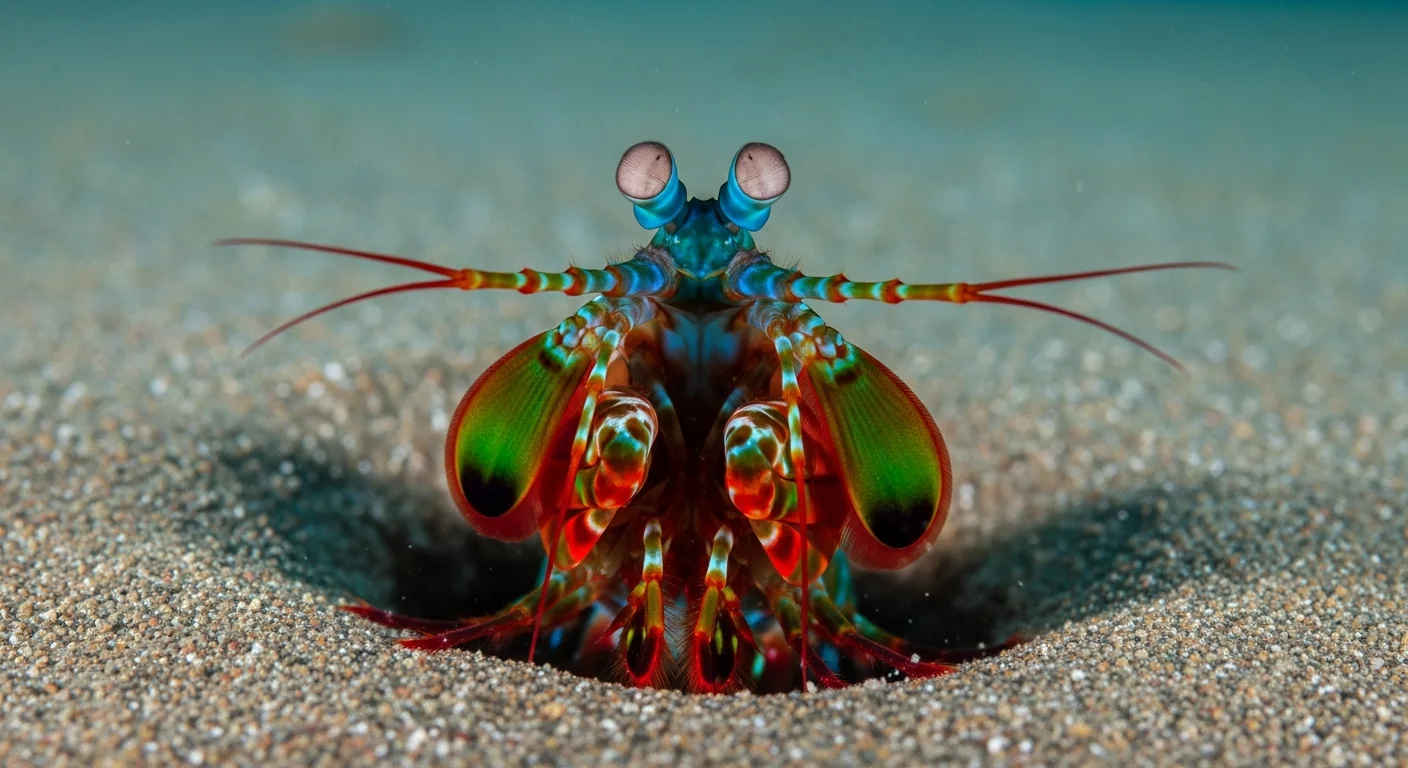
Odontodactylus scyllarus
Peacock Mantis Shrimp
Not a shrimp, a stomatopod with a strike faster than a bullet and the most complex visual system of any animal on earth. Spectacularly coloured, and genuinely dangerous if handled.
The peacock mantis shrimp is one of the most remarkable animals on any Red Sea reef and also one of the most misnamed. It is not a shrimp. It belongs to the order Stomatopoda, an ancient and entirely separate lineage of crustaceans that has been evolving independently from true shrimps and crabs for over 400 million years. Calling it a shrimp is like calling a bat a bird: it looks superficially similar, but the internal architecture is entirely different.
The peacock mantis shrimp is a smasher, one of the two functional types of stomatopod, distinguished by the shape of the raptorial appendage it uses to kill prey. Smashers have a hardened club at the end of the appendage and use it to deliver impact strikes against hard-shelled prey: crabs, snails, clams. The strike velocity has been measured at 23 metres per second, with an acceleration of approximately 10,400g. The energy released on impact is enough to shatter crab shells, crack aquarium glass, and, if the animal is handled carelessly, break a human finger.
The visual system is equally extraordinary. Where humans have three types of photoreceptor (red, green, blue), the peacock mantis shrimp has sixteen. It can perceive wavelengths from deep ultraviolet through to far infrared, including polarised light and circular polarised light that no other animal is known to see. The mechanism by which this visual information is processed and used is still not fully understood.
On the reef, the animal is found in burrows in sandy rubble zones, typically between 3 and 40 metres. It spends most of the day in or near the entrance to its burrow, emerging to hunt and displaying its iridescent colours in the process.
Peacock mantis shrimp are ambush predators. They wait at the entrance to their burrow and launch rapid attacks on prey that passes within range. The strike is preceded by a very brief wind-up phase in which the raptorial appendage is cocked, then released in a movement too fast to follow with the naked eye. The impact itself is visible: a cloud of cavitation bubbles forms at the strike point, produced because the club moves through water so fast that the local pressure drops below the vapour point. The secondary collapse of these cavitation bubbles generates a second impact force almost equal to the first strike.
Territorial behaviour is pronounced. A mantis shrimp will defend its burrow aggressively against other mantis shrimp and has a specific ritualised display for territorial disputes: it spreads its appendages and displays the coloured meral spot on the underside of the raptorial appendage. This display communicates fighting ability without requiring physical contact. In most cases, one animal retreats based on the display alone. The species essentially has a regulated, honest signalling system that prevents the cost of unnecessary fights.
Mating involves a brief, carefully managed physical contact, both animals are armed and capable of injuring the other, which means courtship requires a period of mutual assessment. Pairs may associate for an extended breeding season.
The animal is capable of recognising individual humans who have interacted with it. Laboratory experiments have demonstrated individual recognition over extended periods, which is unusual in an invertebrate.
A peacock mantis shrimp can break a finger. Do not attempt to pick one up or reach into its burrow. The strike is faster than human reflex and the force is substantial.
Watching from a distance of 30–50cm poses no risk. The animal does not pursue divers and will retreat into its burrow if approached too closely.
Peacock mantis shrimp are not commercially targeted and face no significant conservation pressure as a species. They are occasionally collected for the marine aquarium trade, where they are both popular for their colour and notorious for destroying tank inhabitants and equipment. The aquarium trade represents a minor draw on wild populations.
Habitat dependency is the primary long-term concern. The species requires sandy rubble substrate with sufficient compactness to support stable burrows. On reefs where carbonate sand is being lost to erosion or where rubble zones are being physically disrupted, mantis shrimp habitat degrades. They are not dependent on live coral directly but are part of the wider reef ecosystem.
Atlas Position
The peacock mantis shrimp is the animal that most reliably produces the reaction of complete disbelief in new divers who encounter it for the first time. Nothing about a reef prepares you for something that vivid, that architecturally strange, or that demonstrably violent. The Atlas recommends that every diver who spends time in rubble zones at sites like Dahab Lighthouse or Erg Abu Ramada watches for the burrow entrance, a smooth oval tube in the substrate, often with shell fragments piled at the entrance. Hover at a distance and wait. It will come out.
Sign in to share a sighting, behaviour note, or encounter.
No verified sightings yet. Be the first Atlas member to log an encounter.
Keep reading, and open the whole Atlas.
A free account unlocks every dive site guide and map, the marine life library, member reports, and the full incident log. Free to join.
Join free to keep reading