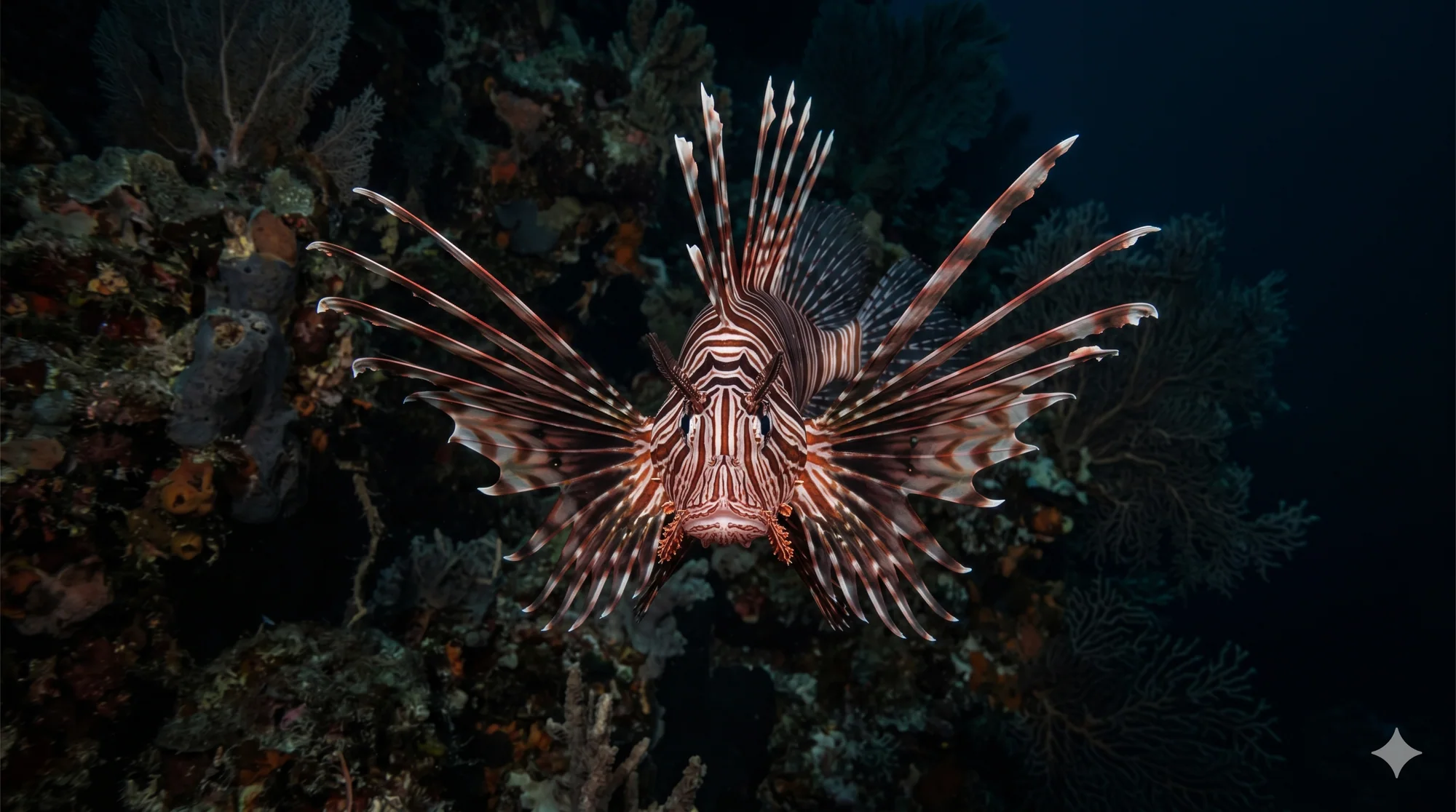
Pterois miles
Common Lionfish
Thirteen venomous spines, spectacular finnage, and total fearlessness. Native to the Red Sea, not invasive here. Found on virtually every wreck and reef overhang.
The lionfish is one of the most visually striking animals in the sea, thirteen dorsal spines each delivering venom, fan-like pectoral fins spread in elaborate display, and a body patterned in red and white stripes that reads as a clear and honest warning: I am not safe to touch. This warning is honest. Contact with the spines produces immediate and intense localised pain, systemic inflammation, and occasionally nausea. It is not lethal to a healthy adult but it is deeply unpleasant and requires hot water immersion as first treatment.
The critical distinction for the Red Sea: lionfish are native here. In the western Atlantic and Caribbean they are an invasive species, transported through ballast water and the aquarium trade, and they have devastated reef fish populations in areas where no natural predator exists and prey species have no learned avoidance behaviour. That is not the Red Sea story. Pterois miles evolved here. Red Sea reef fish know what it is. Groupers eat small lionfish. The ecological balance is very different from the Atlantic situation.
On Red Sea reefs, lionfish are found hovering at the entrance to every significant cave, overhang, and wreck interior. The Thistlegorm engine room, the hold of the Giannis D, the cargo holds of the Carnatic, lionfish are present in all of them. They hunt by corralling small fish using their spread pectorals, then striking with explosive speed. During the day they are largely stationary, positioned to ambush.
Lionfish spend much of the day in a near-stationary hover, positioned in a crevice entrance or at the underside of an overhang, facing outward with pectorals spread. This position combines two functions: it presents maximum warning display to potential threats (the spread fins with their venomous spines) and it maximises the ambush zone for potential prey. Small reef fish swimming past the entrance of a crevice occupied by a lionfish frequently do not see it until it is too late.
The strike is extremely fast, acceleration achieved over a very short distance, the mouth opening to create a suction that draws prey forward. The action is over in milliseconds. This speed, combined with the camouflage of the lionfish's patterning against the reef background, makes them effective predators despite their apparent immobility.
At night, lionfish become actively mobile hunters. They move through the reef in a slow, deliberate glide, using their pectorals to herd small fish into corners. Night divers encounter lionfish in the open water column rather than in fixed positions, a very different experience from daytime observations.
Within the Red Sea, Pterois miles is not a conservation concern, it is a stable, functioning part of the reef ecosystem. The concern runs in the other direction: the spread of lionfish to the Mediterranean through the Suez Canal (a Lessepsian migrant population) and their continued dominance in the Atlantic invasion zone are significant ecological problems outside the Red Sea.
Red Sea lionfish populations appear healthy. No evidence of population decline exists from dive observer records. The species benefits from its venomous defence, which largely protects it from the kind of targeted fishing pressure that affects more commercially valuable species.
Atlas Position
The lionfish is a useful reminder that "invasive" and "native" are not fixed properties of a species, they describe a relationship between an animal and its ecosystem. In the Red Sea, the lionfish is part of a balanced system; in the Caribbean, the same (closely related) species is an ecological disaster. Understanding the difference matters. The Red Sea Atlas notes this context because a diver who has been told "lionfish are destructive invasives", which is true in the Atlantic, may carry that framing to the Red Sea, where it is wrong.
Sign in to share a sighting, behaviour note, or encounter.
No verified sightings yet. Be the first Atlas member to log an encounter.
Keep reading, and open the whole Atlas.
A free account unlocks every dive site guide and map, the marine life library, member reports, and the full incident log. Free to join.
Join free to keep reading