Gymnothorax javanicus
Giant Moray
Up to 3 metres long and present on virtually every reef. The opening mouth is a breathing motion, not a threat display. More curious than aggressive when left alone.
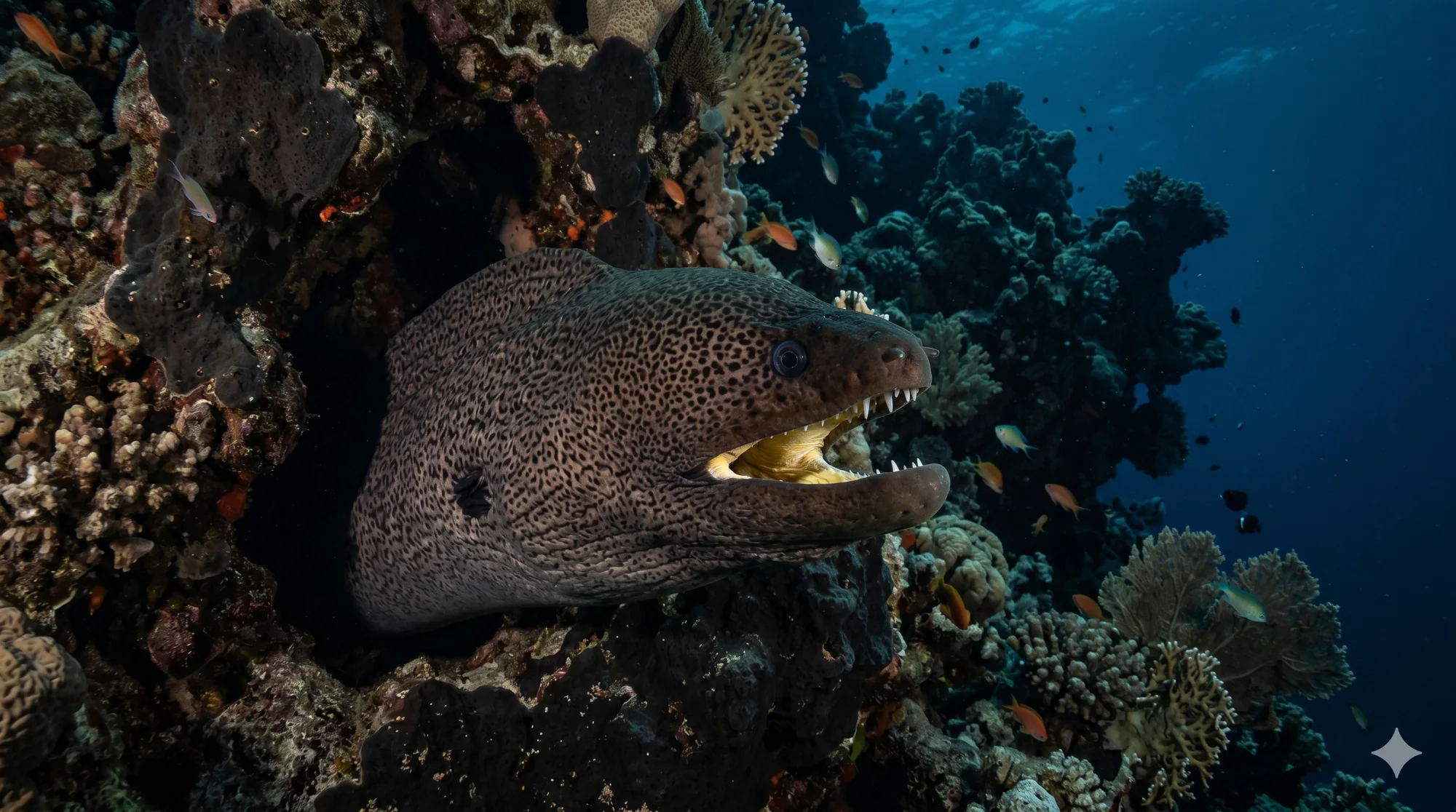
The giant moray is the largest moray eel in the Red Sea and one of the largest in the world. Adults regularly reach 2.5 metres; the largest recorded specimens approach 3 metres and weigh over 30 kilograms. They are found on every significant reef in the Egyptian Red Sea, typically with their heads protruding from holes and crevices in the reef structure, mouths opening and closing in the slow, rhythmic motion that unsettles many new divers.
That opening mouth is not a threat display. Morays breathe by pumping water over their gills, the mouth opening is the equivalent of a human breathing cycle. A giant moray does not need to open its mouth to threaten you. If it wanted to threaten you, you would know. The slow open-close motion means the animal is simply breathing.
Morays have poor eyesight and rely heavily on olfaction, smell, to locate prey. They are active hunters primarily at night, when they emerge from their resting holes to move through the reef searching for fish, octopus, and crustaceans. During the day they rest, with only the head visible. A diver who approaches without thrusting a hand into a crevice, which would be genuinely unwise, has nothing to fear from a giant moray.
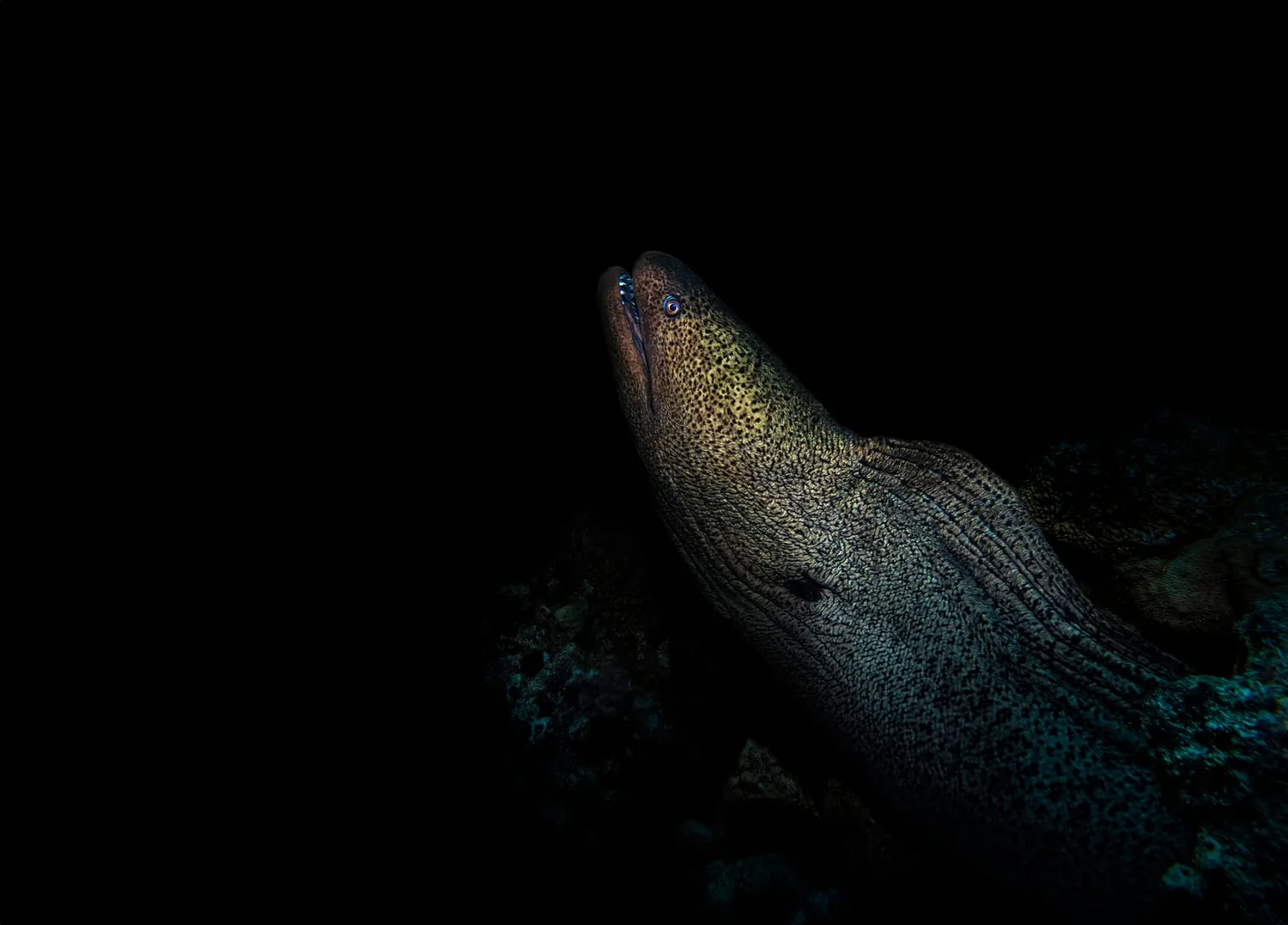
Giant morays have two jaws: the primary jaw that opens at the front of the mouth, and a pharyngeal jaw, a second, retractable set of jaws further back in the throat that grips and draws prey inward. This feature, which moray eels share with a small number of other species and which film-makers made famous in a 1979 science fiction franchise, is an adaptation to the moray's body plan: a long, cylindrical fish without the ability to expand its throat cavity cannot create the suction that most fish use to swallow prey. The pharyngeal jaw substitutes for that suction.
Cooperative hunting between giant morays and groupers has been documented in the Red Sea, one of the few documented examples of inter-species hunting cooperation in fish. The grouper signals its intention to hunt by performing a characteristic head-shaking display; the moray joins it and the two animals work the reef, with the grouper chasing prey toward crevices where the moray drives it back out. Both animals benefit.
Cleaner shrimp, typically Periclimenes or Stenopus species, maintain cleaning stations inside moray resting holes, entering the eel's open mouth to remove parasites and food debris. A giant moray holding its mouth wide open and motionless is likely being cleaned.
Giant morays are not currently under significant conservation pressure in the Red Sea. They are not targeted by commercial fisheries in Egypt. Recreational spearfishing, where it occurs, occasionally takes morays, but the species is widespread, resident on most reefs, and shows no evidence of decline from dive observation records.
The moray's place at the top of the reef food chain means it is sensitive to reef health in the long term, a degraded reef with reduced fish populations supports fewer morays. But this is a second-order concern rather than an immediate threat.
Atlas Position
The giant moray is the Red Sea's most reliably encountered large predator, present on every significant reef, visible from virtually every angle if you look into crevices. It is, for most visitors, the animal that triggers the deepest instinctive unease, a response that the animal has not earned through any aggressive behaviour. The Red Sea Atlas notes this not to dismiss the instinct but to contextualise it: the giant moray has been sharing reefs with divers for as long as diving has existed here, and bites have almost always involved a hand in a hole. Leave the holes alone, and the eels are fine.
Sign in to share a sighting, behaviour note, or encounter.
No verified sightings yet. Be the first Atlas member to log an encounter.
Keep reading, and open the whole Atlas.
A free account unlocks every dive site guide and map, the marine life library, member reports, and the full incident log. Free to join.
Join free to keep reading