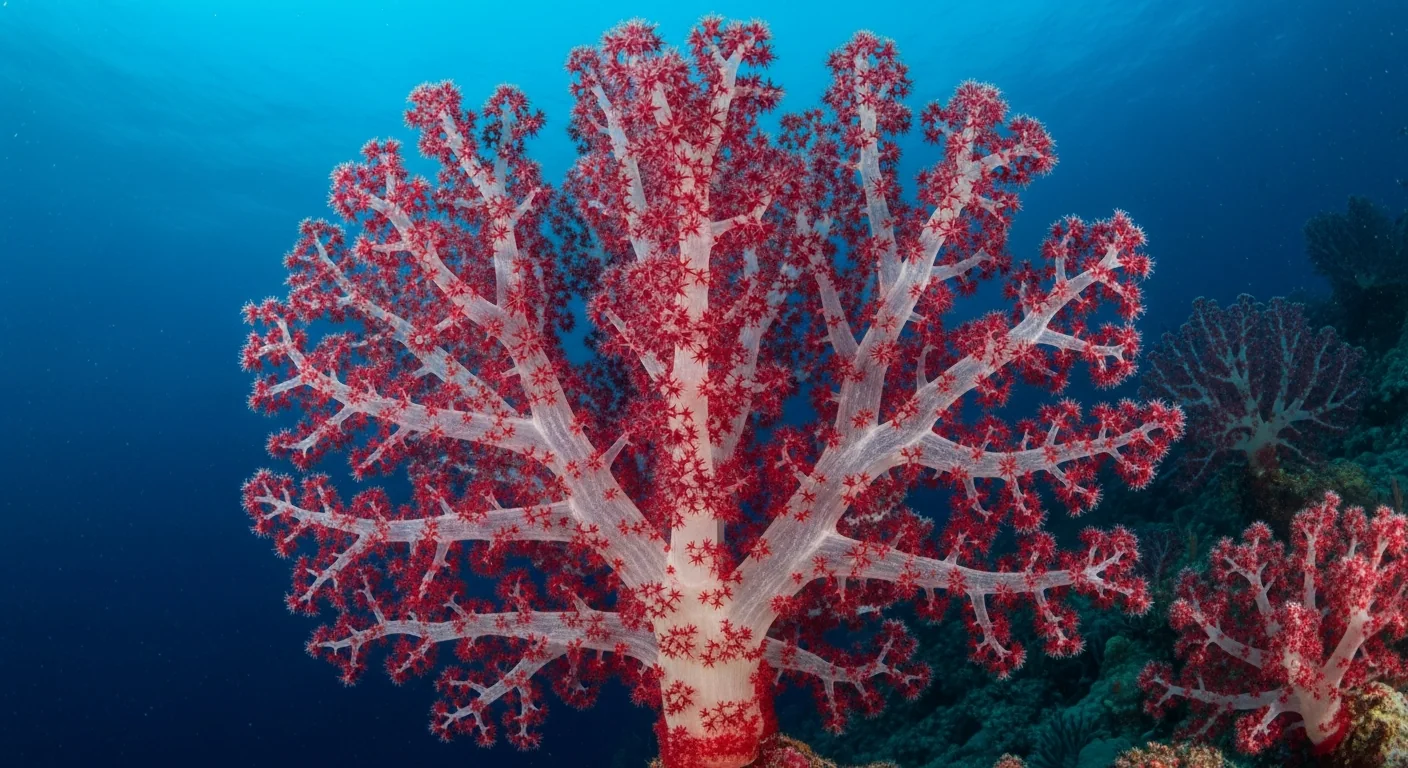
Dendronephthya klunzingeri
Dendronephthya Soft Coral
The most vivid organism on the Red Sea wall. A tree-shaped soft coral that blooms only when current runs, and draws its extraordinary colour from no light at all.
Dendronephthya is the coral that stops divers mid-descent. On the walls of the Red Sea, particularly below 20 metres where the current is reliable and the light begins to fade, colonies of Dendronephthya klunzingeri appear in vivid reds, oranges, pinks and whites, colours that have nothing to do with sunlight and everything to do with the chemical makeup of the animal itself. Where most reef-building corals depend on photosynthesis, Dendronephthya is entirely azooxanthellate: it contains no symbiotic algae. Every calorie it requires comes from the current.
The colony form is tree-like: a central trunk branches repeatedly into progressively finer arms, each tipped with dense clusters of polyps. The skeleton is not a solid calcium carbonate structure like a hard coral but a flexible mesh of spicules, tiny crystalline rods of calcium carbonate embedded in the soft tissue, that give the colony structural support while allowing it to flex in current. The spicules are visible as white granules through the semi-transparent tissue of the branches, giving Dendronephthya its characteristic texture.
In slack water, a Dendronephthya colony deflates and contracts, slumping against the wall into a shapeless mass that looks nothing like the bloomed form. A diver who does not know to look for the contracted state can pass the same wall twice, once in slack water and once in current, and see what appears to be two entirely different organisms. When current picks up, the colony expands rapidly, the branches extending outward and upward into the flow, the polyps deploying their eight-armed tentacles into the plankton stream.
This is the defining feature of Dendronephthya as a dive experience: the same wall dive in current and in slack water are not the same dive. The corals that were invisible on the way down are fully bloomed on the way up, or vice versa. The relationship between water movement and the life of this organism is immediate and legible in a way that most biology is not.
The current-dependent expansion is the most important behavioural feature of this organism, and it is not behaviour in the usual animal sense, it is a passive mechanical response to water flow. When current moves past the colony, the drag force pushes the branches outward and holds them extended. The polyps, feeling the flow, extend their eight-armed tentacles into the stream. When current stops, the hydrostatic pressure that maintained the extended form drops and the colony contracts under its own elastic tension.
The feeding behaviour of individual polyps is passive. Each polyp extends eight pinnate (feather-branched) tentacles into the current and traps zooplankton, bacteria, and fine organic particles on the cilia that line the tentacle surface. Captured particles are transported toward the central mouth of the polyp by coordinated ciliary beating. This is a low-yield feeding strategy that works only because the current delivers a continuous supply of new plankton to the tentacles, without current, the same water would be depleted rapidly and the colony would starve.
The colour of Dendronephthya colonies does not fade with depth, unlike the colours of organisms that depend on reflected light for their appearance. A deep red colony at 35 metres is as vivid as it would be at 10 metres because the colour is structural, it comes from carotenoid and other chemical pigments in the coral tissue. This is why Dendronephthya is among the most colour-accurate subjects for underwater photography: the pigmentation is real, not reflected, and does not require a torch to restore.
Individual colonies appear to occupy the same site for many years. On repeatedly dived walls at the Brothers or Elphinstone, specific large colonies are reference points for dive guides and regular visitors, suggesting stability of position over extended periods.
Dendronephthya is harmless to divers. The polyps have no effective stinging capability at the scale relevant to humans.
Colonies are structurally delicate despite their size. Fin contact or buoyancy failure near a wall can break branches that took years to grow. Maintain distance on current-exposed walls.
Dendronephthya does not depend on photosynthesis, which makes it insensitive to the bleaching stress that drives mass mortality in zooxanthellate corals. However, it is vulnerable to different pressures. Its non-photosynthetic strategy requires consistent, plankton-rich water flow; reef systems that have lost their current dynamics due to habitat degradation support fewer and smaller colonies.
Physical damage is significant. Unlike hard corals, a broken Dendronephthya branch cannot calcify over a wound, the soft tissue must regenerate across the break, a slower process. Diver contact, anchor chains, and trawl damage on deeper walls cause colony fragmentation. At heavily dived sites, colonies at accessible depths show more fragmentation and smaller average size than colonies at depths rarely reached by recreational divers.
Sedimentation is a serious threat. Dendronephthya polyps are small and their tentacles easily blocked by suspended sediment. Colonies on walls affected by runoff from coastal development consistently show reduced polyp extension and, over time, colony death. The species is therefore a useful indicator of water quality: a wall with large, fully bloomed Dendronephthya colonies is a wall with clean, moving water.
Atlas Position
The first time you see a large Dendronephthya colony fully extended in current, the branches spread wide, every polyp deployed, the whole structure lit in red or orange against a dark blue wall, is one of the genuinely surprising moments available in Red Sea diving. Nothing prepares you for something that vivid in water that deep. The Red Sea Atlas notes that the same wall at slack tide, with the colonies contracted and grey, is a reminder that the reef is not a static display. It is alive and it responds to conditions. That relationship between current and colour is worth understanding before you descend.
Sign in to share a sighting, behaviour note, or encounter.
No verified sightings yet. Be the first Atlas member to log an encounter.
Keep reading, and open the whole Atlas.
A free account unlocks every dive site guide and map, the marine life library, member reports, and the full incident log. Free to join.
Join free to keep reading