Octopus cyanea
Day Octopus
The most commonly seen octopus on the Red Sea reef, active by day, capable of 177 colour and texture changes per hour, and considerably more intelligent than most animals its size.
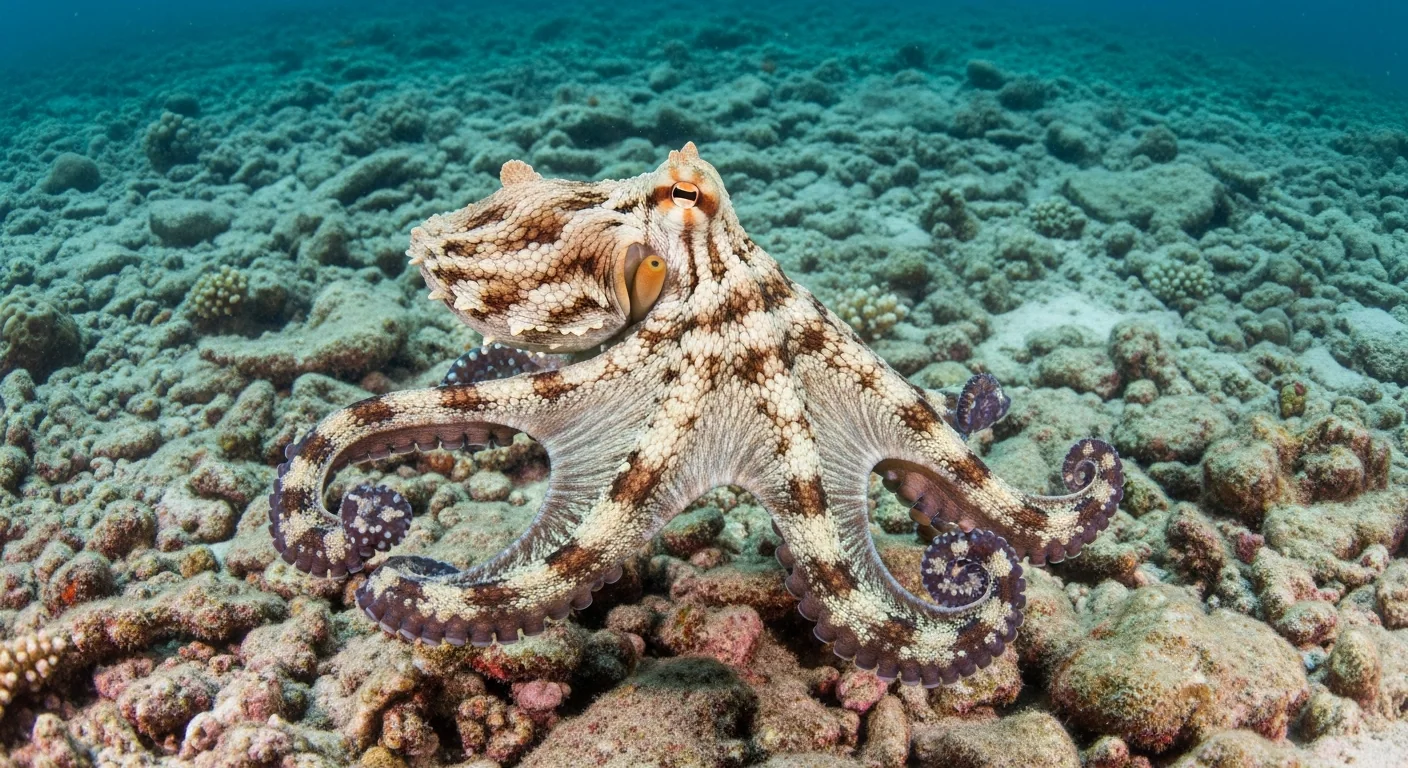
Octopus cyanea, the day octopus or big blue octopus, is the octopus most commonly encountered during daylight dives across the Red Sea. Where the common octopus of temperate seas is primarily nocturnal, the day octopus is an active daytime hunter, moving across the reef and through rubble zones in pursuit of crabs, snails and small fish. This behaviour makes it accessible to divers in a way that other octopus species are not.
The species is named for a distinctive blue ring or spot behind the eye that flashes briefly during stress or excitement, the same bioluminescent warning signal used by the highly venomous blue-ringed octopuses of the Indo-Pacific, though Octopus cyanea itself is not dangerous. The eye-spot is simply a startling signal rather than a genuine advertisement of lethality.
Octopus cyanea has been the subject of significant research on cephalopod intelligence and camouflage. The animal has been observed changing colour and texture up to 177 times per hour when actively hunting across varied substrate. Each change is instantaneous and matches both the colour and three-dimensional texture of the surface the animal is on or moving toward. A day octopus moving from coral rubble to sandy substrate to live reef in the space of a minute will produce three completely different camouflage configurations in a matter of seconds each.
The arms, eight, unlike the squid's eight arms plus two tentacles, are semi-autonomous. Each arm contains two-thirds of the animal's total neurons and can perform complex actions independently while the central brain handles other tasks. An arm severed from the body will continue responding to stimuli for over an hour.
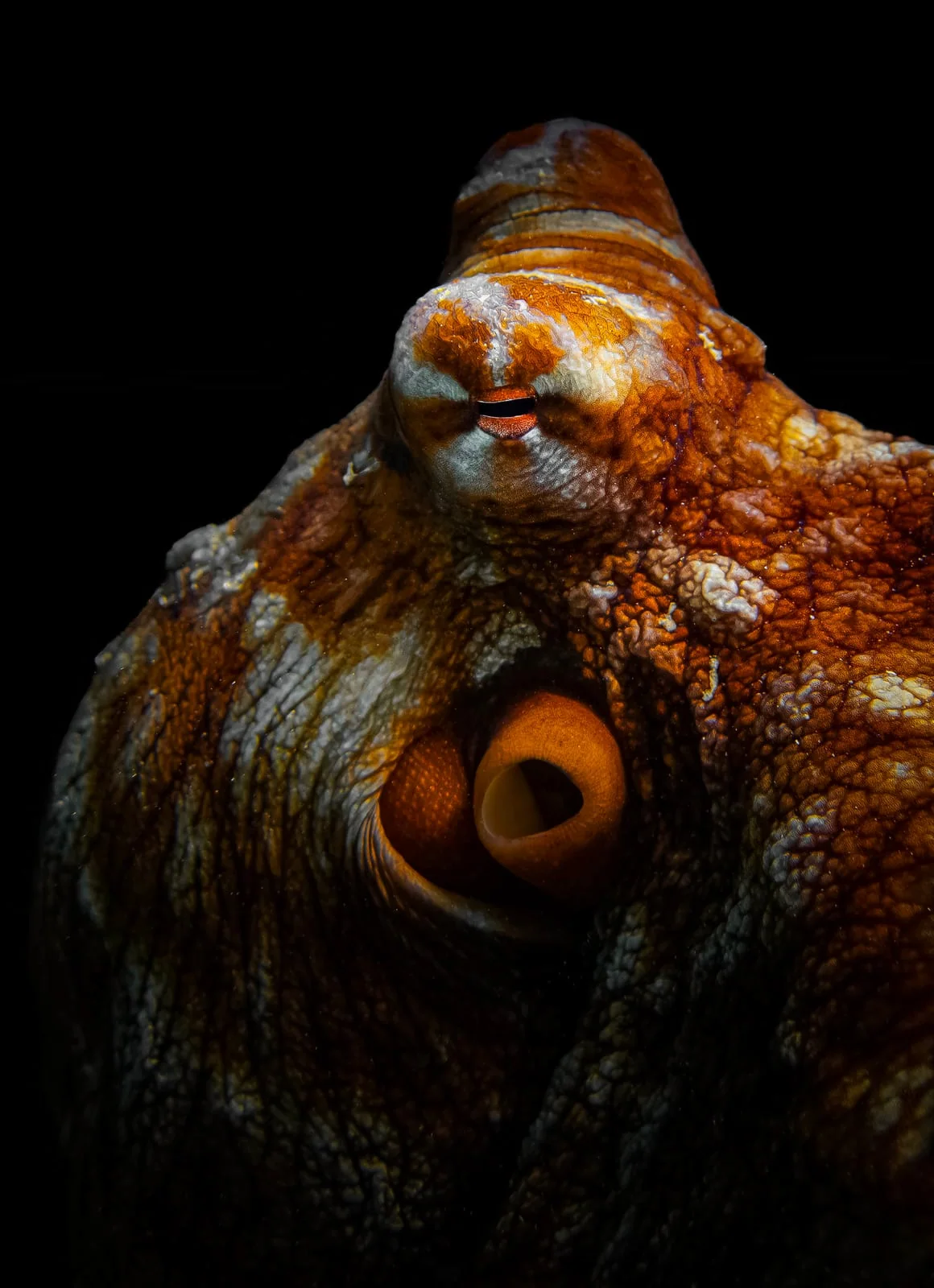
The hunting behaviour of Octopus cyanea involves two primary strategies. The first is slow stalking: the animal moves deliberately across open substrate, pausing to inspect crevices and reach inside with individual arms while maintaining a camouflage pattern appropriate to the current background. The second is a spread-and-pounce: the octopus spreads its arms and mantle web over a section of reef in a tent-like shape, trapping everything underneath, then inspects the space systematically. This second strategy is most effective on rubble and sand patches where prey cannot escape downward.
Tool use has been documented in this species and close relatives. Individual octopuses collect coconut shell halves and carry them while moving across open substrate, assembling them into a shelter at the next resting site. In the Red Sea context, the equivalent is the construction of dens from coral rubble, shell fragments, and any available hard material. Den locations are maintained across multiple hunting excursions and can be identified by the midden of shell debris at the entrance.
Octopuses are solitary and territorial. Two individuals will not share a den. Encounters between adults typically result in one individual retreating. Mating involves a careful approach and transfer of a sperm packet via the hectocotylus, a modified arm, after which the male typically retreats. The female lays eggs in the den, aerates them continuously, and dies shortly after they hatch. The male dies shortly after mating. Neither animal survives to see the next generation.
The day octopus is targeted by artisanal fisheries across its range, including in Egypt. It is caught by hand-picking during low tide on reef flats, by pot traps, and as bycatch in trawl nets. The short lifespan and high fecundity of octopuses provides resilience against moderate fishing pressure, but intensive local collection can deplete populations at accessible sites.
Reef degradation reduces day octopus habitat by eliminating the structural complexity they depend on for den sites and hunting. On heavily degraded reefs where coral structure has been replaced by flat algae-covered rubble, octopus populations are consistently lower.
Atlas Position
The day octopus is one of the more demonstrably intelligent animals a diver will encounter in the Red Sea. Finding one in the open and watching it hunt, the deliberate movement, the instantaneous camouflage changes as it crosses different substrate, the individual arm explorations of each crevice, is a genuine privilege. They are present on virtually every reef that has not been heavily degraded. Look for the midden of shell debris that marks an active den, then wait nearby. The animal will emerge.
Sign in to share a sighting, behaviour note, or encounter.
No verified sightings yet. Be the first Atlas member to log an encounter.
Keep reading, and open the whole Atlas.
A free account unlocks every dive site guide and map, the marine life library, member reports, and the full incident log. Free to join.
Join free to keep reading