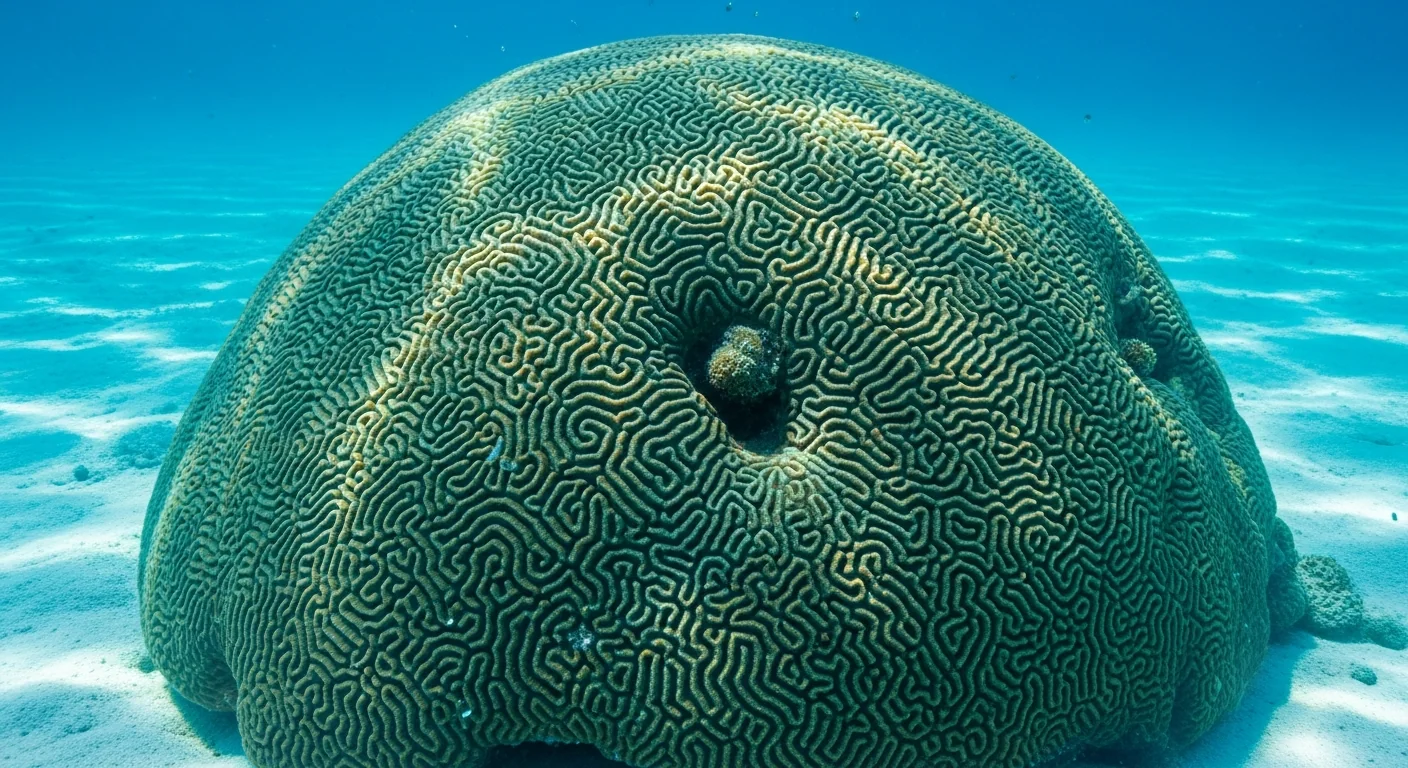
Platygyra lamellina
Brain Coral
The most architecturally striking coral on the reef, the maze-like grooves of its surface have been forming since before your grandparents were born.
Brain corals are among the most immediately recognisable organisms on a reef. The massive, dome-shaped colonies of Platygyra lamellina are covered in a continuous pattern of sinuous ridges and valleys, the corallite walls forming a labyrinthine surface that, at the appropriate scale, is almost indistinguishable from the folded surface of a mammalian brain. This resemblance has given the genus its common name across all languages.
Platygyra lamellina is the dominant brain coral species in the Red Sea. Colonies grow as solid, heavy calcium carbonate domes, typically a metre to a metre and a half across in mature specimens but capable of reaching considerably larger in very old, undisturbed individuals. Unlike branching corals, brain corals are extremely slow growing: a colony a metre in diameter is likely to be between 50 and 200 years old depending on local conditions. The oldest known brain coral colonies elsewhere in the Indo-Pacific have been aged at over 900 years.
The surface pattern of brain corals is formed by elongated polyps arranged in continuous rows, each valley is a long, sinuous polyp, with the walls between valleys formed by fused skeletal material. Individual polyps are not visible at normal viewing distance; the dominant visual feature is the continuous ridge-and-groove pattern. The colouring is typically blue-green, grey-green or brown, determined by the density and type of zooxanthellae within the coral tissue.
Brain corals are among the most thermally resistant corals on the Red Sea reef. Their massive, solid structure allows them to buffer temperature changes more effectively than branching species, and their polyps appear to harbour more heat-tolerant strains of zooxanthellae than many other coral genera.
Brain coral polyps extend their tentacles at night to feed on zooplankton, retracting during daylight hours. In the extended state, the surface of the colony takes on a different texture, the tentacles emerging from the ridge walls give the surface a fuzzy, textured appearance. In the retracted daytime state the surface appears smooth, with the ridge-and-groove pattern clearly defined.
Unlike branching corals, brain corals do not offer complex shelter structure for reef fish. Their primary ecological role is as a substrate and framework organism: their solid domes provide anchor points for other organisms and, over geological time, contribute substantially to the reef limestone matrix. Their longevity and slow growth make them effective recorders of reef history, the annual growth bands visible in cross-section can be read like tree rings, preserving a physical record of water temperature, nutrient conditions and bleaching events over centuries.
Parrotfish feed heavily on brain coral, using their fused beak-like teeth to scrape biofilm from the surface and, in some species, to bite directly into the skeleton to access the coral tissue. The grinding of ingested skeletal material is one of the primary sources of the white carbonate sand found on reef flats, a large parrotfish can produce several hundred kilograms of sand per year. The bite scars on brain coral surfaces are visible as white circular patches across the colony surface.
Brain corals also interact with encrusting algae and other competitors for space on the reef. The border between a brain coral colony and an adjacent algae patch is an active competitive frontier: the coral uses sweeper tentacles, unusually long, sting-loaded tentacles that extend beyond the normal feeding position, to kill encroaching tissue and clear space for expansion.
Brain coral poses no hazard to divers. It does not sting, bite or have any defensive mechanism.
Despite their massive form, brain coral surfaces are living tissue. Physical contact damages and kills the polyps on impact. Do not sit on, touch or lean against corals of any kind.
Brain corals are among the more durable reef organisms in the context of climate-related bleaching. Their massive form, thermal buffering capacity and tendency to host heat-tolerant zooxanthellae strains give them a relative advantage during warming events compared to branching Acropora and Pocillopora species. In post-bleaching surveys across the Red Sea, brain coral colonies have frequently survived events that killed large areas of branching coral.
This resilience is relative, not absolute. Severe or prolonged bleaching events do kill brain corals, and because each colony represents potentially centuries of growth, the loss is particularly irreversible. A brain coral that takes 200 years to reach a metre in diameter cannot be replaced on any human timescale.
Physical damage is a significant concern. Brain coral surfaces are occasionally damaged by anchor chains, particularly at sites where boats anchor repeatedly in shallow water. A chain dragged across a brain coral colony leaves a visible scar and kills the tissue along the contact path. This damage does not heal in the manner of animal tissue: the bare skeleton is colonised by algae, and the surrounding polyps do not grow back over it.
Atlas Position
A large brain coral is among the oldest living things a diver will encounter in the Red Sea, older than the dive boats above it, older than the dive centres on shore, and in many cases older than the modern state of Egypt. The Red Sea Atlas believes this deserves acknowledgement in how divers approach these colonies. They are not background scenery. They are individual organisms with a history. Watch your buoyancy, stay off the reef, and leave them exactly as you found them.
Sign in to share a sighting, behaviour note, or encounter.
No verified sightings yet. Be the first Atlas member to log an encounter.
Keep reading, and open the whole Atlas.
A free account unlocks every dive site guide and map, the marine life library, member reports, and the full incident log. Free to join.
Join free to keep reading