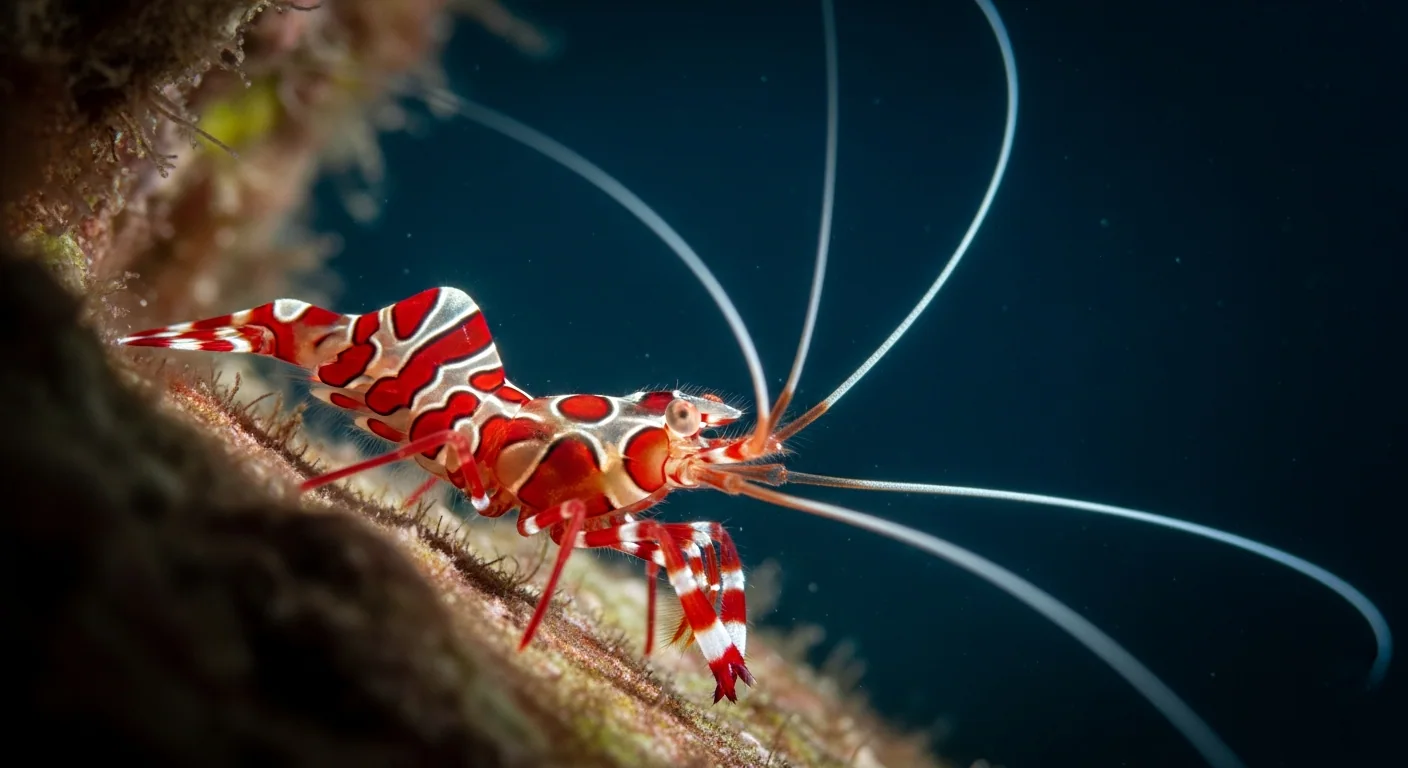
Stenopus hispidus
Banded Coral Shrimp
The most recognisable cleaner shrimp on the Red Sea reef, vivid red-and-white bands, antennae longer than its body, paired for life.
The banded coral shrimp is present on virtually every significant Red Sea reef and is among the most reliably spotted invertebrates on a night dive. It is small, the body rarely exceeds five centimetres, but its long white antennae, which it waves continuously from the entrance to its crevice, can extend two to three times its body length and are visible from several metres away. The red-and-white banding of the carapace is unmistakable.
Stenopus hispidus is a cleaner shrimp. It operates cleaning stations at fixed locations on the reef, typically at the entrance to a crevice or under a ledge, where it removes parasites, dead tissue, and food debris from fish that present themselves for cleaning. The fish cooperate: they adopt characteristic postures, fins spread, gill covers flared, hovering motionless, and allow the shrimp to move across their bodies and into the gill chambers. This service is valuable enough that the shrimp is safe from predation even by fish that would otherwise eat a shrimp its size.
Pairs are monogamous and territorial. A mated male and female share a crevice and defend it jointly. The male is noticeably smaller than the female. When a female is ready to moult, the pair enters a brief window of vulnerability, the female's new exoskeleton is soft for several hours after moulting, and it is during this window that mating occurs. The male stays close and guards the female throughout.
On night dives the antennae glow in torchlight from a distance. Finding a pair in their crevice, watching the male position himself above the female during her moult, is the kind of observation that requires patience but returns it fully.
The cleaning station behaviour is the dominant behavioural feature of this species. A pair will occupy the same crevice for extended periods, months or longer, and fish return repeatedly to the same station. The relationship is not indiscriminate: the shrimp selects which fish to service and can refuse a client by retreating into the crevice. Larger, more aggressive fish are typically serviced more cautiously than smaller reef fish.
The antennae serve multiple purposes. They are sensory organs, capable of detecting chemical signals in the water that indicate nearby predators or potential mates. They are also advertisements: the constant waving signals the presence of the cleaning station to fish moving through the reef. A shrimp that has stopped waving its antennae is typically a shrimp that has detected a threat.
Moulting is a fundamental constraint on the life of any crustacean. The exoskeleton cannot grow, so growth requires periodic shedding and replacement. In the hours after moulting, before the new shell has hardened, the shrimp is entirely vulnerable to predation. The male's guarding behaviour during the female's moult is among the clearest examples of partner investment observed in reef invertebrates.
The banded coral shrimp will, on occasion, clean divers. It will inspect and pick at exposed skin and wetsuits with the same behaviour it applies to fish. The contact is gentle and the sensation, a light tapping and occasional pinch, is harmless.
Banded coral shrimp are completely harmless to divers. They may inspect exposed skin on a night dive, the sensation is gentle and the contact is harmless.
The banded coral shrimp is not under significant conservation pressure. It is common throughout its range, not targeted by any commercial fishery, and not heavily collected for the aquarium trade. Its primary dependency is on reef health: the cleaning station relationship requires a functioning reef community, and degraded reefs with reduced fish populations support fewer cleaning stations.
The species is not a reef builder and does not depend on live coral directly, it will occupy rubble zones and artificial reefs as readily as natural reef. But it depends on the fish community that a healthy reef supports, and any large-scale loss of reef fish populations removes the clients that make its cleaning station viable.
Atlas Position
The banded coral shrimp is one of the animals that rewards divers who slow down. It is easy to swim past an antennae-waving pair in a crevice without registering what you are seeing. Spend two minutes watching a cleaning station and the whole transaction becomes legible: the fish queuing, the posture changes, the shrimp moving with complete confidence over an animal that could swallow it. It is a reminder that the reef is not a collection of static organisms but a network of relationships, operating constantly.
Sign in to share a sighting, behaviour note, or encounter.
No verified sightings yet. Be the first Atlas member to log an encounter.
Keep reading, and open the whole Atlas.
A free account unlocks every dive site guide and map, the marine life library, member reports, and the full incident log. Free to join.
Join free to keep reading