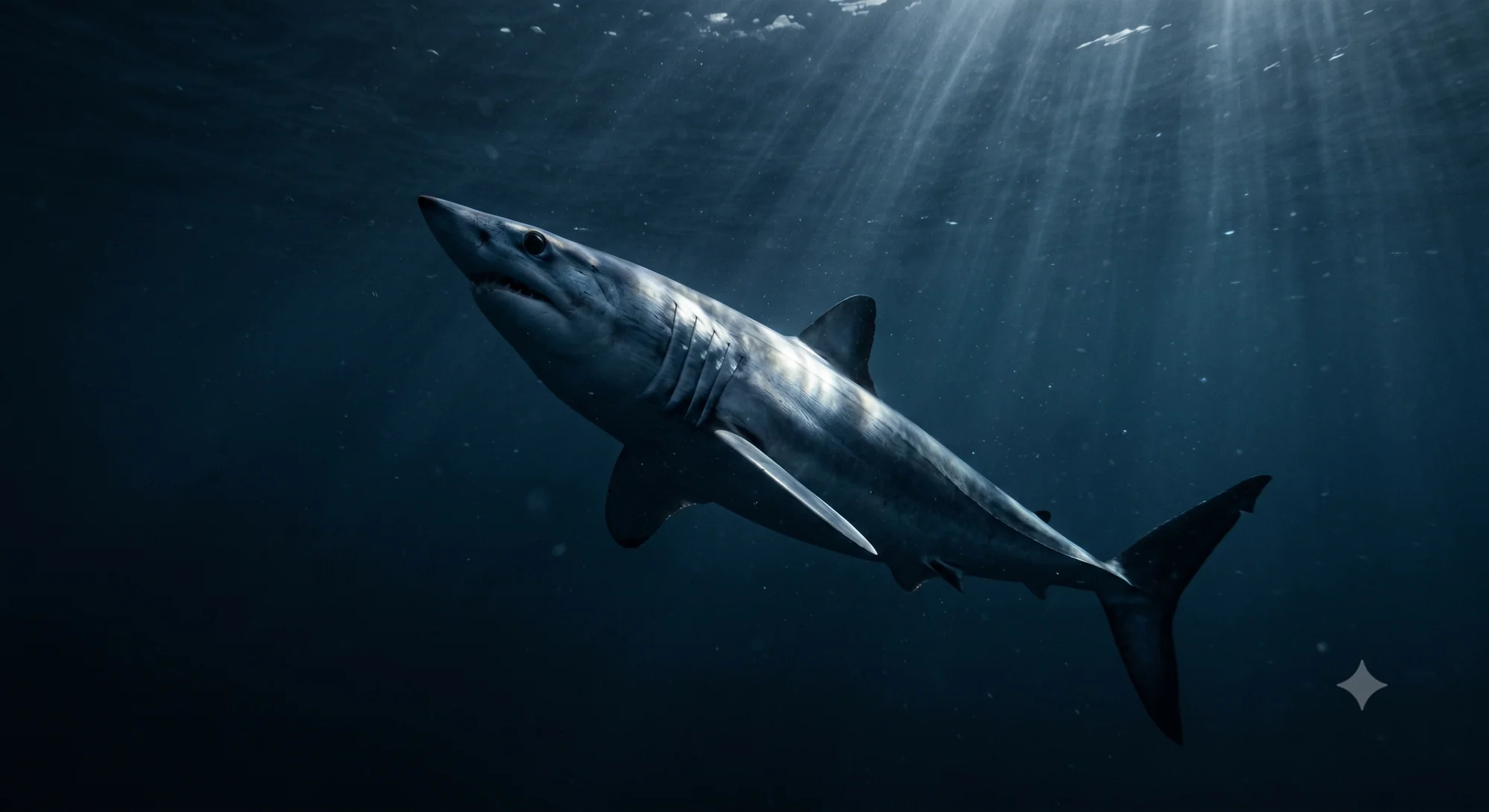
Isurus oxyrinchus
Shortfin Mako
The fastest shark in the ocean is a rare and fleeting presence in Red Sea waters. Encounters are so uncommon that each one carries genuine significance.
The shortfin mako is built for speed. The crescent shaped tail, the hydrodynamic profile, the counter-shaded cobalt and white coloration. Everything about this animal is optimised for sustained, high velocity pursuit in open water. Recorded swimming speeds exceed 70 kilometres per hour in short bursts, and its core body temperature runs warmer than the surrounding water, a trait shared with tuna and swordfish. It is the apex predator of the pelagic zone, and it looks the part.
In the Red Sea, the mako occupies deep offshore waters. It is not a reef shark. It does not patrol dive sites or follow thermoclines into bays. When it appears, it does so in the blue water beyond the reef edge, typically at depth, typically alone. The northern Red Sea and the offshore seamounts of the Egyptian coastline represent the most plausible habitat within this region, though sightings are genuinely rare and difficult to verify with precision.
The global population of shortfin mako has declined sharply over recent decades. Intensive longline fishing pressure, a slow reproductive rate, and high demand for mako fins and meat in Asian markets have combined to push this species to Endangered status on the IUCN Red List. The Red Sea population is part of the broader Indo-Pacific stock, and its status here reflects the same pressures operating across the wider ocean.
Because reliable encounter data from the Red Sea is so limited, we treat mako sightings in these waters with appropriate caution. We do not assign dive sites to this species. If you see one, consider yourself fortunate, and report the sighting through a credible marine research channel.
If you encounter a shortfin mako in the Red Sea, the encounter will almost certainly be brief. This animal does not linger. It may make a single pass at speed and disappear into the blue before you have fully registered what you are looking at. Do not chase it. Do not ascend or descend aggressively. Hold your position and watch. Erratic movement on your part will either spook the animal or, in the unlikely event it is food curious, give it the wrong signal.
Mako sharks have been involved in incidents with humans, primarily in the context of fishing vessels and spearfishing. In a standard diving encounter, the risk is low, but this is not an animal to approach or crowd. Keep your fins still. Avoid strobing lights or flash photography at close range. If the shark makes repeated passes and reduces its circling radius, calmly and slowly move toward the reef structure or your ascent line. Do not surface rapidly. A controlled, unhurried exit is always the correct response.
The most common mako encounter in pelagic conditions involves one or two fast passes at distance. The animal is assessing, not threatening. Stay calm, hold your depth, and avoid sudden movements. These encounters typically end within seconds as the shark loses interest and continues on its course.
If a mako returns and each pass brings it closer, treat this as a genuine caution signal. Do not turn your back. Face the animal at all times. Move slowly toward your boat or reef structure. Makos are fast enough that any attempt to outswim them is futile. Composed, directional movement away from the open blue is your best option.
The shortfin mako is listed as Endangered on the IUCN Red List, a status reached in 2019 following assessment of population data showing declines exceeding 50 percent over three generations across much of its range. The primary driver is longline bycatch. Mako sharks are caught incidentally in tuna and swordfish fisheries across the Atlantic, Pacific, and Indian Oceans. They are also targeted directly for their fins and meat. Their slow maturation, long gestation, and small litter sizes mean populations recover slowly, if at all, under sustained fishing pressure.
In the Red Sea, the mako has no formal species specific protection, though Egyptian marine protected areas offer incidental coverage in some offshore zones. Regional fisheries management in the Red Sea remains inconsistent. CITES Appendix II listings require that international trade in mako products be demonstrably sustainable, but enforcement is uneven. The situation for this species is serious, and the Red Sea population cannot be considered insulated from the broader global decline.
Atlas Position
We list the shortfin mako not because divers will reliably encounter it, but because any honest account of Red Sea shark diversity must include it. Its presence here is real, if rare. Its decline globally is documented and ongoing. We believe platforms like this one have a responsibility to reflect conservation reality accurately, not to present a version of the ocean that is rosier than the data supports. If you dive in the Red Sea and see a mako, that moment carries weight. Treat it accordingly.
Sign in to share a sighting, behaviour note, or encounter.
No verified sightings yet. Be the first Atlas member to log an encounter.
Keep reading, and open the whole Atlas.
A free account unlocks every dive site guide and map, the marine life library, member reports, and the full incident log. Free to join.
Join free to keep reading