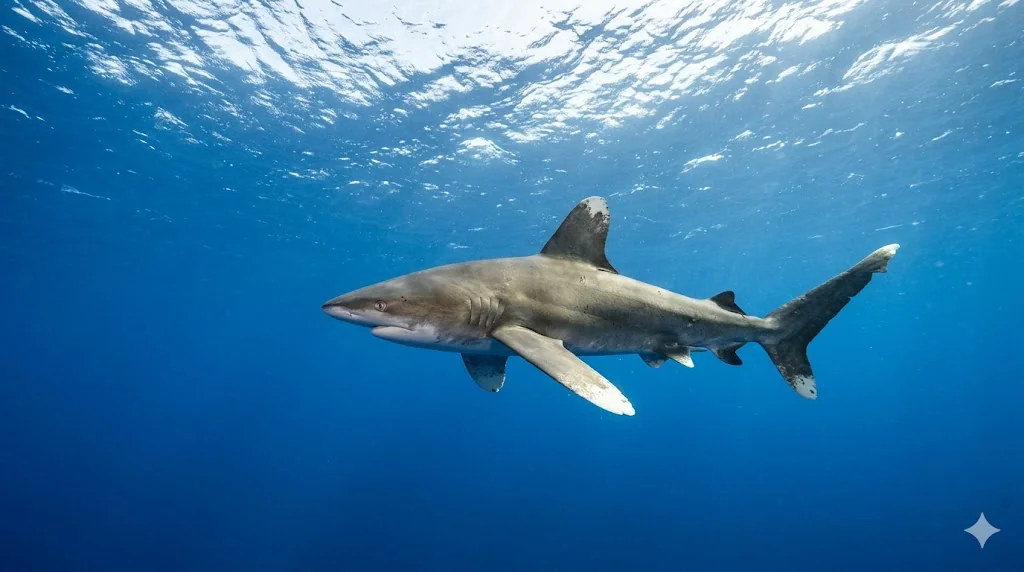
Carcharhinus longimanus
Oceanic Whitetip Shark
Once the most abundant large oceanic shark on earth. The Brothers and Daedalus are among the last places on the planet where encounters are still likely.
The oceanic whitetip was once described by the naturalist Jacques Cousteau as "the most dangerous of all sharks." What he meant was not unpredictability but abundance, these animals were everywhere in the open ocean, curious, confident, and present in numbers that no other large shark could match. That abundance is gone. Global populations have collapsed by an estimated 98 percent since the mid-twentieth century, driven by longline fishing pressure, finning, and bycatch.
The Red Sea is one of the few places in the world where a diver still has a genuine chance of encountering an oceanic whitetip in open water. The Brothers Islands, Daedalus Reef, and Elphinstone Reef, all remote seamounts accessible only by liveaboard, are the primary sites. These are not reef sharks that have learned to tolerate divers at a safe distance. Oceanic whitetips are pelagic animals, apex predators of the open ocean, and they behave accordingly: direct, inquisitive, and occasionally persistent in a way that demands respect rather than alarm.
Encounters at depth are typically relaxed. The shark approaches, circles, assesses, and moves on. Problems arise when divers act unpredictably, sudden movements, dangling equipment, or surfacing without awareness. Every operator working the Brothers or Daedalus should deliver a pre-dive shark briefing. If yours does not, ask for one.
Oceanic whitetips are primarily solitary, pelagic hunters. In the Red Sea they are most reliably encountered mid-water and at the surface, particularly around the structure of offshore seamounts where baitfish concentrate. Unlike reef sharks, they do not retreat when approached, they move toward points of interest with a measured, rolling gait that can be unsettling to divers unfamiliar with the species.
At the Brothers and Daedalus, whitetips are often present from the moment the boat arrives. They investigate the vessel, the anchor chain, and anything that enters the water. During a dive they will make slow passes at mid-water depth, gradually closing the distance. Staying in a tight group and maintaining eye contact, not aggressive, simply steady, is the correct response. A diver who breaks formation and turns away tends to attract more attention, not less.
Night dives at these sites are a different experience. Oceanic whitetips become significantly more active and assertive after dark. Night diving alongside them is not recommended for the inexperienced. Most operators do not offer it.
Oceanic whitetips are inquisitive and can be persistent. Stay in group formation, avoid dangling equipment. Always follow the pre-dive briefing.
These sharks are significantly more active and assertive after dark. Night diving alongside them is not recommended unless you have prior experience with pelagic shark night dives.
Daytime encounters are typically relaxed and predictable. A composed, stationary diver in a group is not at meaningful risk.
The oceanic whitetip's collapse is one of the clearest illustrations of industrial fishing pressure on the open ocean. The species is highly susceptible to longline fishing, it takes bait readily and fights long enough to survive the hook, which made it a bycatch staple for decades before fin prices made it a direct target.
CITES Appendix II listing in 2013 regulated international trade. Egypt prohibits finning and targeted take. But oceanic whitetips are open-ocean animals: they do not respect borders, and the legal protection that applies inside Egyptian territorial waters does not follow them across international waters or into the jurisdiction of neighbouring states.
In the Red Sea the situation is more positive than the global picture. The Brothers, Daedalus and Elphinstone support resident populations that appear stable on annual observation, though no rigorous long-term population study exists for the Egyptian Red Sea specifically. The depth and remoteness of these sites provides some natural protection, the fishing pressure that has devastated oceanic whitetip populations in more accessible seas has not fully penetrated here.
Atlas Position
The oceanic whitetip is, for this site, an argument for liveaboard access done correctly. The remoteness that protects these animals is the same remoteness that makes responsible dive tourism valuable. Operators who run Brothers and Daedalus itineraries are, in a real sense, stewarding the last viable populations of this species in the northern Red Sea. That comes with responsibilities, in briefing standards, group management, and refusal to allow the kind of feeding or bait use that would alter natural behaviour. The Red Sea Atlas supports no operator that conducts baited shark dives.
Sign in to share a sighting, behaviour note, or encounter.
No verified sightings yet. Be the first Atlas member to log an encounter.
Keep reading, and open the whole Atlas.
A free account unlocks every dive site guide and map, the marine life library, member reports, and the full incident log. Free to join.
Join free to keep reading