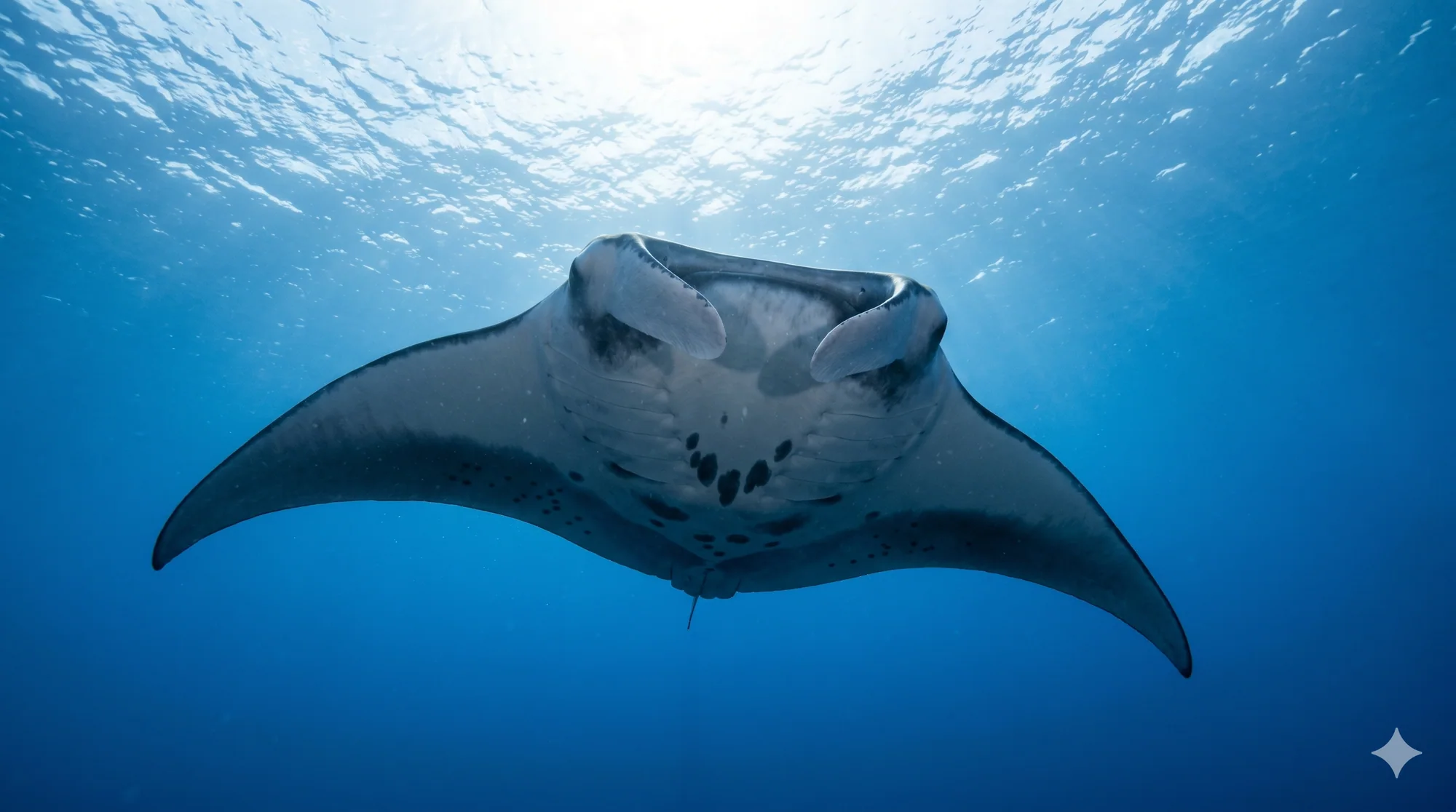
Mobula alfredi
Reef Manta Ray
The largest rays in the Red Sea. Cleaning stations at Fury Shoals bring them in reliably, a slow, elegant encounter unlike almost anything else underwater.
The reef manta is large enough to be felt before it is seen, a change in the water, a shadow at the edge of vision, and then the full form gliding through. Wingspans of three to five metres are standard; the largest animals in the Red Sea reach 5.5 metres across. They move with the kind of unhurried ease that makes everything else in the water look effortful by comparison.
Fury Shoals, specifically the cleaning stations at Sha'ab Maksour and the surrounding reefs, is the most consistent manta site in the Egyptian Red Sea. These cleaning stations attract mantas year-round, though the peak period runs from March through October when warm water and plankton concentrations are highest. Divers position themselves near the station and wait; the manta completes its cleaning circuit before moving on to feed.
At Daedalus and Elphinstone, mantas appear mid-water rather than at cleaning stations, slow circuits in blue water, filtering plankton. These encounters are less predictable but often more dramatic: an animal the size of a dining table banking silently through the water column with nothing but blue around it.
Mantas at cleaning stations follow a predictable circuit. They enter the station area, typically a coral head or reef feature with resident cleaner wrasse, slow to near-stationary, spread their cephalic fins wide to give the cleaners full access, and hover. The circuit might last three minutes or twenty. When cleaning is complete, the manta banks away.
Divers approach cleaning stations from below and stay low, avoiding the manta's eye-line where possible. A manta disturbed mid-circuit, by a diver surfacing through its path, or by flash photography at close range, will abort the circuit and move on. A composed group positioned below the station and breathing slowly can watch the process in full.
Away from cleaning stations, mantas filter-feed at the surface and at mid-water depth in areas of plankton concentration. These encounters are opportunistic, current lines and temperature breaks concentrate plankton, and mantas follow. Live-aboards that cover Fury Shoals territory and monitor surface conditions can position divers in the path of feeding animals.
Reef mantas are targeted for their gill plates, which are sold in Asian traditional medicine markets despite no evidence of efficacy. A single animal's gill plates can sell for hundreds of dollars, a sum that exceeds what many small-scale fishermen earn in a month. Mantas are exceptionally vulnerable to targeted harvest: they reproduce slowly (one pup every two to five years), live long enough to be tracked as individuals, and aggregate predictably at cleaning stations.
The Red Sea manta population has no dedicated monitoring programme. Citizen science records, photographs shared by divers that allow individual ID through spot patterns, represent the primary data source for population tracking in the region.
Atlas Position
Fury Shoals is one of the most underrated liveaboard destinations in the Red Sea, and the manta cleaning stations at Sha'ab Maksour are a significant part of why. The Red Sea Atlas considers Fury Shoals an essential inclusion on any serious Red Sea itinerary, the combination of manta encounters, spinner dolphins, and the quality of the hard coral remains exceptional. Development pressure at Marsa Alam is growing; the reefs that currently protect these animals will not remain protected without active management.
Sign in to share a sighting, behaviour note, or encounter.
No verified sightings yet. Be the first Atlas member to log an encounter.
Keep reading, and open the whole Atlas.
A free account unlocks every dive site guide and map, the marine life library, member reports, and the full incident log. Free to join.
Join free to keep reading