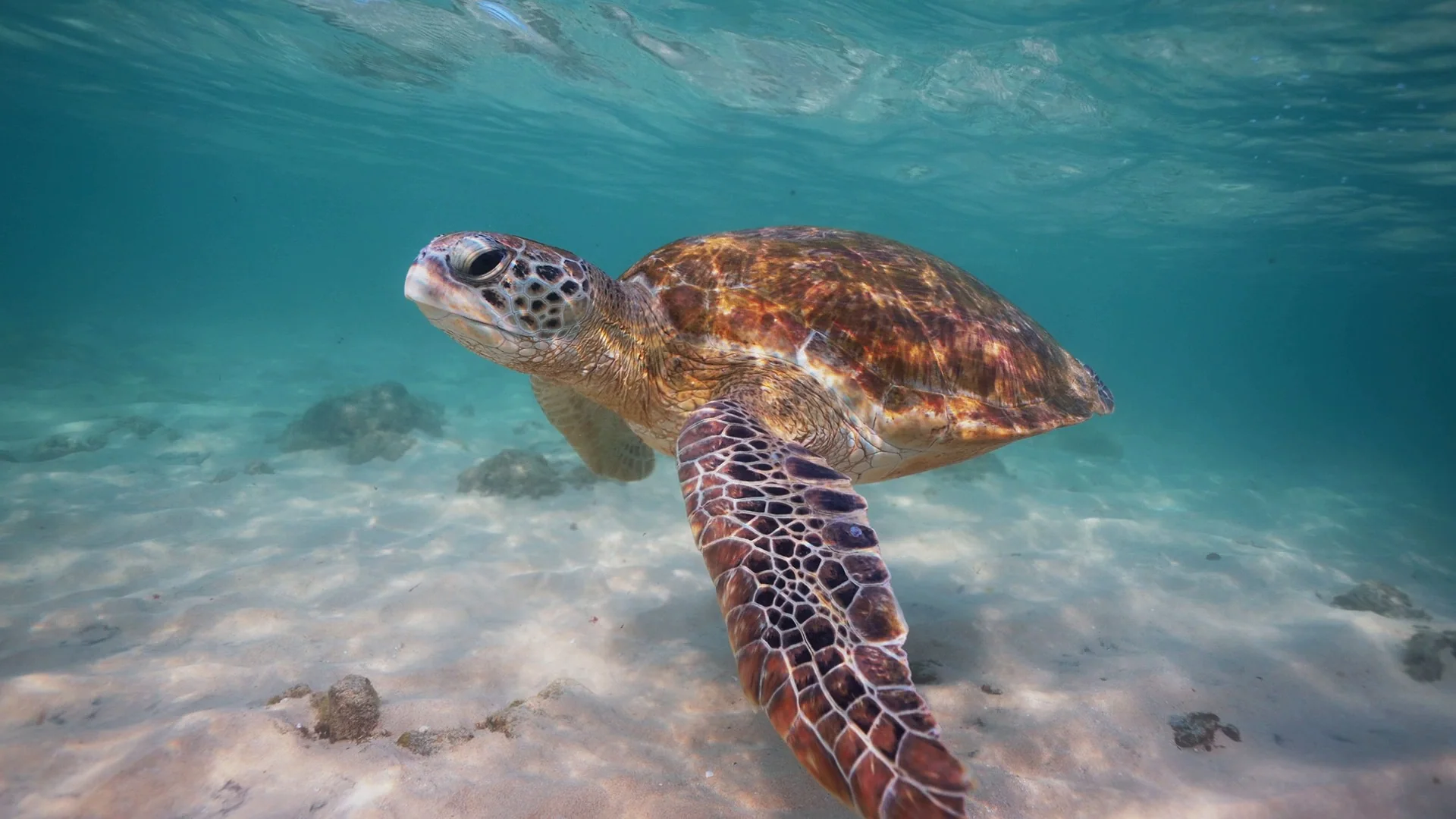
Chelonia mydas
Green Turtle
Widespread across the Red Sea. Nesting on remote southern beaches, feeding on seagrass from Abu Dabbab to Wadi El Gemal, and seen on almost every reef in between.
The green turtle is the most frequently encountered sea turtle in the Red Sea. It is present across the full range of the Egyptian coast, from the Gulf of Aqaba to the deep south, and on most significant reef systems. A diver who makes twenty dives across different sites and does not see a green turtle is either diving in unusual conditions or not looking.
They are large animals in adulthood, 150 to 190 kilograms for a mature female, and surprisingly graceful underwater. The shell is smooth, the flippers powerful, and a cruising turtle at depth moves with minimal apparent effort. On seagrass beds they are almost meditative, head down, cropping the grass with a beak adapted for the purpose, surfacing every few minutes to breathe, then returning to feed.
The name "green" refers not to the shell colour, which ranges from brown to olive to black, but to the colour of the fat stored beneath the skin, a product of the animal's largely herbivorous diet. Juvenile turtles are more carnivorous; adults transition to a seagrass and algae diet that produces the distinctive green fat.
Nesting beaches in the deep south of Egypt, Wadi El Gemal, Zabargad, and the remote shores near Ras Banas, host green turtle nesting populations. Females return to the beach where they hatched to lay their own eggs, a fidelity that makes nesting populations highly vulnerable to any disturbance of specific beaches.
Green turtles on seagrass beds are methodical feeders. They crop the grass close to the substrate using a serrated beak, leaving closely grazed patches, "turtle lawns", where they return repeatedly. This grazing is not destructive; moderate seagrass grazing maintains meadow productivity in the same way that controlled land grazing maintains grassland health. Overgrazing, typically where turtles are concentrated in a small area, can degrade meadows, but at natural stocking densities the relationship is balanced.
Resting turtles are found tucked into coral overhangs and under ledges, using thermal mass of the reef to rest comfortably. A diver who swims directly over or directly toward a resting turtle risks startling it; approach from the side at the same depth for a calm encounter.
Female green turtles navigate thousands of kilometres between feeding grounds and nesting beaches, returning to the same beach across multiple nesting seasons. Tag recovery data from Red Sea nesting beaches links animals to feeding sites as far as the Indian Ocean.
Green turtles face layered threats across their range: egg collection on nesting beaches, entanglement in fishing gear (particularly ghost nets), boat strike in shipping channels, plastic ingestion, and habitat loss through seagrass degradation and beach development. The Red Sea nesting populations are not formally counted annually; the best data comes from satellite tagging programmes run by research institutions operating from the Wadi El Gemal area.
In Egypt, sea turtles are legally protected. Enforcement varies. The greatest practical protection for nesting beaches in the deep south comes from their remoteness, the majority of Red Sea nesting sites are far from permanent settlement or high-traffic tourist areas.
Atlas Position
Green turtles are one of the Red Sea's most accessible large marine animals, present on reefs from Sharm to the deep south, tolerant of careful divers, and visible to snorkellers on sites as accessible as Abu Dabbab and Ras Mohamed. Their accessibility should not translate to casualness. Every boat strike, every entanglement in discarded gear, every disturbed nesting beach removes an animal from a population that cannot afford the loss.
Sign in to share a sighting, behaviour note, or encounter.
No verified sightings yet. Be the first Atlas member to log an encounter.
Keep reading, and open the whole Atlas.
A free account unlocks every dive site guide and map, the marine life library, member reports, and the full incident log. Free to join.
Join free to keep reading