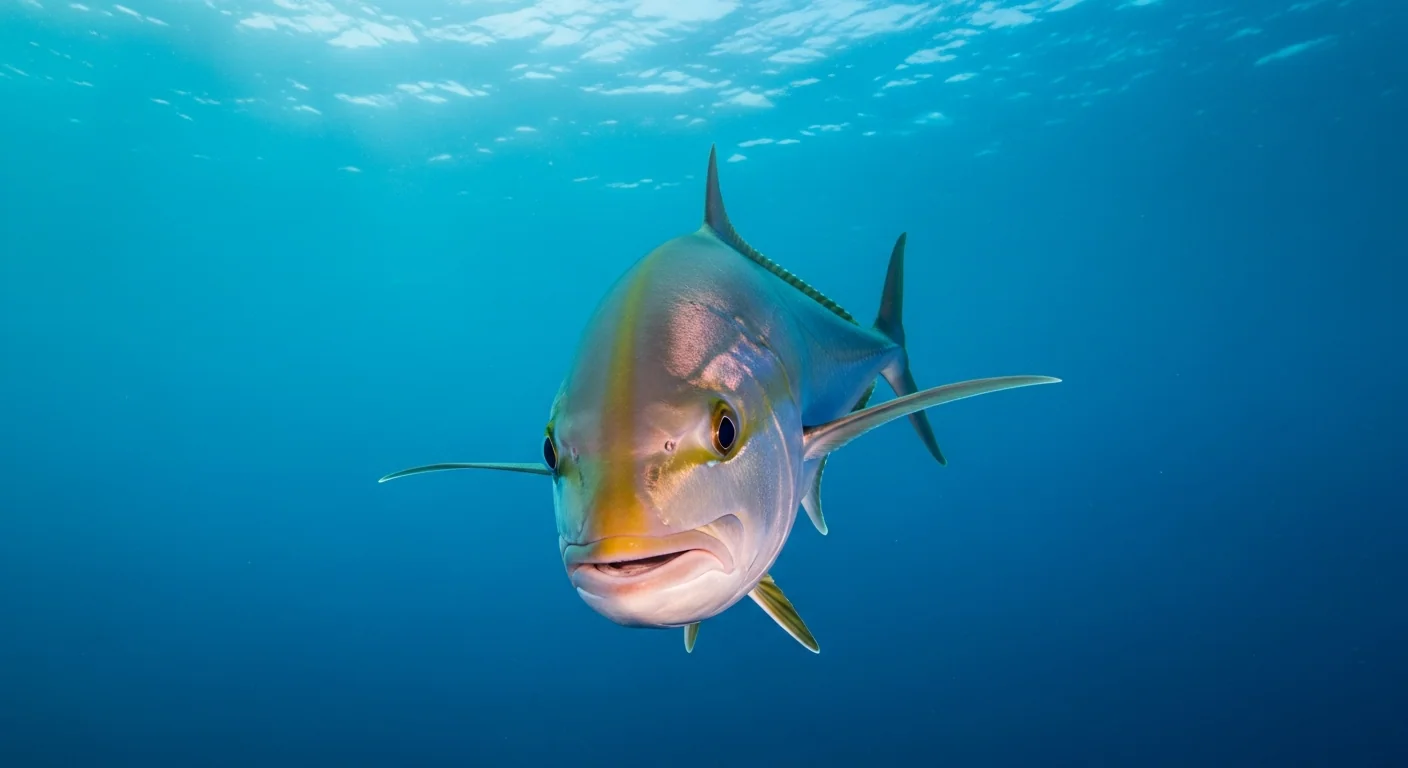
Seriola dumerili
Greater Amberjack
The largest of the jacks, a powerful, fast-running pelagic predator of offshore structure. One of the strongest fish for its size in the Red Sea.
The greater amberjack is the largest member of the family Carangidae present in the Red Sea, a family that already contains some of the most powerful and fast-moving fish in the ocean. Adult specimens reach two metres in length and 80 kilograms, though most fish encountered in the Red Sea run between 60 and 100 centimetres. The species is distinguished by an amber or pale gold stripe running from the eye to the tail, most vivid in fresh fish and most clearly visible underwater in the transition zone between the darker back and paler flanks.
Known to Egyptian fishermen as the Ansh (الانش), the species is well-recognised on the Red Sea coast, particularly among offshore anglers targeting structure. The name is used consistently across the northern Egyptian coast.
The amberjack is an offshore and pelagic species, associated with underwater structure: seamounts, reef walls, shipwrecks, offshore buoys, and any hard substrate that creates current shadow and attracts baitfish. In the Red Sea it is most reliably encountered during spring, the peak period runs from approximately April through June, when fish move through the northern sections of the sea. Encounters at sites like the Brothers Islands, Daedalus Reef, and offshore pinnacles near Hurghada and Safaga are documented annually during this window.
For anglers, the amberjack is one of the most demanding fish available in the Red Sea. It is fast, powerful, and dives toward structure when hooked, a direct consequence of the instinct that makes it a predator of reef structure. The first run is the test: a large amberjack on light tackle will reach a reef corner and cut the line before most anglers can respond.
Greater amberjack are highly mobile and associate loosely with structure rather than being territorial at it. They patrol a wide area, using structure as a reference point and hunting zone rather than a fixed residence. Schools of juveniles are more common than aggregations of adults; large adults are typically encountered in small groups of two to six fish or alone.
The hunting technique involves cooperative behaviour in some contexts. Groups of amberjack have been observed corralling schools of baitfish against the surface or a reef wall, taking turns making passes through the school. The amber stripe is thought to function as a herding signal, moving fish in the same school can track each other's position by the stripe, maintaining formation during coordinated attacks.
The dive-for-structure response when hooked is hardwired. The fish perceives the tension of the line as a threat from above, and the instinctive response is to dive toward the nearest structure below. On open-water encounters this can be managed; on reef wall encounters the fish will attempt to reach the wall and cut the line against coral. Experienced anglers apply side pressure to redirect the run, but the window to do so is short.
Amberjack are known to respond to live bait very aggressively. In the Red Sea, live sardines or small carangids presented near the reef edge during the spring peak produce fast takes. The fish will often follow a lure to the boat and can be teased into striking multiple times.
Greater amberjack are assessed as Near Threatened globally, with the primary pressure being commercial and recreational fishing. In the Mediterranean and Atlantic, targeted longline fisheries and recreational spearfishing have significantly reduced populations of large adults. The Red Sea population is not separately assessed but is subject to targeted fishing at accessible offshore sites.
The species' offshore habitat provides some protection compared to reef residents: areas of the Red Sea that are remote enough to be inaccessible to day-trip fishing boats support healthier populations of large adults. The liveaboard diving circuit and offshore sportfishing fleet access the same remote sites, however, and the interaction between diving tourism and spearfishing pressure at sites like the Brothers is a management concern.
Atlas Position
The greater amberjack is a fish that demands honest tackle and honest fishing. It is not an animal to pursue on light gear at reef edges where the outcome will be a lost fish and a broken reef. The Atlas's position on amberjack fishing specifically mirrors its general approach to Red Sea fishing: fish the offshore structure, use appropriate tackle, and if you are not able to land the fish cleanly, do not target it. Released fish that have been fought to exhaustion on the reef crest do not always survive.
Sign in to share a sighting, behaviour note, or encounter.
No verified sightings yet. Be the first Atlas member to log an encounter.
Keep reading, and open the whole Atlas.
A free account unlocks every dive site guide and map, the marine life library, member reports, and the full incident log. Free to join.
Join free to keep reading