Aetobatus narinari
Spotted Eagle Ray
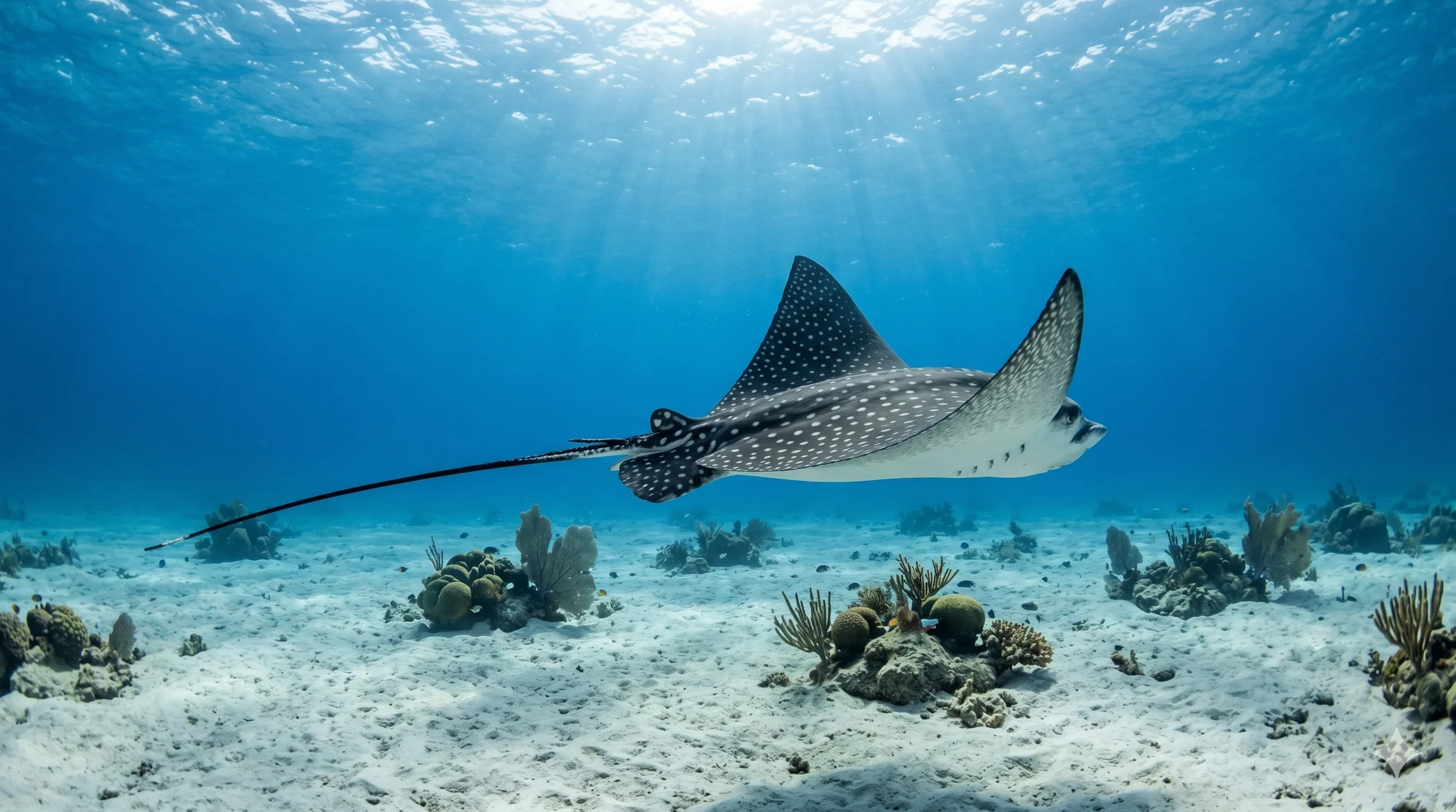
White spots on a dark back, long whip tail, broad wingspan. Often encountered in small groups cruising sandy flats, one of the most visually distinctive animals in the Red Sea.
The spotted eagle ray is one of the easiest rays to identify underwater: a dark blue-black back covered in white or cream spots and rings, a distinctive duck-billed snout, and a tail several times the length of the body disc. They cruise with a slow, rowing motion, the pectoral fins beating rather than undulating, and project an unhurried self-assurance that is characteristic of animals near the top of their local food web.
In the Red Sea they are encountered across a broad range of sites: sandy flats, reef edges, open lagoons. Ras Mohamed and the Straits of Tiran are reliable spots, as are the sandy corridors between reef structures throughout the Fury Shoals region. They are not particularly shy and will often continue on their original course even when a diver is nearby, though they tend to alter depth slightly when approached directly.
Groups of three to twenty are common, these are social animals, not fully solitary, and a small squadron of eagle rays moving across a sandy flat in formation is one of those images that stays with a diver long after the trip.
Eagle rays feed by excavating sand and rubble, the rounded snout acts as a shovel, disturbing substrate to expose molluscs and crustaceans. A feeding eagle ray produces a small cloud of sand particles and can be heard working the bottom with a rhythmic pressing motion. They will move along a reef base or sandy flat methodically, occasionally surfacing to cruise before descending again to feed.
Social groups are not permanent schools, individual animals move between groups. The aggregations seen at Ras Mohamed and Tiran are likely loose associations of animals that share territory rather than tight social units. Courtship behaviour has been observed at Ras Mohamed in late spring, with males following females closely and attempting to position underneath for mating.
Spotted eagle rays face pressure from targeted fishing, bycatch, and habitat loss through the degradation of coastal reef and sandy flat environments that they depend on for feeding. Their venomous tail spines have historically led to incidental killing by fishermen, and their size makes them a significant bycatch problem in both artisanal and commercial nets.
Atlas Position
Eagle ray encounters are one of the Red Sea's more reliable pleasures, common enough to occur on most liveaboard trips, distinctive enough to remain memorable. The populations at Ras Mohamed appear healthy on observation, though no formal assessment exists. The Red Sea Atlas notes that the Sandy Bottom at Ras Mohamed, the shallow, sandy expanse behind Shark Reef, is particularly reliable for groups of three to ten animals.
Sign in to share a sighting, behaviour note, or encounter.
No verified sightings yet. Be the first Atlas member to log an encounter.
Keep reading, and open the whole Atlas.
A free account unlocks every dive site guide and map, the marine life library, member reports, and the full incident log. Free to join.
Join free to keep reading