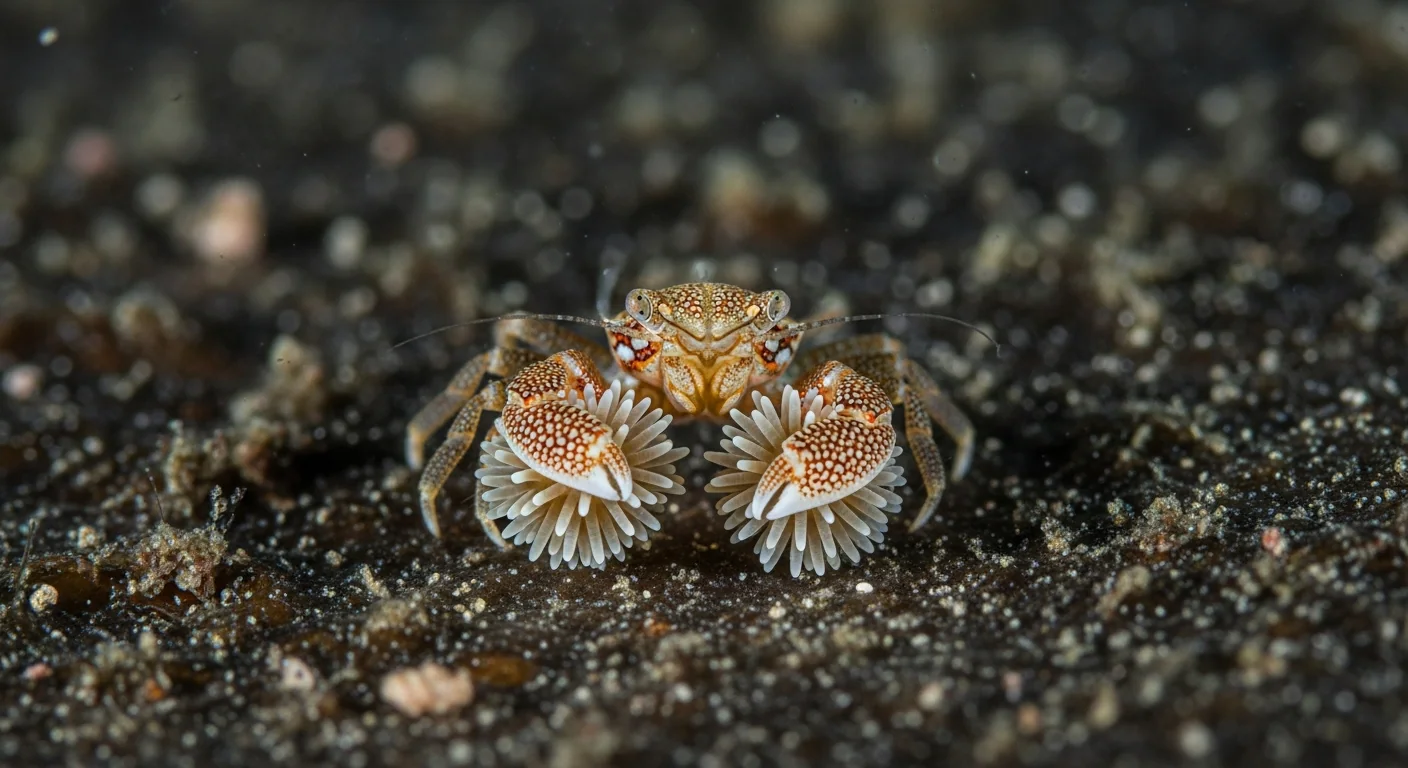
Lybia tesselata
Boxer Crab
A crab the size of a thumbnail that carries a live sea anemone in each claw and uses them simultaneously as weapons, feeding tools, and a cleaning service.
The boxer crab is one of the most extraordinary examples of tool use in the invertebrate world. Lybia tesselata, rarely exceeding two centimetres in carapace width, carries a small pom-pom sea anemone in each of its two claws at all times, waving them toward threats when disturbed in a movement that precisely resembles a boxer raising his guard. The common name follows from this behaviour, and, unlike most common names in natural history, it is entirely appropriate.
The anemones carried by boxer crabs are typically Triactis producta, a small species with potent stinging cells. The crab uses them defensively: when a potential predator approaches, the crab raises both claws and presents the anemone tentacles, which sting on contact. This deters most predators substantially larger than the crab itself. The relationship is a form of weaponised mutualism, the crab gains protection, the anemone gains mobility and access to food particles stirred up by the crab's movement.
What makes the relationship particularly remarkable is that the crabs appear to propagate the anemones themselves. Studies have shown that boxer crabs carrying a single anemone will physically tear it in two, ending up with two half-anemones that regenerate into full individuals over several days. This is functionally clonal reproduction of the anemone, controlled by the crab. No other animal has been documented manipulating another organism's reproduction for its own benefit in this way.
Finding a boxer crab requires patience and close attention. They inhabit rubble zones and the spaces beneath and within coral structure at depths of five to thirty metres. A macro lens or close-focus capability is essential for any photographic attempt, the animal is simply too small for a standard wide-angle frame.
The defensive display is triggered by any close approach or contact. The crab raises both claws and extends them toward the threat, presenting the anemone tentacles. The movement is rapid and deliberate, not random. The anemone tentacles sting on contact and are effective against the small fish and other crabs that represent the boxer crab's primary predation risk.
Feeding involves the same two claws. The crab sweeps the anemone tentacles across the substrate and food particles that stick to the tentacles are transferred to the crab's mouth. The anemone benefits from the increased foraging range and from the fragments of food that the crab drops or ignores. The relationship is therefore mutualistic in feeding as well as defence.
If a crab loses one of its anemones, to a predator strike or accidental separation, it will immediately seek out a replacement. In laboratory conditions, crabs presented with a single anemone will tear it in half rather than carry one. The compulsion to carry two appears to be hard-wired. When crabs are given access to each other's anemones, they will attempt to steal them, leading to contests that end when one crab retreats. In some observed cases, the victor ends up with two anemones in one claw while the loser retains one, both animals then work toward the two-clawed equilibrium.
Boxer crabs are entirely harmless to divers. The anemone sting has no effect on human skin at the scale of this animal. Do not handle, they are fragile and the anemone relationship is easily disrupted.
Boxer crabs are not commercially exploited. They are occasionally collected for the marine aquarium trade, but their extreme small size and specialist care requirements limit demand. The primary pressure on the species is habitat: rubble and structured reef complexity is required, and heavily degraded reefs with reduced structural diversity support lower boxer crab densities.
The anemone partner species Triactis producta is equally small and similarly unprotected by any targeted conservation measure. Both species depend on functioning reef ecosystems.
Atlas Position
The boxer crab is among the animals most likely to be missed entirely and most rewarding when found. At two centimetres it is invisible at normal diving speeds. Slowing down, hovering over rubble zones, and looking carefully at the substrate with a torch on a daytime dive or at night when the animals are more active, this is the only way to find them. When you do, the behaviour is immediately legible: the raised pom-poms, the waving display, the scale of it all. A crab you could cover with a coin, negotiating the reef with two live weapons.
Sign in to share a sighting, behaviour note, or encounter.
No verified sightings yet. Be the first Atlas member to log an encounter.
Keep reading, and open the whole Atlas.
A free account unlocks every dive site guide and map, the marine life library, member reports, and the full incident log. Free to join.
Join free to keep reading