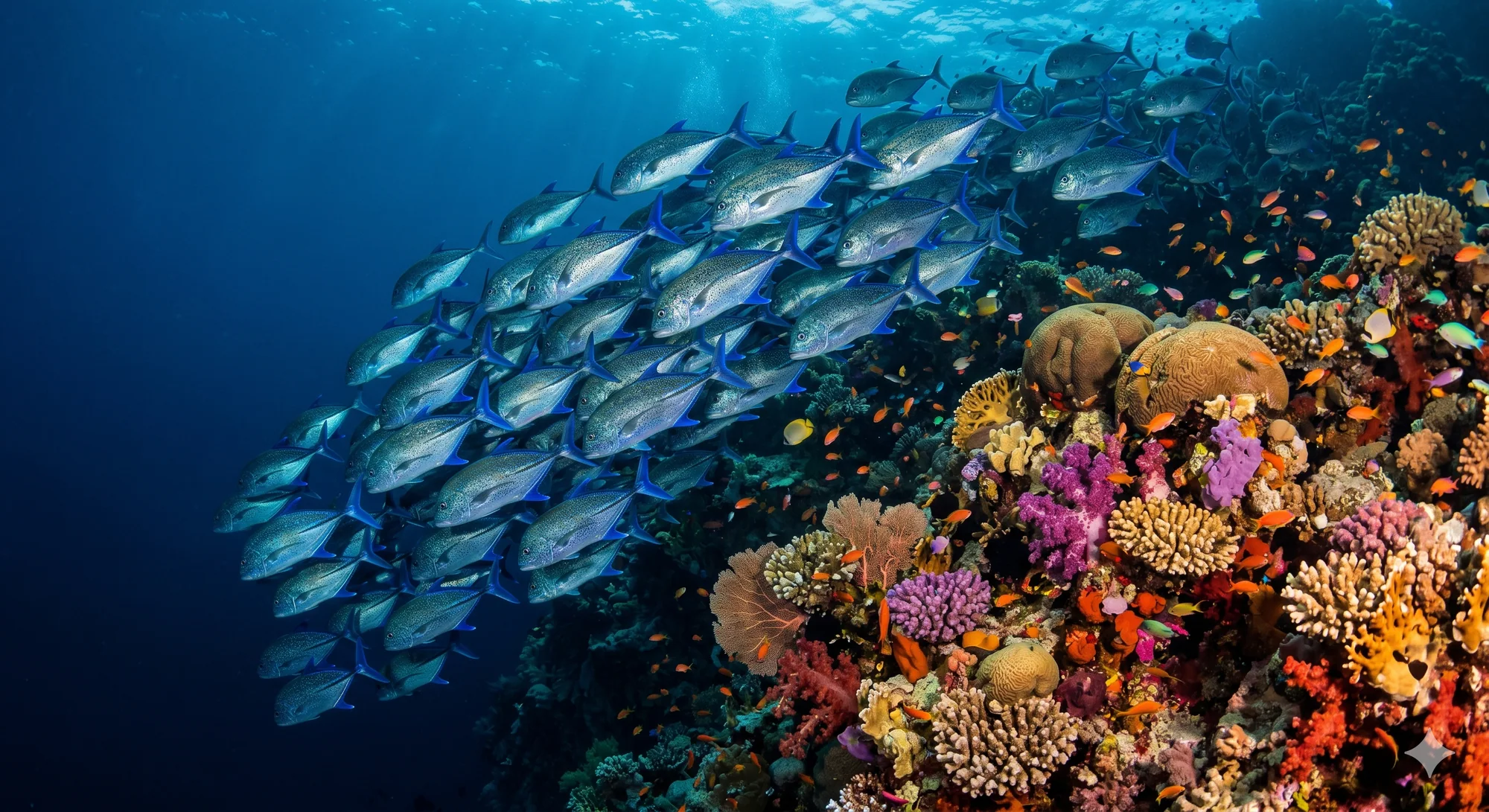
Caranx melampygus
Bluefin Trevally
Electric blue fins, blue-spotted body, schools that light up the reef wall at speed. The most visually striking trevally in the Red Sea.
The bluefin trevally is, visually, the most striking member of the trevally family in the Red Sea. The second dorsal fin, anal fin, and tail are a vivid, electric blue, intense enough to be visible at depth and to identify the species immediately. The body is silver-gold with scattered blue spots that increase in density with age. Large adults have a distinctly blue-tinted body overall.
Smaller than the giant trevally, adults run to about 90 centimetres and 15 kilograms, the bluefin trevally compensates with speed and aggression out of proportion to its size. Schools of bluefin are highly coordinated hunters: they work in formation along reef edges, driving baitfish against the reef wall and attacking simultaneously. The hunting behaviour is fast and kinetic, brief, explosive feeding windows that the school moves through before relocating to the next concentration.
Bluefin trevally are among the most commonly seen trevally species at dive sites throughout the Red Sea. Schools patrol the outer reef at consistent depths during the day, dispersing to hunt at dawn and dusk. They are highly responsive to fast-moving lures and can be extremely aggressive to surface presentations when in hunting mode.
Bluefin trevally schools hunt in a highly organised formation. The school moves as a unit, with fish taking turns at the leading edge to drive prey, then cycling to the rear. The formation tightens as the school closes in on a prey concentration and explodes outward at the moment of attack, a strategy that maximises confusion in the bait school while minimising competition between individuals.
This schooling behaviour makes them accessible in a way that solitary predators like dogtooth tuna are not. Once a school is located, identified by the flash of blue fins at depth or the surface disturbance of a feeding event, it will hold in the area, making repeated passes, for extended periods.
Individual large bluefin are found alone on reef structure in the same way that giant trevally are, single large fish holding on specific coral heads or channel edges. These solitary fish are typically the largest individuals and fight with a deliberateness that smaller school fish do not.
Bluefin trevally are classified Least Concern and appear stable across the Indo-Pacific. They are less commercially targeted than giant trevally due to their smaller size. The species benefits from its widespread distribution and its presence at sites protected by dive tourism, the commercial value of seeing intact schools of bluefin trevally on a dive site provides a tangible economic argument for reef protection.
Atlas Position
The bluefin trevally is the entry point to trevally fishing in the Red Sea, more accessible than the GT, reliably present, and with schooling behaviour that makes it catchable on lighter tackle. For a fisherman encountering the outer reef system for the first time, bluefin trevally on a fast-retrieved metal jig is one of the most immediate and satisfying experiences the Red Sea offers.
Sign in to share a sighting, behaviour note, or encounter.
No verified sightings yet. Be the first Atlas member to log an encounter.
Keep reading, and open the whole Atlas.
A free account unlocks every dive site guide and map, the marine life library, member reports, and the full incident log. Free to join.
Join free to keep reading