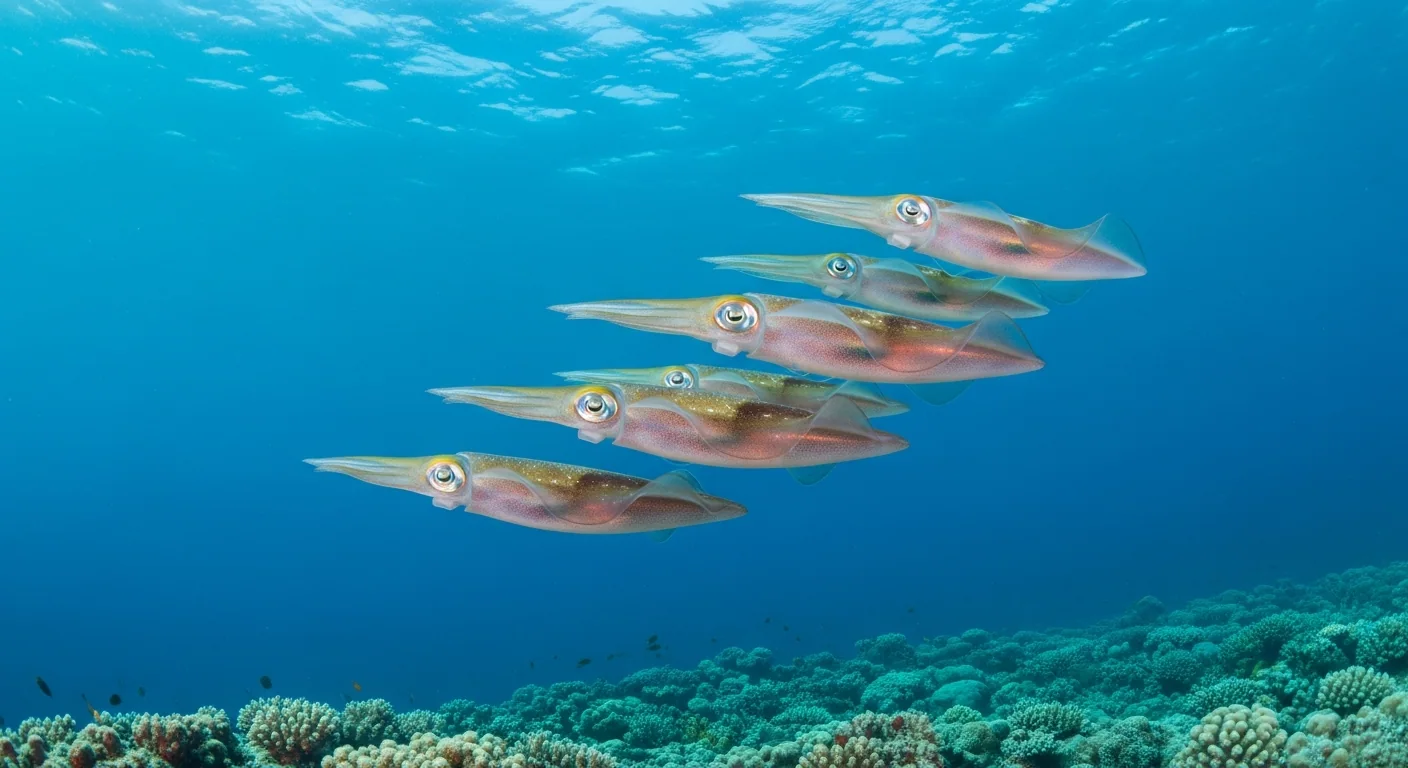
Sepioteuthis lessoniana
Bigfin Reef Squid
The most commonly encountered squid on Red Sea reefs, hunts in coordinated groups, communicates through light and colour, and can display two completely different patterns simultaneously on opposite sides of its body.
The bigfin reef squid is the squid most reliably seen by divers in the Red Sea. Small groups, typically five to fifteen individuals, hover in open water above the reef or at the reef edge, often at a consistent depth of five to fifteen metres, and are identifiable at distance by their distinctive profile: a torpedo-shaped mantle with large, distinctive fins running its entire length from the mantle edge to the tip. These fins undulate continuously in a wave-like motion that provides fine-speed manoeuvrability.
Sepioteuthis lessoniana is a member of the family Loliginidae, the reef squids, and occupies an ecological niche distinct from the open-ocean squid species that feature in commercial fisheries. It is primarily a reef predator, hunting small fish and crustaceans in coordinated group attacks in which individuals drive prey toward each other. It is also prey: barracuda, trevally and larger reef fish hunt squids actively, and the squid's survival depends on the group's collective vigilance.
The colour communication system is one of the most sophisticated in the animal kingdom. Squid skin contains three layers of specialised cells: chromatophores (pigment cells with muscular expansion), iridophores (structural colour cells producing iridescence), and photophores in some species. The squid controls each chromatophore individually via direct neural connection, producing patterns that can change in milliseconds. A squid can display a full male courtship pattern on the side of its body facing a female, while simultaneously displaying a female-mimicking pattern on the side facing a rival male, a documented deceptive signalling strategy.
Encounters are most common in the late afternoon and around dusk, when squid groups move over the reef to hunt.
Group hunting behaviour is well documented in this species. When a group detects prey, typically a school of small fish, the squid spread into a loose formation and accelerate simultaneously. Individual squid extend two longer tentacles to grasp prey while the eight shorter arms hold it in place. The strike is rapid and precise. Groups will make multiple hunting passes over a reef section before moving on.
The deceptive dual-display behaviour has been documented in the wild. Males competing for females have been filmed displaying male courtship colouration (bright, high-contrast patterns) on the side facing a female while displaying the mottled brown colouration of a female on the side facing a rival male. The rival male, seeing what appears to be a female rather than a competitor, does not escalate into conflict. This requires the squid to simultaneously produce two different patterns in the same skin, something no other documented animal does.
Squids are short-lived. The bigfin reef squid completes its entire life cycle in a matter of months: hatch, grow, reproduce, die. The eggs are laid in white gelatinous clusters on the reef or on structured substrate, and newly hatched squid are miniature adults capable of independent feeding immediately. This short lifespan and rapid reproductive cycle makes the species robust to fishing pressure in a way that long-lived fish are not.
The group maintains cohesion through visual signalling. When a threat is detected, a rapid colour change propagates through the group in a ripple pattern, coordinating the evasion response faster than any individual could process the threat independently.
Bigfin reef squid are targeted by artisanal fisheries throughout the Indo-Pacific, including on the Red Sea coast. They are caught at night using lights, squid are attracted to bright lights at the surface, which concentrates them for jigging or net capture. The short lifespan and high reproductive rate of the species makes it relatively resilient to fishing pressure compared to long-lived fish, but localised overexploitation can reduce group sizes significantly.
As with all reef cephalopods, the primary long-term pressure is reef health. A degraded reef with reduced fish diversity provides less prey and less structural cover for the eggs, reducing reproductive success. Squid populations around heavily degraded reef systems are consistently smaller than those around healthy reef.
Atlas Position
A group of bigfin reef squid hovering at the reef edge at dusk, skin pulsing, eyes tracking, is one of those encounters that does not make it into dive briefings but should. They are not rare, but they require presence of mind to appreciate: most divers are looking at the reef below and miss the animals hovering in open water at eye level. Slow down, look out into the blue, and watch the communication happening across the group. The colour patterns are not random.
Sign in to share a sighting, behaviour note, or encounter.
No verified sightings yet. Be the first Atlas member to log an encounter.
Keep reading, and open the whole Atlas.
A free account unlocks every dive site guide and map, the marine life library, member reports, and the full incident log. Free to join.
Join free to keep reading