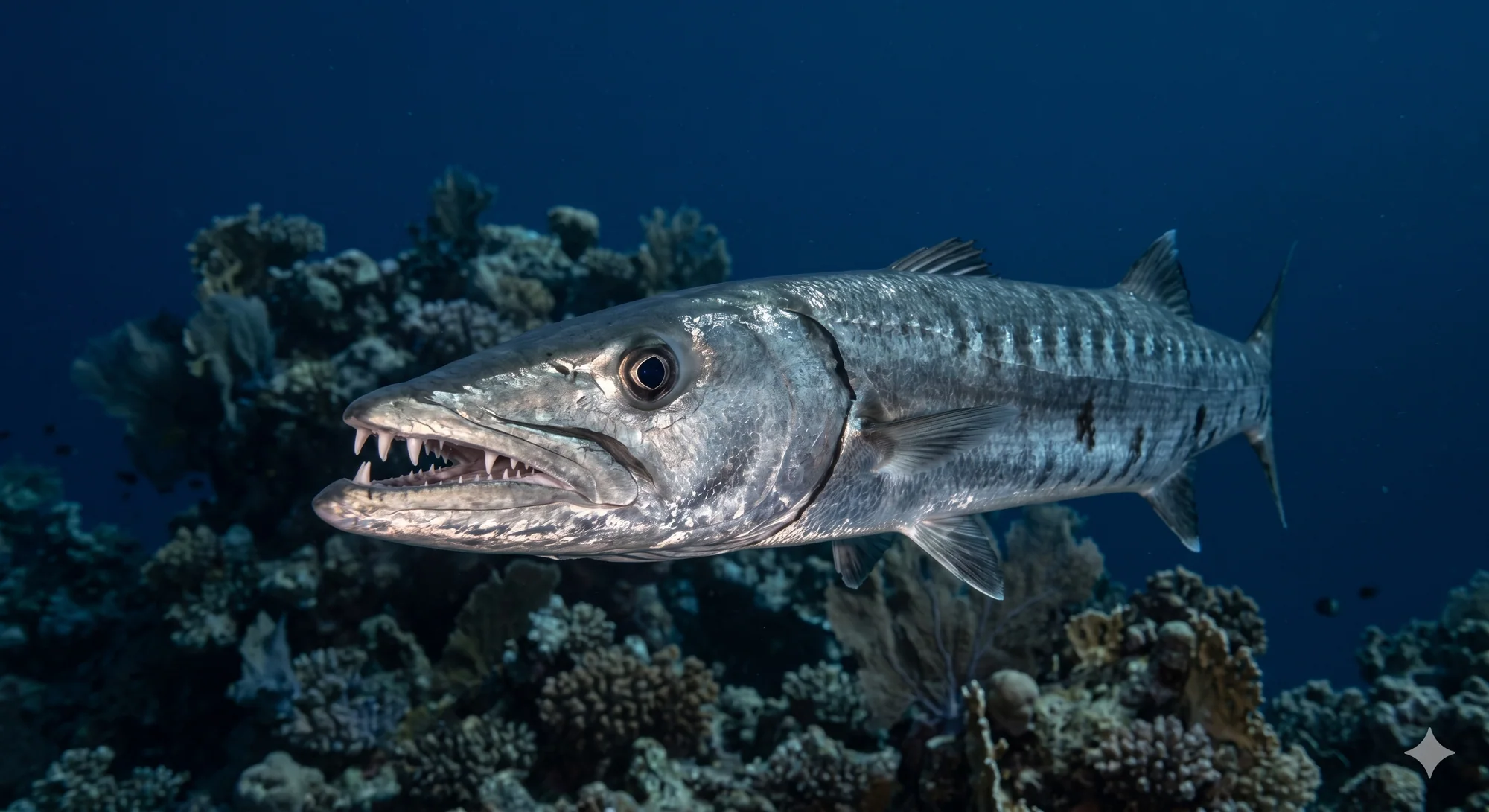
Sphyraena barracuda
Great Barracuda
The torpedo. A metre of silver muscle with a mouth full of blade-like teeth, present on virtually every reef in the Red Sea, from the shallows to open water.
The great barracuda is one of the most immediately recognisable fish in the Red Sea, torpedo-shaped, silver, with blade-like teeth and a habit of holding motionless in the current in a way that unsettles divers encountering it for the first time. It is also one of the most ubiquitous: present on reefs throughout the Red Sea, from the shallows of Dahab to the offshore pinnacles of the southern sea, in schools of juveniles and as large, solitary adults.
Adults reach 180 centimetres and approach 50 kilograms. The body is silver with scattered dark blotches on the flanks and a bronze tinge in older fish. The mouth, when open, reveals two rows of teeth, outer teeth are short and pointed; inner teeth are long, fang-like, and recurved. The dentition is designed for gripping fast-moving prey, not for crushing. A barracuda bite causes a clean shearing wound.
Despite an intimidating reputation, unprovoked attacks on divers are extremely rare. Most documented incidents involved divers wearing reflective jewellery or spearfishing with wounded fish, stimuli that resemble the visual and hydrodynamic signature of struggling prey. A barracuda hovering near a diver is almost always investigating, not threatening.
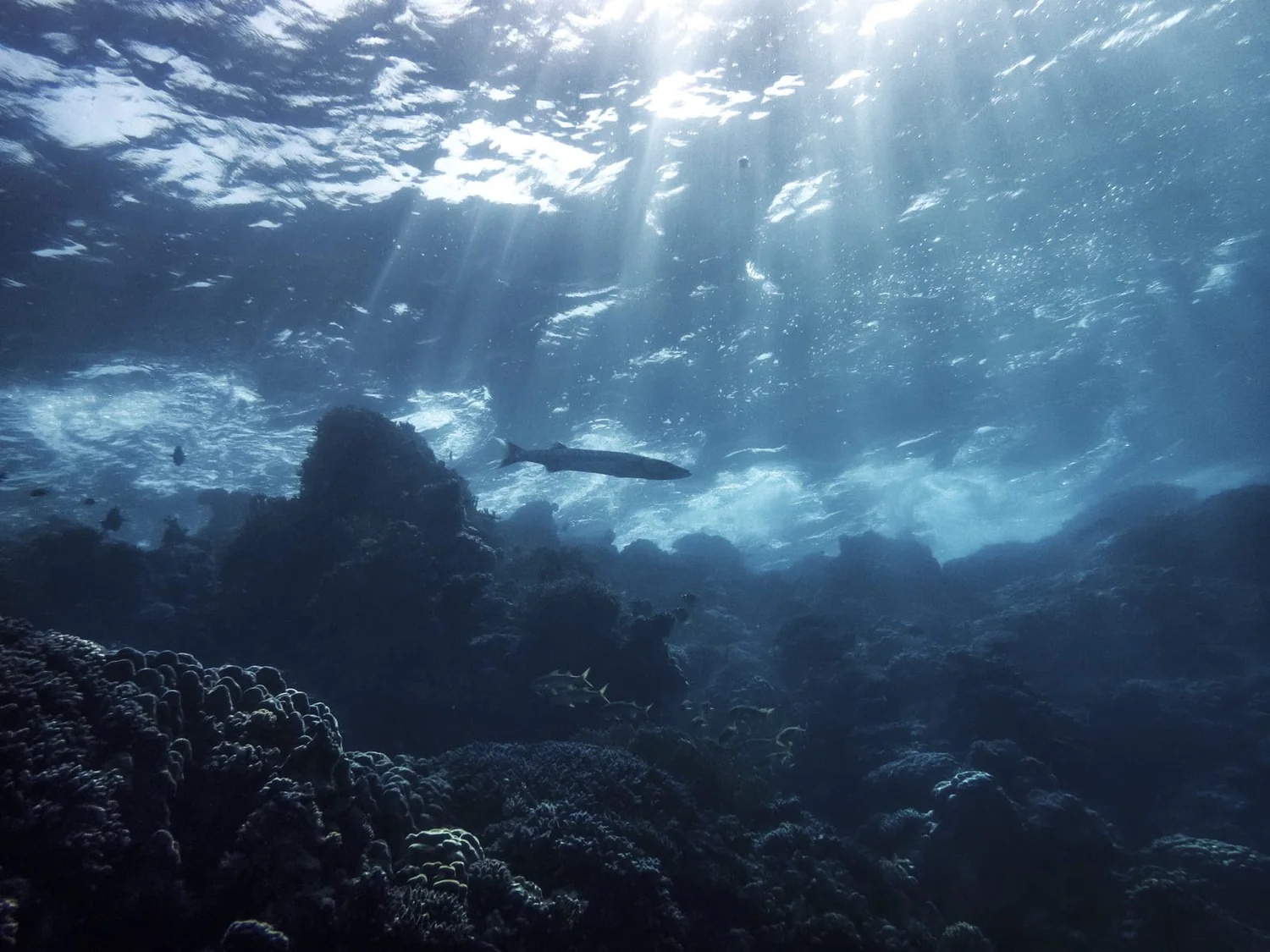
Barracuda exist in two distinct modes: the juvenile and sub-adult school, which hunts cooperatively and occupies specific reef areas in large, coordinated groups; and the large, solitary adult, which holds territory and hunts independently. Schools of juvenile barracuda are a common sight at dive sites, hundreds of fish in a loose tornado formation, circling in mid-water. These formations are defensive as much as they are hunting aggregations.
Large solitary adults are found holding on reef edges and channel edges, facing into the current. They are ambush predators: the body holds perfectly still while the current flows past, and prey fish that venture too close are taken with an explosive acceleration. The strike is delivered from stationary, 0 to maximum speed in a body length.
On the line, barracuda are fast, surface-oriented fighters. Multiple runs, occasional jumps, and a fight that is more exciting than sustained. They are accessible on light offshore tackle and produce consistent action on metal jigs worked fast.
Great barracuda are listed Least Concern globally and appear stable across the Red Sea. No targeted stock assessment identifies a conservation concern for the species.
One practical note that is also a safety note: ciguatera toxin accumulates in large barracuda through the food chain. Fish above approximately 6 kilograms should not be eaten. Ciguatera poisoning causes neurological symptoms that can persist for months and for which there is no effective treatment. The only mitigation is not eating large barracuda.
Atlas Position
The barracuda is the constant of Red Sea diving and reef fishing, present everywhere, frequently visible, occasionally alarming to new divers, and not particularly dangerous. On a rod, it is an accessible and aggressive target that has converted more people to sport fishing than almost any other species. The ciguatera note is the one piece of information that every fisherman here needs before putting a large barracuda in a cooler.
Sign in to share a sighting, behaviour note, or encounter.
No verified sightings yet. Be the first Atlas member to log an encounter.
Keep reading, and open the whole Atlas.
A free account unlocks every dive site guide and map, the marine life library, member reports, and the full incident log. Free to join.
Join free to keep reading