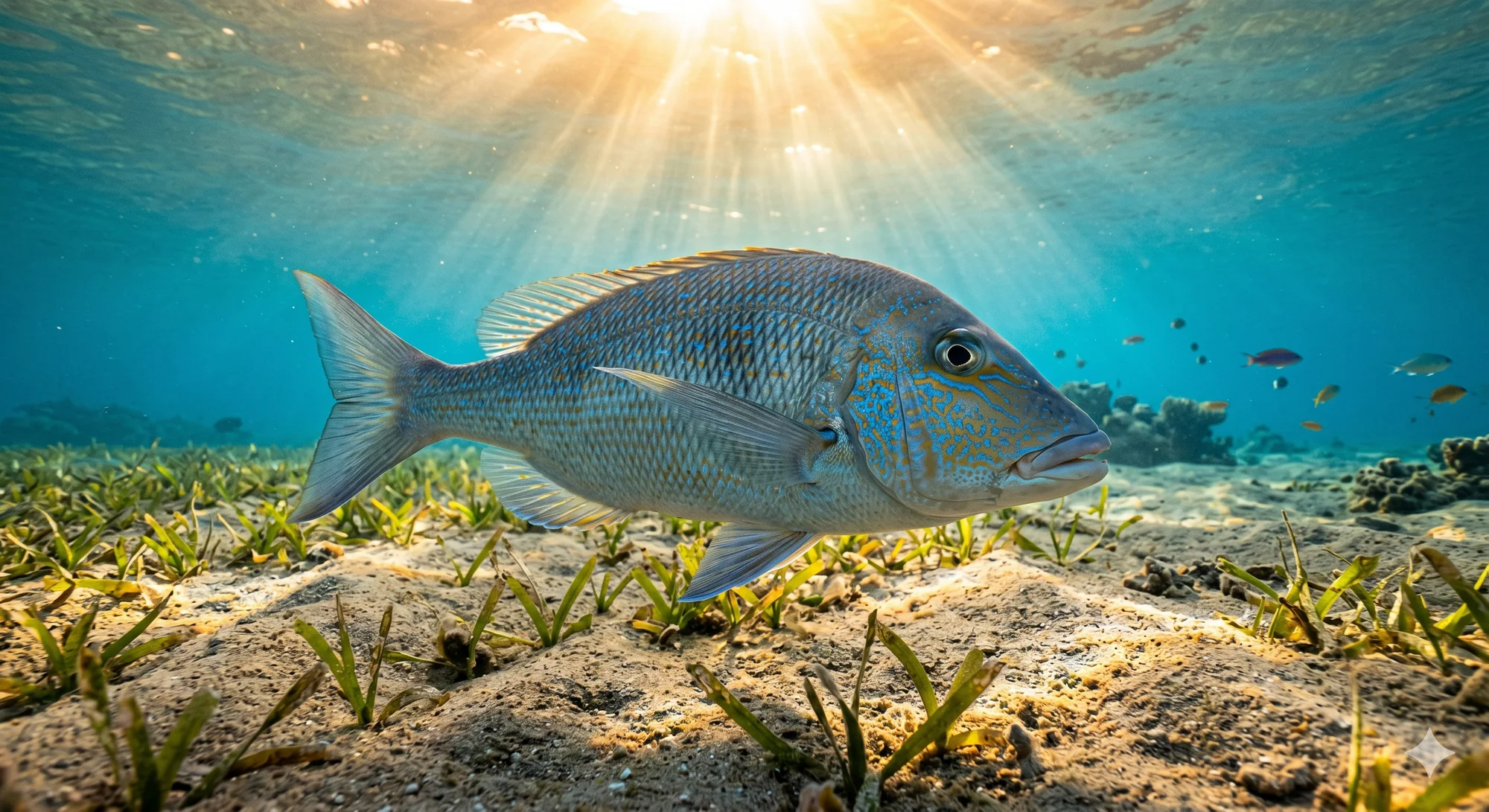
Lethrinus nebulosus
Spangled Emperor
The Shu'our: the most important food fish of the Egyptian Red Sea coast. Sandy flats, seagrass beds, reef edges. Night fishing at its most productive.
The spangled emperor, universally called Shu'our throughout the Egyptian Red Sea and wider Gulf fishing community, is among the most important food fish in the region. It supports significant artisanal fisheries, commands a high price in fish markets, and is the primary target species for shore-based and small-boat fishing along the Egyptian coast from Suez to the Sudanese border.
The Shu'our is a medium-to-large fish: adults reach 90 centimetres and approach 8 kilograms, with typical catches running 500 grams to 3 kilograms. The body colouration is olive-grey with distinctive blue-green spangling, small, bright spots across the head and flanks that are most vivid in live fish and fade significantly after death. The eyes are large, adapted for feeding in low light, and the mouth is equipped with molariform teeth at the rear of the jaw, adapted for crushing the hard-shelled prey that makes up much of the diet.
Habitat is fundamentally different from the offshore pelagic and reef species: the Shu'our is a bottom-associated fish of sandy flats, seagrass beds, and mixed sand-rubble areas in relatively shallow water (typically 5–40 metres). It is the species that defines the inshore, bottom-fishing dimension of Red Sea angling that the offshore pelagic focus can obscure, accessible from shore, productive through the night, and the species that most Egyptian fishermen have the most history with.
The Shu'our is primarily a nocturnal feeder. During the day, fish rest in deeper water or under reef structure; at dusk they move onto sandy flats and seagrass beds to feed on the invertebrates, sea urchins, and crustaceans that become active after dark. This nocturnal feeding pattern means that the most productive fishing is between dusk and midnight, a pattern familiar to every shore-based fisherman in Egypt.
The feeding technique is rooting and crushing. Using the molariform posterior teeth, the Shu'our grubs through soft substrate to extract buried invertebrates, and crushes hard-shelled prey, crabs, urchins, molluscs, without needing to swallow them whole. This diet means that cut squid, crab sections, and sea urchin are among the most effective baits, more so than live fish presentations that work for predatory species.
In groups, Shu'our feed in loose formations across the flat, moving slowly and methodically. A productive night on a sandy flat near a reef edge can concentrate significant numbers of fish over a relatively small area.
The Near Threatened IUCN classification reflects sustained fishing pressure across the species' range. The Shu'our is one of the most heavily targeted inshore fish in the Egyptian Red Sea, accessible to small boats and shore fishermen, highly valued in the market, and present in easily identified habitats. The cumulative effect of sustained fishing pressure on inshore populations has measurably reduced average fish size at many sites.
This is the conservation story that receives less attention than the charismatic pelagics but is arguably more significant for the health of the Red Sea as a fishing system: the quiet, persistent depletion of the inshore fish that ordinary fishermen catch.
Atlas Position
The Shu'our is the fish that connects the offshore sport fishing community to the wider culture of Red Sea fishing that long predates it. Every Egyptian who has fished, from a beach, from a small boat, from a coral promontory at night, knows the Shu'our. Any serious coverage of Red Sea fishing that ignores it in favour of offshore billfish is missing the point. The Atlas covers both.
Sign in to share a sighting, behaviour note, or encounter.
No verified sightings yet. Be the first Atlas member to log an encounter.
Keep reading, and open the whole Atlas.
A free account unlocks every dive site guide and map, the marine life library, member reports, and the full incident log. Free to join.
Join free to keep reading