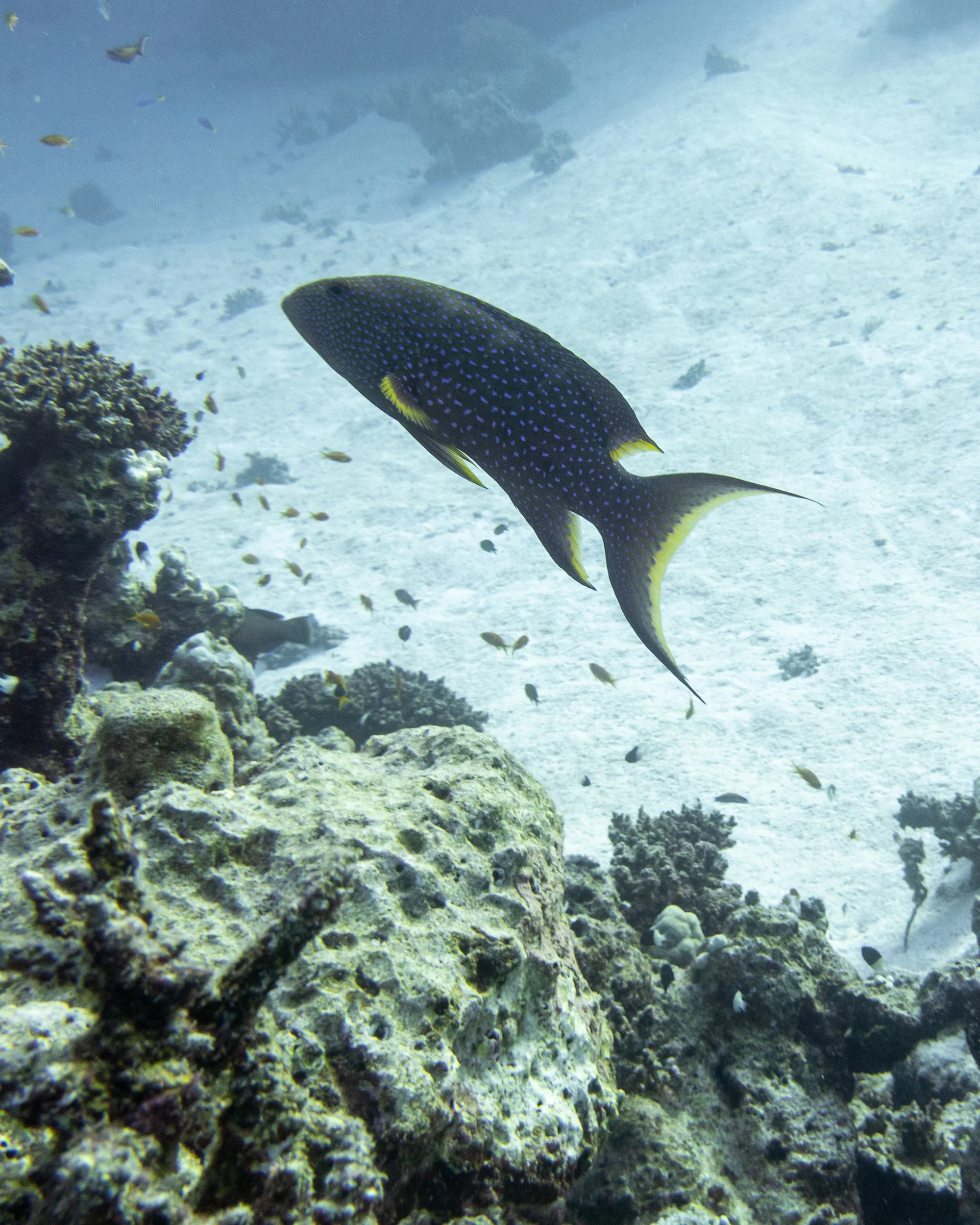
Variola louti
Moontail Grouper
The Sherifa: one of the most beautiful fish on the reef, and one of the most prized. The crescent tail marks it from across the water.
The moontail grouper, the Sherifa, universally known by its Arabic name throughout the Red Sea, is among the most visually distinctive fish on the reef. The body is covered in dense orange-red to yellowish spots with yellow edges, becoming denser and more vivid on the head, and the tail fin is deeply lunate, the crescent shape that gives the species its common name. In motion across the reef, the combination of spotted body and pale-edged crescent tail is unmistakable.
Adults reach 80 centimetres and 12 kilograms, with most fish encountered in the 2–6 kilogram range. The Sherifa is less commonly encountered than the more widespread groupers or the Nagel, partly because it is not a shallow-water species, it is found on outer reef slopes and walls, typically between 10 and 200 metres, and partly because, like most groupers, it has been reduced in numbers near populated ports.
The species is classified Near Threatened by the IUCN. It is present from the northern Sinai reefs to the deep south, most reliably encountered at remote offshore sites where fishing pressure is lower. A Sherifa on the line or encountered on a dive is a marker of a healthy, lightly-fished reef system.
The Sherifa is a solitary ambush predator in the typical grouper mould, it holds on specific sections of reef wall, hunting the fish and crustaceans that pass in range of its strike. Unlike the more mobile trevallies or the roaming Nagel, the Sherifa tends toward deeper, more structured habitat: outer reef slopes at 20–60 metres, where the reef wall is undercut and provides shelter, and where the fish can hold against the current.
Encounters at depth are typically brief, the fish flushes from its holding position when approached too closely, retreating to deeper structure. Patient observation at depth, holding position and waiting for the fish to settle, is more productive than pursuit.
The crescent tail is visible in motion at considerable distance, the pale margin catches ambient light in a way that the body, even with its vivid colouring, does not. This makes the Sherifa recognisable even in peripheral vision at depth, and explains why even brief sightings at 30 metres or more are memorable.
Variola louti is classified Near Threatened. It is subject to the same artisanal fishing pressure as other grouper species throughout its range, and the targeting of large reproductive adults removes the most productive individuals from the population. Combined with the species' relatively low population density, this creates meaningful conservation concern.
In the Red Sea, the Sherifa is most reliably encountered at remote offshore sites with limited fishing access. Sites near Hurghada and Sharm that receive intensive fishing pressure have noticeably fewer large individuals.
Atlas Position
Encountering a Sherifa on an outer reef wall, the crescent tail, the spotted body against the deep blue of the drop-off, is one of those moments that makes the remote offshore dive worthwhile. The Red Sea Atlas considers it a meaningful indicator of reef health and fishing pressure: where Sherifa are present and large, the reef is being given the space it needs.
Sign in to share a sighting, behaviour note, or encounter.
No verified sightings yet. Be the first Atlas member to log an encounter.
Keep reading, and open the whole Atlas.
A free account unlocks every dive site guide and map, the marine life library, member reports, and the full incident log. Free to join.
Join free to keep reading