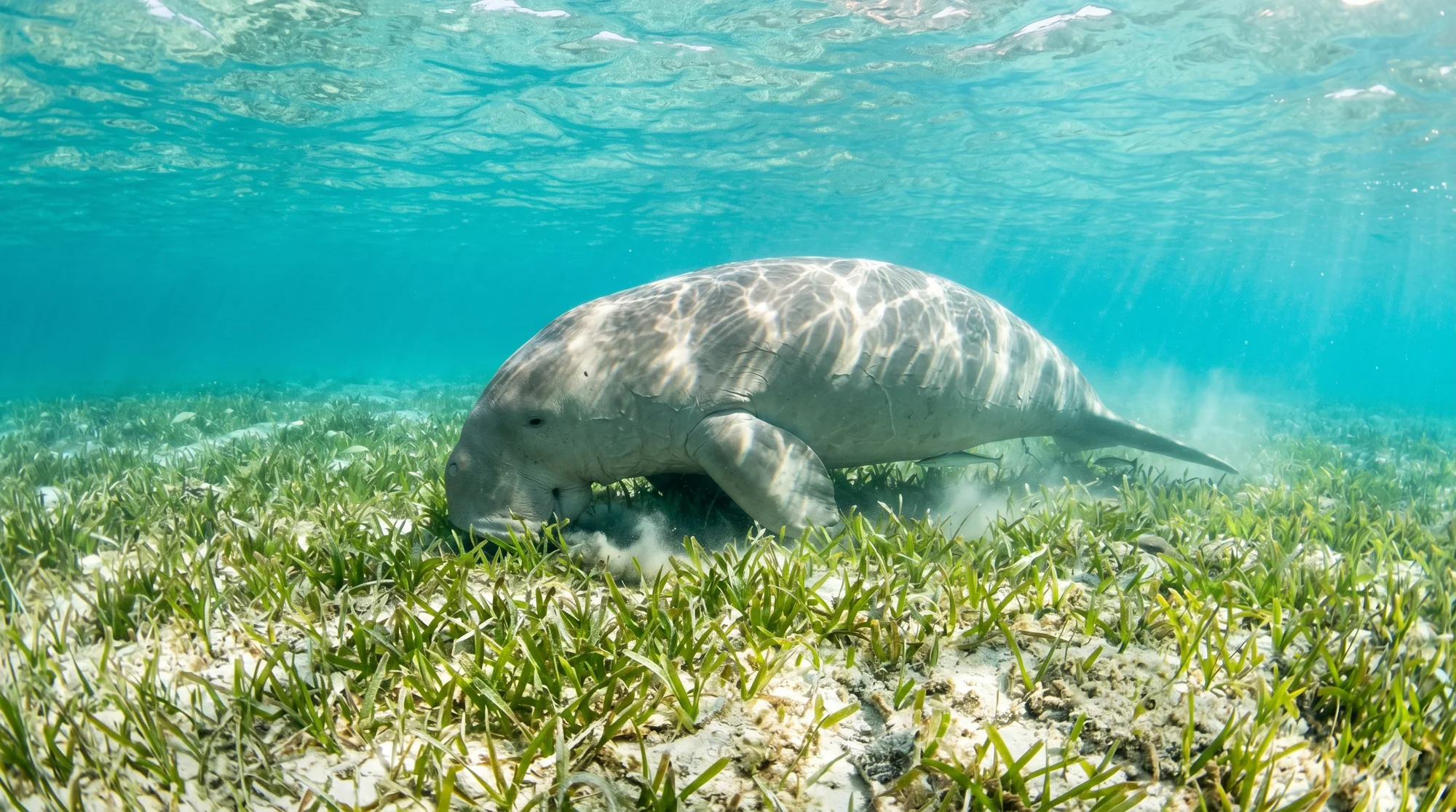
Dugong dugon
Dugong
Abu Dabbab is the most reliable dugong site on earth. The Red Sea holds one of the world's last healthy populations of this ancient marine mammal.
The dugong is one of four surviving species in the order Sirenia, the sea cows, and the only one found in the Red Sea. It is a large, slow, herbivorous mammal that grazes seagrass beds in shallow coastal waters, surfacing to breathe every five to seven minutes. Dugongs evolved from terrestrial ancestors shared with elephants, and their genetics confirm a common ancestor from approximately fifty-five million years ago. There is nothing else quite like them in the sea.
Abu Dabbab Bay, near Marsa Alam, is the most reliable dugong site in the world. A resident population of approximately fifteen to thirty animals grazes the bay's extensive seagrass meadows year-round. The bay is shallow, four to twelve metres across most of its extent, and the water clarity is typically excellent. A snorkeller, not even a diver, can find a dugong here on most mornings. That this is still true is a minor miracle.
The global dugong population has collapsed across most of its range. Hunting, boat strikes, habitat loss through seagrass degradation, and entanglement in fishing gear have reduced populations from Australia to the Persian Gulf. The Red Sea is one of the few areas where a meaningful population persists, and even here the picture is not uniformly positive, Marsa Alam's tourist infrastructure has expanded considerably in recent years, and the boat traffic through Abu Dabbab Bay has increased accordingly.
Dugongs are slow, deliberate grazers. They move across seagrass beds using their muscular, mobile upper lip to pull grass from the substrate, leaving feeding trails, long furrows in the seabed where grass has been removed root and all. These trails are a reliable indicator of dugong presence even when no animal is visible. A fresh trail, still slightly clouded with disturbed sediment, means a dugong has been here in the last hour or two.
At the surface they are cautious animals that respond to engine noise with course changes. Approach by boat within their comfort zone causes a stress response, accelerated surfacing, altered feeding pattern, and eventual movement away from the area. Snorkellers who enter the water quietly at the bay edge and allow the animals to feed undisturbed can observe at very close range. Dugongs are not shy of stationary humans, they are shy of unpredictable, approaching movement.
Calves stay close to their mothers for up to two years and are smaller, lighter-coloured versions of the adult form. A mother-calf pair at Abu Dabbab is not uncommon.
The dugong's vulnerability stems from its biology: it breeds slowly, lives long, and depends on a single food source, seagrass, that is itself vulnerable to degradation from boat anchoring, runoff, and coastal construction. A population that loses calves faster than it can replace them will decline for decades before the trajectory becomes visible.
Abu Dabbab has nominal protection as part of the Wadi El Gemal National Park, but enforcement of boat speed limits within the bay and the no-anchor zone over the seagrass beds is inconsistent. The site currently operates on the goodwill of the operators who use it correctly and the awareness of visitors who understand what they are seeing.
Atlas Position
Abu Dabbab is a site that should be treated with more care than it currently receives. The dugong encounters here are among the most intimate large marine mammal experiences available to recreational divers anywhere on earth, and they are sustained by a population that cannot absorb indefinite pressure. The Red Sea Atlas asks every visitor to Abu Dabbab to enter the water quietly, stay horizontal and relaxed in the shallows, and never chase. The animals that live here are not a feature of the tour. They are the reason the tour is possible.
Sign in to share a sighting, behaviour note, or encounter.
No verified sightings yet. Be the first Atlas member to log an encounter.
Keep reading, and open the whole Atlas.
A free account unlocks every dive site guide and map, the marine life library, member reports, and the full incident log. Free to join.
Join free to keep reading