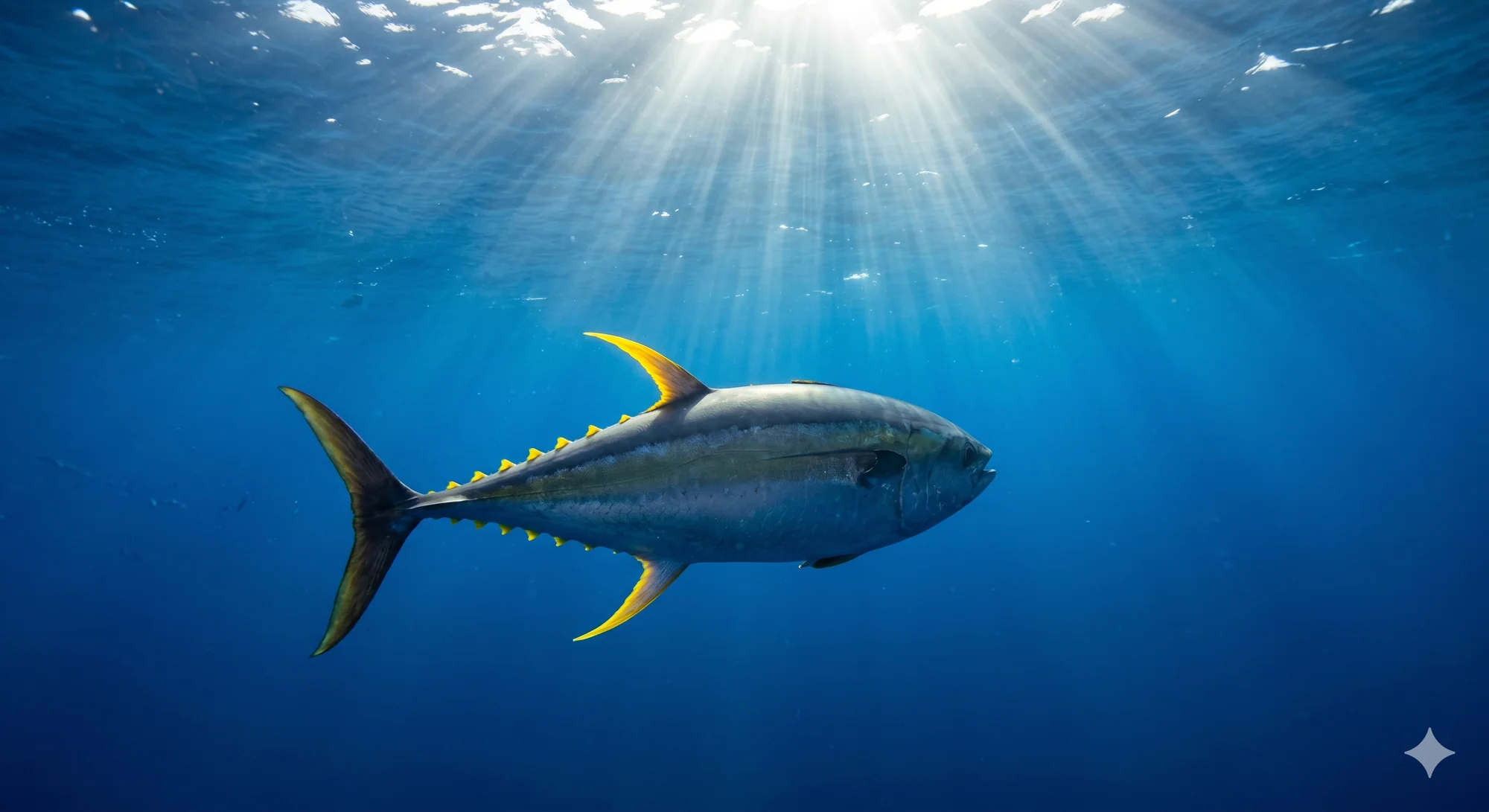
Thunnus albacares
Yellowfin Tuna
One of the fastest fish in the ocean, capable of 75km/h. Year-round in the Red Sea, with peaks November through March on the offshore banks.
The yellowfin tuna is the defining pelagic target of Red Sea sport fishing. Fast, powerful, and present in numbers unusual for a fish under this level of commercial pressure, it represents everything that makes offshore fishing in this sea exceptional, deep blue water within reach of day boats, consistent encounters, and the kind of fight that makes the target species irrelevant once it is on the line.
Yellowfin are one of the largest members of the tuna family, with adults regularly exceeding 100 kilograms and exceptional fish approaching 200. The name refers to the distinctive bright yellow second dorsal and anal fins and the yellow finlets running toward the tail, vivid markings that identify large yellowfin even at depth. Young fish lack the elongated sickle-shaped dorsal fin that develops in large adults, which is itself a diagnostic feature.
In the Red Sea, yellowfin are present year-round but concentrate on offshore banks and around productive upwellings during the cooler months from November through March. They associate with other marine animals, dolphin schools, whale sharks, and patches of floating debris, and are typically located by reading the surface: birds diving, fins showing, baitfish disturbance. The fish cover enormous distances; the same individual may be off Hurghada one week and south of Marsa Alam the next.
Yellowfin tuna are highly gregarious schooling fish. They forage in coordinated groups that drive baitfish to the surface, often in association with dolphins, seabirds, and occasionally whale sharks, the same surface commotion that allows fishermen to locate them. This association has been exploited commercially through the practice of setting purse seine nets around dolphin schools, which has historically caused significant dolphin bycatch.
On the line, a yellowfin fights with sustained power rather than spectacular single bursts, long, powerful runs that test drag settings and line strength. Large fish above 50 kilograms will sound deep and hold, requiring sustained pressure to work back to the surface. The fight is physical and prolonged in a way that lighter offshore species are not.
Surface-feeding fish, when baitfish are being pushed to the surface, are the most accessible target. Topwater poppers and stickbaits cast into the feeding frenzy produce strikes immediately. These windows are unpredictable but spectacular when they occur.
Yellowfin tuna are classified Near Threatened globally. The Indian Ocean population, which includes the Red Sea, has been subject to heavy commercial pressure, primarily from longline and purse seine fleets. Stock assessments suggest the Indian Ocean population is overfished, though the situation varies considerably by region within the ocean.
Sport fishing catch-and-release contributes negligibly to overall tuna mortality by comparison with commercial take. The Red Sea Atlas strongly supports catch-and-release practice for yellowfin above a reasonable size threshold, not because individual releases save the species, but because a sport fishing culture built around conservation is more likely to advocate effectively for the regulatory changes that would.
Atlas Position
The yellowfin tuna is the species that defines offshore Red Sea fishing. An early morning departure from Hurghada, a school of surface-feeding yellowfin located by birds twenty miles offshore, a topwater strike on the first cast, this is what the fishery is for. The Red Sea Atlas recommends catch-and-release for large fish and encourages the sport fishing community here to build the conservation credentials that will be needed when commercial pressure on the stock increases, as it inevitably will.
Sign in to share a sighting, behaviour note, or encounter.
No verified sightings yet. Be the first Atlas member to log an encounter.
Keep reading, and open the whole Atlas.
A free account unlocks every dive site guide and map, the marine life library, member reports, and the full incident log. Free to join.
Join free to keep reading