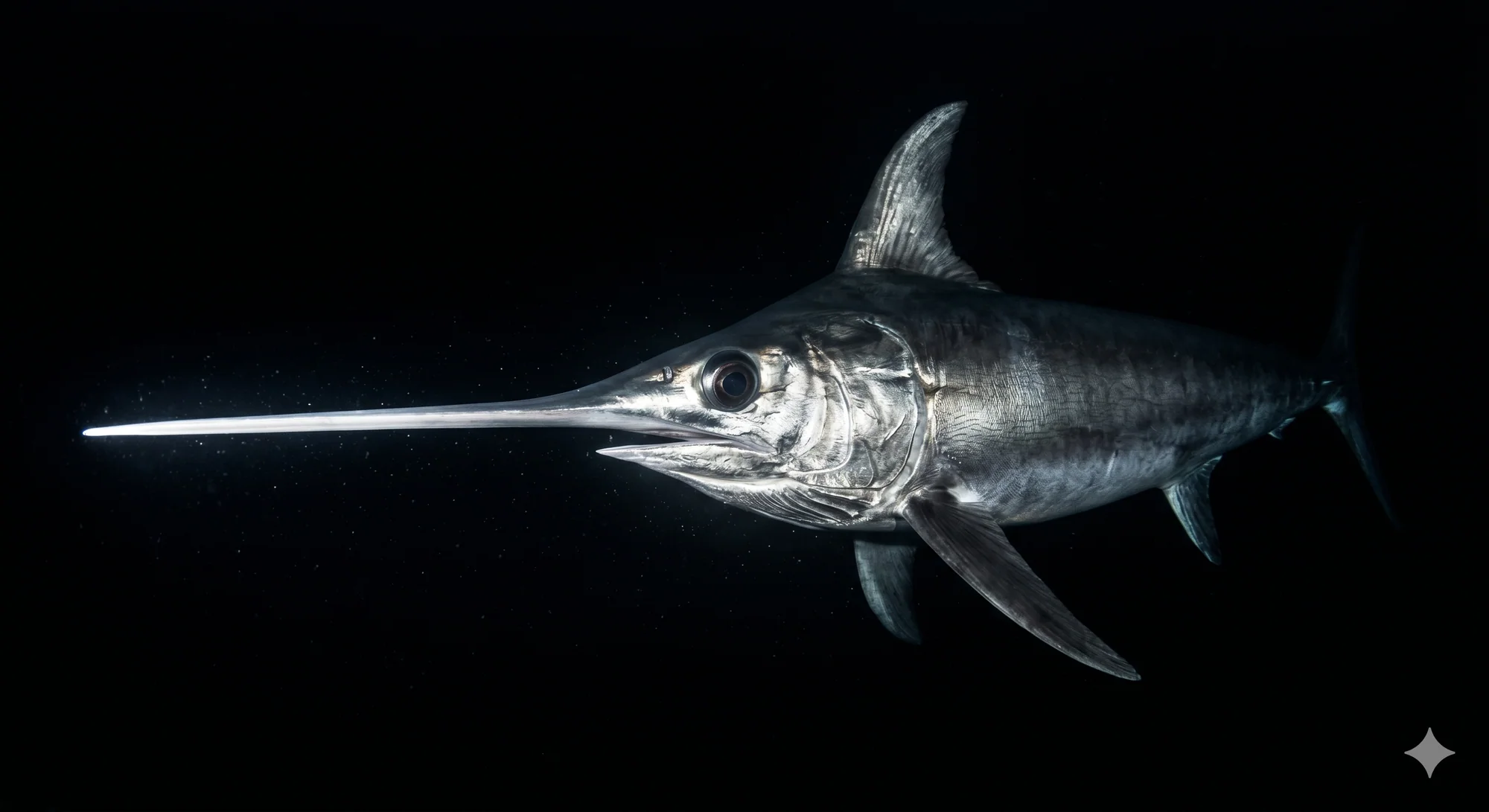
Xiphias gladius
Swordfish
The deep-water night hunter. Swordfishing is a specific discipline: late departure, deep rigs, long waits, and the possibility of the largest fish you will ever catch.
The swordfish is unique among billfish: the only member of the family Xiphiidae, with a flat, sword-shaped bill rather than the round spear of marlins and sailfish, a body built for deep diving rather than surface speed, and habits fundamentally different from its billfish relatives. Where marlins and sailfish hunt near the surface in daylight, swordfish are nocturnal and bathypelagic, spending days at depths of 500 to 800 metres and ascending to shallower water at night to feed.
This behaviour defines how swordfish are targeted in the Red Sea: night fishing, deep rigs, long drifts. Departures are typically at dusk, fishing through the night hours when swordfish are actively feeding in the 200–400 metre water column, returning at dawn. The technique is demanding, deep drops with live or dead squid and baitfish, light sticks to attract squid and the swordfish that hunt them, and patience that runs counter to the action-oriented instincts most sport fishermen bring from shallower fishing.
The bill, flat-sided and blade-like, unlike the rounded bills of other billfish, is used as a weapon against prey: a downward and lateral slashing motion that stuns or kills fish before the swordfish turns to eat them. Stomach contents analysis has revealed remarkable animals, including deep-sea species rarely encountered at the surface.
Swordfish undertake a daily vertical migration: deep during the day (500–800 metres), ascending to feed at night in the 200–400 metre range. This migration is driven by prey: the deep scattering layer, a dense layer of fish and squid that itself migrates upward at dusk, draws swordfish toward the surface. At the depths where they feed at night, swordfish are encountered by the night-fishing rigs.
They are solitary animals. Unlike tuna or mackerel, swordfish do not school and cannot be found by locating surface activity. The fishing technique is positional, identifying productive deep-water areas (canyon edges, offshore banks with a pronounced depth profile) and fishing them at depth through the night. Electronics help; local knowledge helps more.
The fight is unlike any other offshore species. A large swordfish runs deep and stays there, the challenge is not surface acrobatics but sustained vertical pressure against an animal that may outweigh the fisherman. Pulling a large swordfish from depth on appropriate tackle is one of the most physically demanding experiences in sport fishing.
Swordfish are classified Least Concern globally but are heavily targeted by longline fisheries worldwide. North Atlantic populations were historically severely overfished and have partially recovered under managed catch limits. Indian Ocean populations support major commercial fisheries but are less formally assessed.
The Red Sea represents a small fraction of the global swordfish range and swordfishing in Egypt is primarily recreational. Catch-and-release is increasingly practised but not universal.
Atlas Position
Swordfishing is not the entry point to Red Sea offshore fishing. It is the discipline you come to after you have run tuna, caught mackerel, fought a GT, and started asking what else the water holds. The night departure, the deep drift, the possibility of a very large fish, it is a different relationship with the sea than daylight fishing. Bluefin Academy runs a Swordfish Specialist Course for anglers who want to pursue it properly. That is the right way to start.
Sign in to share a sighting, behaviour note, or encounter.
No verified sightings yet. Be the first Atlas member to log an encounter.
Keep reading, and open the whole Atlas.
A free account unlocks every dive site guide and map, the marine life library, member reports, and the full incident log. Free to join.
Join free to keep reading