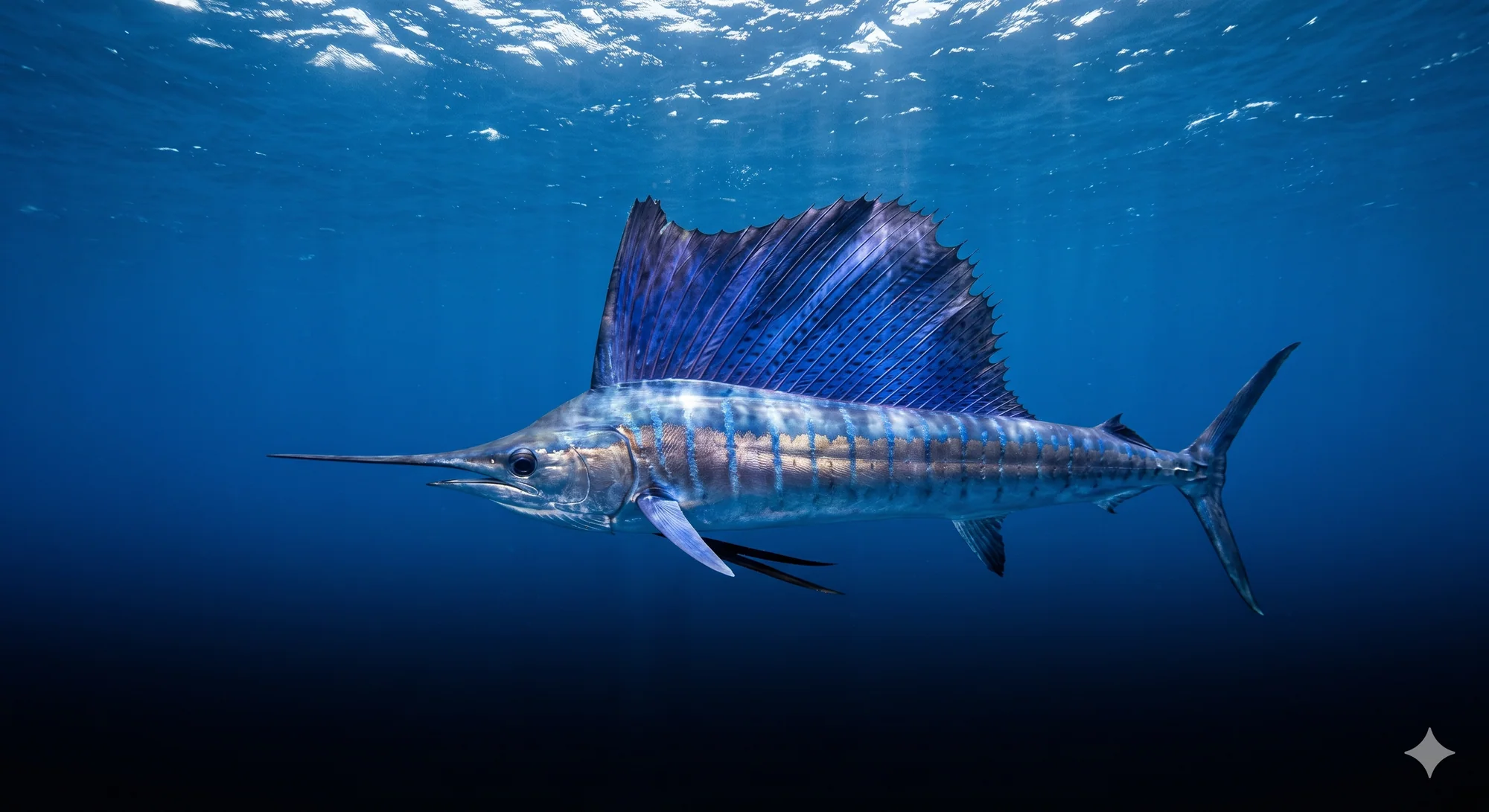
Istiophorus platypterus
Sailfish
The most spectacular fish in the Red Sea. The sail erects on the strike. The first jump is a reminder of what the ocean is capable of.
The sailfish is the signature billfish of the Red Sea, migratory, spectacular, and an embodiment of offshore fishing as a genuinely extraordinary experience. The extended dorsal fin, the sail, can exceed the depth of the body and is erected during moments of excitement: on the strike, in the fight, and when the fish surfaces and jumps. A sailfish with its sail fully raised is one of the most dramatic sights in sport fishing anywhere.
Sailfish are among the fastest fish in the ocean, with burst speeds estimated at 80–110 kilometres per hour. The bill, an extension of the upper jaw, is used not to spear prey but to slash through baitfish schools, stunning multiple fish with a single lateral strike. The sailfish then turns and eats the disabled prey. This hunting technique, which has been documented on video in the Red Sea and Indian Ocean, produces the characteristic appearance of a sailfish attacking a bait school: the bill visible above the surface, multiple fish scattering, the large body rolling through the boil.
In Egyptian waters, sailfish are migratory visitors peaking between October and March. They follow warm current edges and baitfish concentrations and are not resident in the way that reef species are. A productive season depends on oceanographic conditions that vary year to year. In good years, multiple fish per day are possible on offshore charters from Hurghada and Marsa Alam.
Sailfish hunt in groups when targeting bait schools, cooperative behaviour unusual in billfish. Multiple fish will round up a school of sardines or similar prey, herding them into a compact ball, then take turns making slashing passes through the school. This behaviour, which has been filmed in the Red Sea and Indian Ocean, keeps the bait available for subsequent passes and benefits each fish in the group.
The fight is primarily aerial. A sailfish's first response to the hook is typically a series of high leaps, the full body clearing the water, before sustained surface runs. The fight is rarely long by tuna or dogtooth standards but it is spectacular in a way that no other Red Sea species matches. The sail fully erect during a jump above blue water is the defining image of offshore fishing in this sea.
Individual sailfish are also encountered at depth, hunting squid on structure near offshore banks. These fish are less visible but accessible to trolled deep lures and pitched live bait.
Indo-Pacific sailfish are classified Vulnerable by the IUCN. They are caught as bycatch by longline fleets targeting tuna and as direct targets by both commercial and sport fisheries. Declining catch-per-unit-effort in long-running sport fisheries suggests population pressure across the Indian Ocean.
Catch-and-release practice is well-established in sailfish sport fishing globally. Properly handled fish, brought to the boat and released without removal from the water where possible, recover quickly and show no evidence of elevated post-release mortality in tagging studies. The Red Sea Atlas advocates strongly for release of all sailfish.
Atlas Position
The sailfish is the argument for doing offshore fishing in the Red Sea seriously and correctly. The encounter is rare enough to be meaningful, the fight is spectacular, and the argument for release is obvious and immediate, a fish that beautiful and that extraordinary has no business being killed for a photograph. The Red Sea Atlas supports catch-and-release for all billfish, without exception.
Sign in to share a sighting, behaviour note, or encounter.
No verified sightings yet. Be the first Atlas member to log an encounter.
Keep reading, and open the whole Atlas.
A free account unlocks every dive site guide and map, the marine life library, member reports, and the full incident log. Free to join.
Join free to keep reading