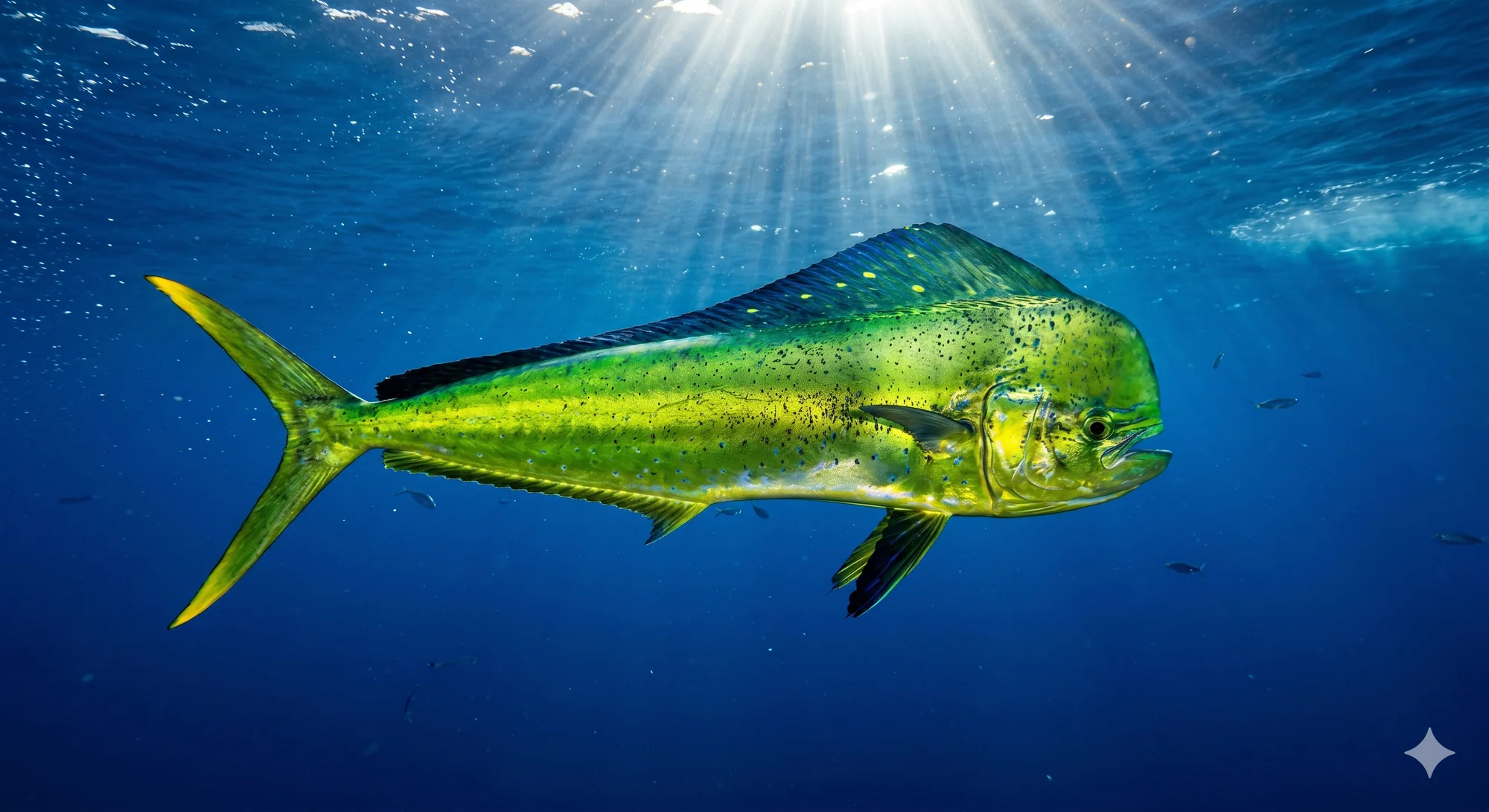
Coryphaena hippurus
Mahi-Mahi
The most colourful fish in the ocean: iridescent greens and golds that fade within minutes of death. Season March through October.
The mahi-mahi, also called dorado and dolphinfish, is among the most visually spectacular fish in the Red Sea. The living animal is a spectacle of iridescent colour: deep greens and blues along the back, gold and yellow on the flanks, silver on the belly, with the entire palette shifting as the fish moves. This extraordinary colouration fades within minutes of death, which is why photographs of mahi-mahi never quite convey the experience of seeing one alive in clear water.
The species is notable among large sport fish for its growth rate, the fastest of any large marine fish. A mahi-mahi reaches sexual maturity at four to five months, and a two-year-old fish may weigh 10 kilograms. This biological productivity makes it relatively resilient to fishing pressure compared to slower-growing pelagics like sailfish or tuna, though populations can still be locally depleted by concentrated fishing effort.
In the Red Sea, mahi-mahi are most reliably encountered from March through October, associated with floating objects, weed lines, debris, FADs (Fish Aggregating Devices), or any flotsam, where they gather to shelter and feed on the small fish and invertebrates that congregate around structure. Reading the surface for floating objects and working them methodically is the most reliable technique.
Mahi-mahi are social and curious fish. They aggregate under floating objects, a behaviour so consistent that artificial FADs are deployed by fishermen specifically to attract and concentrate them. A piece of floating debris as small as a wooden pallet can hold a dozen fish; a large weed line may hold hundreds. The fish shelter under the floating object and feed on the small fish that in turn shelter there.
The curiosity extends to boats. A mahi-mahi under a FAD will often investigate the vessel itself, holding alongside the hull and swimming in formation with the boat at low speed. This behaviour allows anglers to sight-fish to individual fish, selecting larger animals and making accurate casts. Few species in sport fishing offer this combination of accessibility and visual drama.
On the line, mahi-mahi are aerials. The first jump, often immediately on the strike, is spectacular: a full body clear of the water, the iridescent colours catching the sunlight. Subsequent runs are fast and close to the surface. The fight is not long but it is exciting throughout.
Mahi-mahi populations are considered globally healthy. The species' exceptional growth rate provides biological resilience to fishing pressure that slower-growing species cannot match, and the IUCN Least Concern classification reflects this.
Heavy commercial take, primarily through longline, is the main pressure point. In the Red Sea, the fishery is primarily recreational, with limited commercial targeting. Population levels appear stable.
Atlas Position
The mahi-mahi is the perfect introduction to offshore fishing in the Red Sea. It is seasonal but reliably present during its season, it responds to accessible techniques, the fight is immediately exciting, and the visual experience of watching one alive in the water is genuinely extraordinary. For a first offshore trip, the combination of mahi-mahi and king mackerel covers both the visual spectacle and the physical fight that defines offshore fishing here.
Sign in to share a sighting, behaviour note, or encounter.
No verified sightings yet. Be the first Atlas member to log an encounter.
Keep reading, and open the whole Atlas.
A free account unlocks every dive site guide and map, the marine life library, member reports, and the full incident log. Free to join.
Join free to keep reading