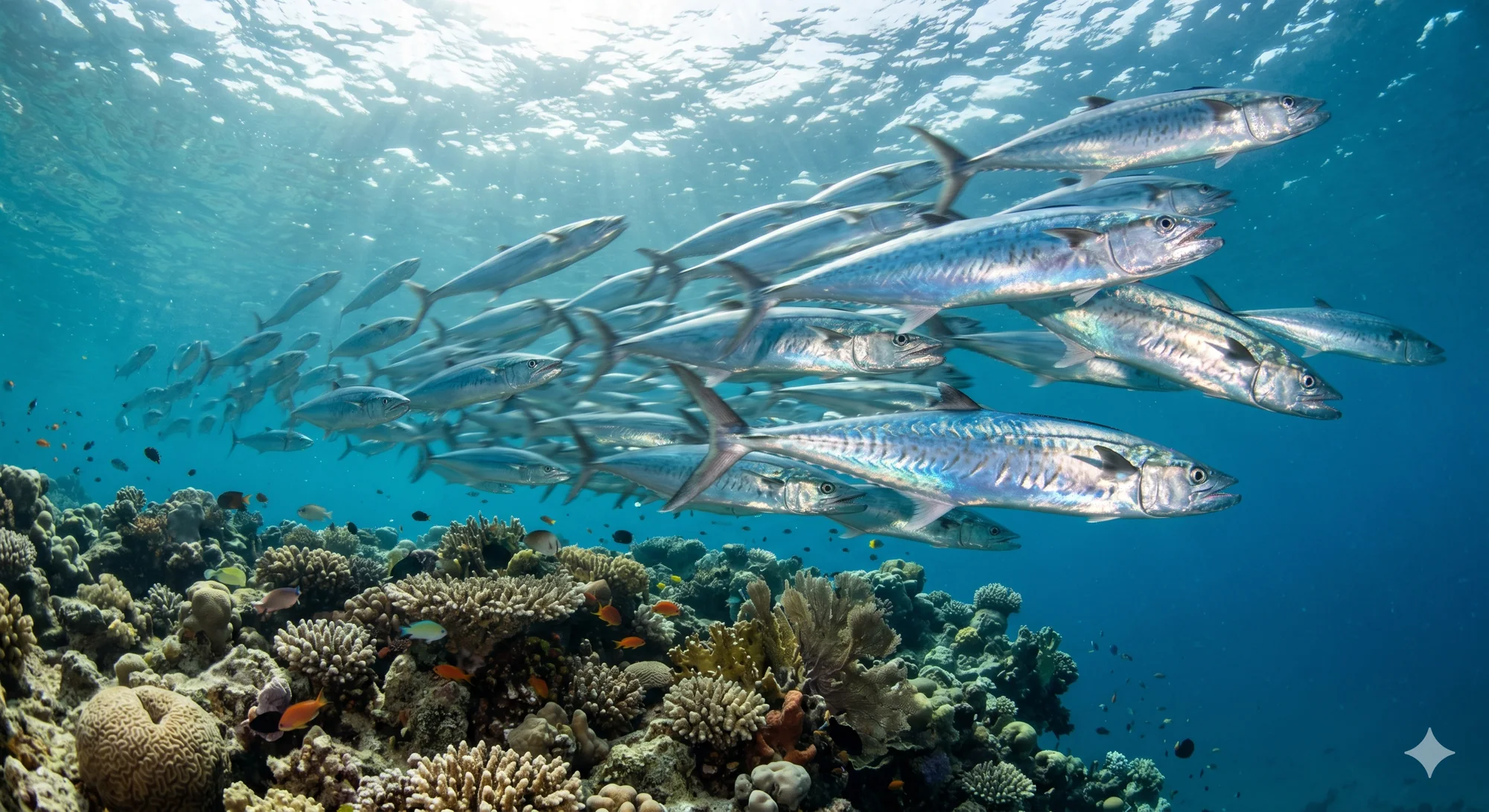
Scomberomorus commerson
King Mackerel
The razor-toothed mackerel of the Red Sea: fast, predatory, and year-round. Strikes hard on trolled lures and wire leaders are not optional.
Scomberomorus commerson, the narrow-barred Spanish mackerel, called King Mackerel in Egypt and known in the Arabic-speaking fishing community as the Draak, is the dominant mackerel of the Red Sea and one of its most reliable sport fishing targets. The fish ranges from shallow reef edges to open water, follows baitfish concentrations with persistence, and attacks lures with an aggression that makes it one of the most immediately satisfying species to target.
The body plan is purpose-built for speed: laterally compressed, torpedo-shaped, with a series of small finlets behind the main dorsal and anal fins and a deeply forked tail. The lateral line drops sharply at mid-body, a diagnostic feature that distinguishes S. commerson from similar species. Adults reach 240 centimetres and 70 kilograms, though most fish encountered sport fishing run 5–15 kilograms, with fish over 25 kilograms being exceptional catches.
The teeth require attention. King mackerel teeth are razor-sharp and arranged closely, designed to disable fast-moving baitfish with a single slashing strike. Wire traces or heavy mono leaders are mandatory, monofilament leader of less than 80 pounds is a liability. Fishermen who lose fish to bite-offs are usually underleadered.
King mackerel are pursuit predators. They hunt baitfish schools in open water and on reef edges, herding concentrations to the surface in the same way that tuna do, and are often present in the same surface-feeding events. Unlike tuna, mackerel make multiple passes through baitfish schools, slashing and disabling prey, then returning to eat the stunned fish. This feeding behaviour is why dead baits and cut baits are as effective as live fish.
They are highly responsive to fast-moving surface lures. A trolled lure at speed will draw strikes from fish that have not shown at the surface. The hit is savage, the fish takes the lure and immediately changes direction, putting immediate shock load on the tackle. The subsequent fight is fast and superficial, multiple runs close to the surface rather than the deep, sustained fight of tuna or GT.
At first light and last light, mackerel feed in the shallows near reef edges and can be sight-fished on appropriate tackle. This pattern makes them accessible to anglers without dedicated offshore fishing boats.
Scomberomorus commerson is classified Near Threatened globally. It supports major commercial fisheries across its Indo-Pacific range and is heavily targeted by artisanal fisheries in Egypt and throughout the Red Sea basin. Stock assessments suggest fishing pressure is high but populations remain viable.
The sport fishing community's contribution to population pressure is minimal compared to commercial and artisanal take. The conservation concern is the consistent removal of large breeding-size fish from accessible reef areas by small-scale fisheries operating without size limits.
Atlas Position
The king mackerel is probably the most commonly caught offshore species in Egypt. It is accessible from day boats, present year-round, aggressive on lures, and good eating. For a first offshore fishing trip in the Red Sea, it is the right target, the fight is satisfying, the tackle is accessible, and the learning curve is not steep. The wire leader is the only non-negotiable.
Sign in to share a sighting, behaviour note, or encounter.
No verified sightings yet. Be the first Atlas member to log an encounter.
Keep reading, and open the whole Atlas.
A free account unlocks every dive site guide and map, the marine life library, member reports, and the full incident log. Free to join.
Join free to keep reading