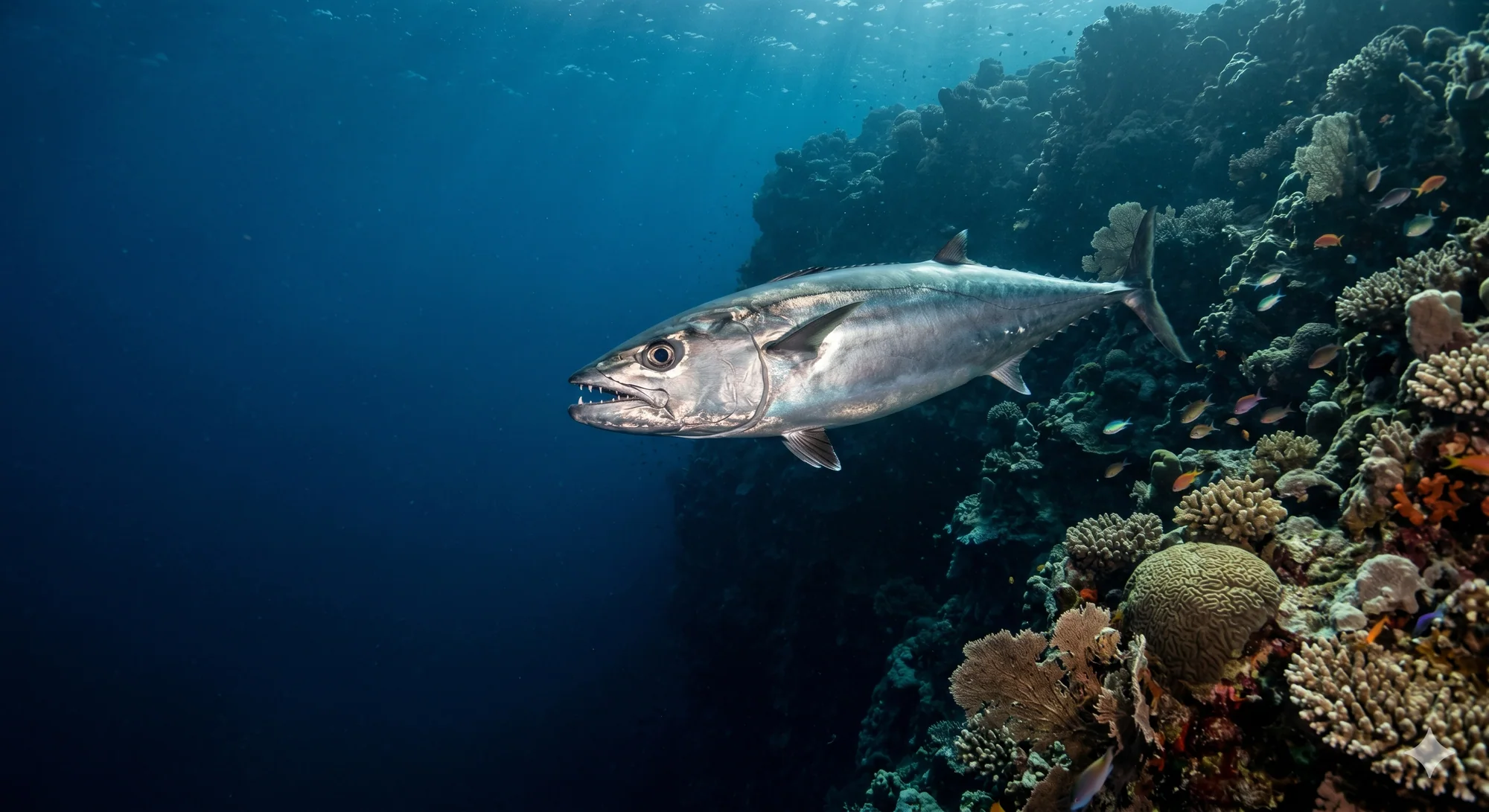
Gymnosarda unicolor
Dogtooth Tuna
The most powerful fish on the outer reef. Kilo for kilo, nothing in the Red Sea fights harder. Resident on every major offshore pinnacle.
The dogtooth tuna is not a true tuna. It is the sole member of the genus Gymnosarda, a classification that reflects its evolutionary divergence from the schooling, open-ocean tunas of the genus Thunnus. Where yellowfin range across hundreds of miles of open water in coordinated schools, the dogtooth is a reef-associated solitary predator, resident on specific drop-offs and pinnacles, hunting the baitfish that gather on offshore structure.
The name comes from the teeth: prominent, conical, and fang-like, unlike the smaller teeth of most tunas. The body is a uniform silver with a pale underside and no distinctive colouring, functional camouflage for an ambush predator that hunts against the open-water backdrop visible from the reef edge. Adults reach 130 centimetres and approach 130 kilograms, though the majority of fish caught in the Red Sea run 10–30 kilograms.
For pound-for-pound fighting power, nothing in the Red Sea rivals a dogtooth tuna on appropriate tackle. The fish makes explosive initial runs toward the reef structure, the standard tactic is to cut the line on the coral, which succeeds more often than the fisherman would like, followed by sustained deep-water pressure. Landing a large dogtooth cleanly requires a boat that can chase, a captain who knows the structure, and tackle that can absorb the initial run.
The dogtooth tuna is an apex predator of the reef edge. Unlike its pelagic relatives, it holds territory on specific structures, a particular pinnacle, a specific section of outer wall, returning to the same area across days and weeks. Experienced captains and guides know individual productive structures and return to them seasonally, building up observations over years.
The hunting strategy combines ambush with speed. A dogtooth holding on a pinnacle waits for baitfish schools to aggregate on the structure, then attacks from depth with a high-speed charge. The strike is explosive and the initial run is straight toward the reef, an attempt to cut the line on coral. This is why dogtooth tuna fishing demands heavier tackle and heavier drag settings than most offshore fishing: the fish does not give you time to think.
They are solitary animals, occasionally encountered in pairs but never in large schools. A productive pinnacle might hold two or three resident fish of varying sizes. Catching one does not mean the structure is exhausted, the territory may be taken by another fish, or the same fish returns after release.
Dogtooth tuna face limited commercial fishing pressure compared to the schooling pelagic tunas, partly because they do not aggregate in numbers that make purse seining efficient and partly because their reef-associated habitat makes longline targeting less systematic. No population collapse has been documented.
In the Red Sea specifically, the offshore pinnacles and seamounts that hold dogtooth tuna are not heavily fished by commercial vessels. The species appears stable on the basis of recreational catch-per-unit-effort observations, though formal population assessments are lacking.
Atlas Position
The dogtooth tuna is the Red Sea's benchmark fight. A 20-kilogram dogtooth on 30-pound tackle at a deep pinnacle, the initial run, the line burning over the reef edge, the decision to give drag or chase, is the standard by which serious anglers here measure the fishery. The Red Sea Atlas considers it the signature species of offshore structure fishing in this sea, and notes that its health is tied directly to the health of the offshore reef systems where it lives.
Sign in to share a sighting, behaviour note, or encounter.
No verified sightings yet. Be the first Atlas member to log an encounter.
Keep reading, and open the whole Atlas.
A free account unlocks every dive site guide and map, the marine life library, member reports, and the full incident log. Free to join.
Join free to keep reading