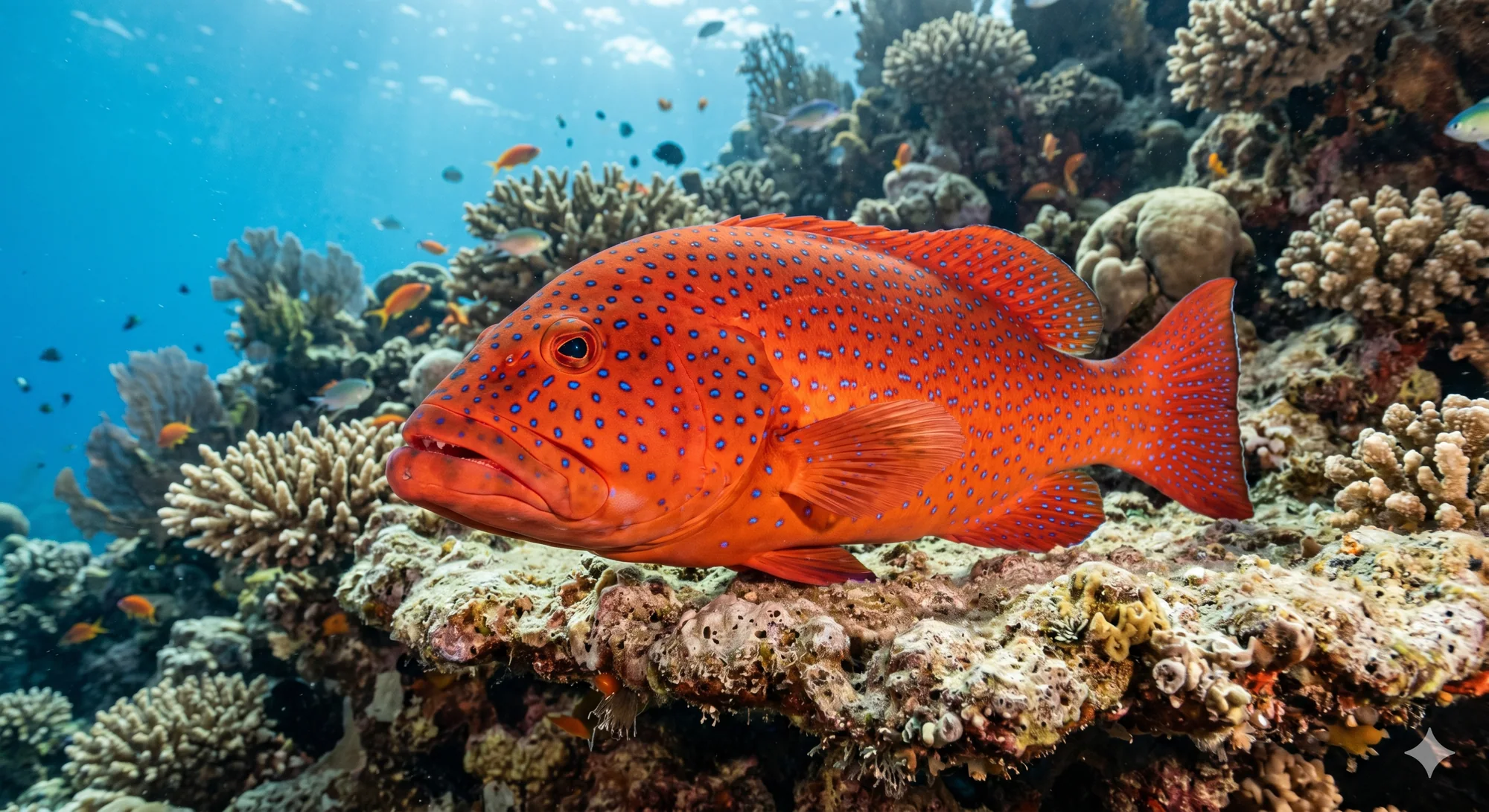
Plectropomus pessuliferus
Coral Trout
The Nagel: one of the most prized reef fish in the Red Sea. Striking red body, blue spots, resident on reef walls to 100 metres. Not a Hamour.
The coral trout, called Nagel throughout the Red Sea fishing community, is technically a grouper (family Serranidae) rather than a trout, but the common name has stuck in English-speaking fishing circles for decades. In the Red Sea and Gulf region, Nagel is the universal name: in fish markets, on charters, in fishing discussions, the Arabic name is what everyone uses, and it is explicitly distinct from Hamour, which covers the broader grouper category.
The species is Plectropomus pessuliferus, the Marbled Coral Grouper, one of several Plectropomus species found in the Red Sea and the most commonly encountered. The body is a rich red-orange with dense blue-outlined spots across the body and face. The spots become more prominent with age. Large adults darken to a deeper red-brown; juveniles are paler. No other Red Sea reef fish combines this colour combination with this size, adults reach 120 centimetres and approach 25 kilograms.
The Nagel is a targeted species for both sport and artisanal fishermen, and highly prized at the table. A large Nagel commands a premium throughout the region, the price differential from ordinary grouper is significant, which is both a reflection of the fish's quality and the reason it faces disproportionate fishing pressure.
Coral trout are solitary ambush predators. They hold on specific sections of reef wall, beneath ledges, in the shadow of coral heads, at the junction of a coral structure and open sand, and wait for prey fish to move within striking distance. The strike is explosive and short-range: a burst of speed, a wide-open mouth generating suction, and the prey drawn in before it can react.
They are territorial but not fiercely so. A large coral trout on a productive patch of reef wall will maintain that territory across seasons, allowing dive guides and experienced fishermen to locate the same individual repeatedly. Unlike the nomadic GT or the schooling mackerel, the Nagel tends to be where it was last week.
Feeding activity peaks at dawn and dusk, the natural windows when prey fish are most active and when the coral trout's ambush advantage is strongest.
Plectropomus pessuliferus is classified Vulnerable by the IUCN, primarily due to pressure from the live fish trade. The species fetches high prices in live reef fish markets in East Asia, targeted collection using cyanide has degraded populations across parts of its range.
In the Red Sea, artisanal fishing pressure on coral trout is significant. The species' territorial habits make it predictable to experienced fishermen and therefore vulnerable to systematic targeting. Populations at the less-accessible southern sites appear healthier than those near populated ports.
The Red Sea Atlas recommends minimum size limits for Nagel (35cm or larger) and advocates against fish traps or anchored line-fishing over known holding areas.
Atlas Position
The Nagel is the table fish of the Red Sea reef system, the species that serious fishermen and fish market buyers distinguish from the broader grouper category, that commands its own price, and that requires its own approach on the rod. Knowing the difference between Nagel and Hamour, in the fish market and on the reef, is basic literacy for fishing the Red Sea.
Sign in to share a sighting, behaviour note, or encounter.
No verified sightings yet. Be the first Atlas member to log an encounter.
Keep reading, and open the whole Atlas.
A free account unlocks every dive site guide and map, the marine life library, member reports, and the full incident log. Free to join.
Join free to keep reading