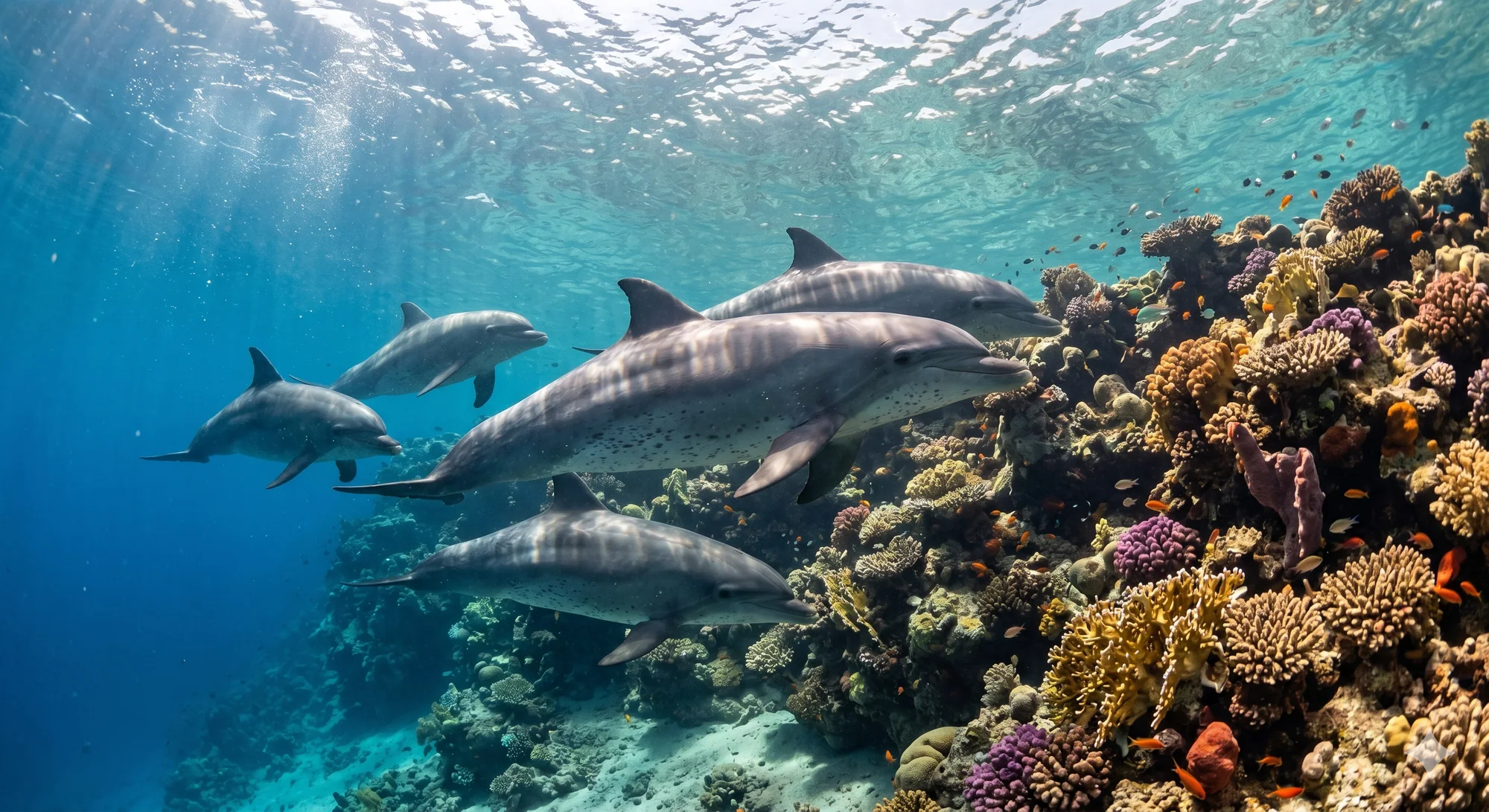
Tursiops aduncus
Bottlenose Dolphin
Resident pods from El Gouna to Marsa Alam. Bow-riders, reef hunters, and the most reliably encountered cetacean in the Red Sea.
The Indo-Pacific bottlenose dolphin is the most widely encountered cetacean in the Red Sea. Where spinner dolphins concentrate at specific resting lagoons, Sataya above all, the bottlenose is a general coastal resident, found in sheltered bays, around offshore reefs, and alongside boats throughout the sea from Sinai to the Sudanese border.
The Indo-Pacific species (Tursiops aduncus) is smaller and more slender than its common bottlenose relative (T. truncatus), with a longer beak and spotted ventral surface in adults. In the Red Sea it is predominantly a coastal and reef-associated animal, hunting baitfish in shallow water, working reef edges at depth, and making use of the coral structure in ways that the open-ocean spinner dolphin does not.
Resident pods maintain consistent home ranges around specific reefs and bays. The dolphins around El Gouna and Hurghada are well-documented and have been the subject of long-term observation by local researchers and dive operators. Individual dolphins in these pods can be identified by dorsal fin markings, some animals have been continuously monitored for over fifteen years. These are not migratory animals passing through; they are resident wildlife whose entire lives play out within a relatively constrained geographic area.
Pod sizes typically range from five to thirty individuals, with larger aggregations occasionally forming on productive offshore grounds. Family units, mother, calf, and associated juveniles, are the stable social core. Young males form loose bachelor groups. Interspecific associations with spinner dolphins occur, particularly at Sataya, where mixed species groups are regularly observed.
Bottlenose dolphins in the Red Sea display a broad repertoire of behaviours that reflect their social complexity and ecological flexibility. Unlike the spinner dolphin, which has a clear daily rhythm of offshore pelagic feeding followed by inshore reef resting, the bottlenose is an opportunistic generalist, hunting at whatever depth and location current conditions make productive.
Bow-riding is a characteristic and commonly observed behaviour. Dolphins approach moving vessels from distance and position themselves in the pressure wave generated by the bow, surfing it with minimal effort. This is not learned human behaviour, it is an extension of the same hydrodynamic exploitation the dolphins apply to large sharks, whale sharks, and other marine animals producing pressure waves. Boats offer a useful and apparently enjoyable free ride.
Cooperative hunting is a more complex behaviour. Small groups drive baitfish against the reef surface or herd them into a tight ball at the surface, with individuals taking turns charging through the bait school. This can produce surface disturbance visible from some distance, circling dolphins, birds diving, fish breaching, and is one of the more spectacular naturally occurring feeding events in the Red Sea.
Mothers with young calves maintain close physical contact with their offspring for the first several years of life. Calves are present year-round in resident pods; births are not seasonally concentrated. The long mother-calf association and extended juvenile learning period reflect the complexity of skills, hunting, social navigation, local environmental knowledge, that bottlenose dolphins must acquire to function effectively within their pod.
The Indo-Pacific bottlenose dolphin is listed as Least Concern globally, reflecting wide distribution and generally stable populations outside of areas with intensive direct exploitation. In the Red Sea the primary pressures are indirect.
Tourism disturbance is well-documented. Dolphin encounter sites, particularly around El Gouna, Hurghada, and Sha'ab El Erg, have grown substantially in commercial scale. Boats approaching pods at speed, snorkellers entering the water immediately around resting animals, and the cumulative effect of repeated encounters through a day can alter dolphin behaviour, reduce time budgets available for rest and nursing, and in some documented cases cause temporary abandonment of traditional home range areas.
Prey availability is a less-studied but meaningful concern. Overfishing of reef and coastal fish stocks affects the prey base that coastal bottlenose pods depend on. A dolphin pod that has occupied the same reef system for decades is dependent on the health of that ecosystem.
The Red Sea Atlas considers the resident bottlenose pods of the northern Red Sea to be a conservation asset of significant value, both ecologically and as a basis for a sustainable wildlife tourism economy.
Atlas Position
The resident bottlenose pods around El Gouna and Hurghada are among the most accessible wild dolphin populations on earth. They are also among the most commercially exploited. The Red Sea Atlas position is that encounter quality matters more than encounter frequency, a boat that slows before approach, waits for dolphin interest rather than forcing it, and withdraws when animals show stress signals provides a better experience for passengers and a sustainable one for the pod. An informed operator is not harder to find than a bad one; it is simply a question of whether you ask before you board.
Sign in to share a sighting, behaviour note, or encounter.
No verified sightings yet. Be the first Atlas member to log an encounter.
Keep reading, and open the whole Atlas.
A free account unlocks every dive site guide and map, the marine life library, member reports, and the full incident log. Free to join.
Join free to keep reading