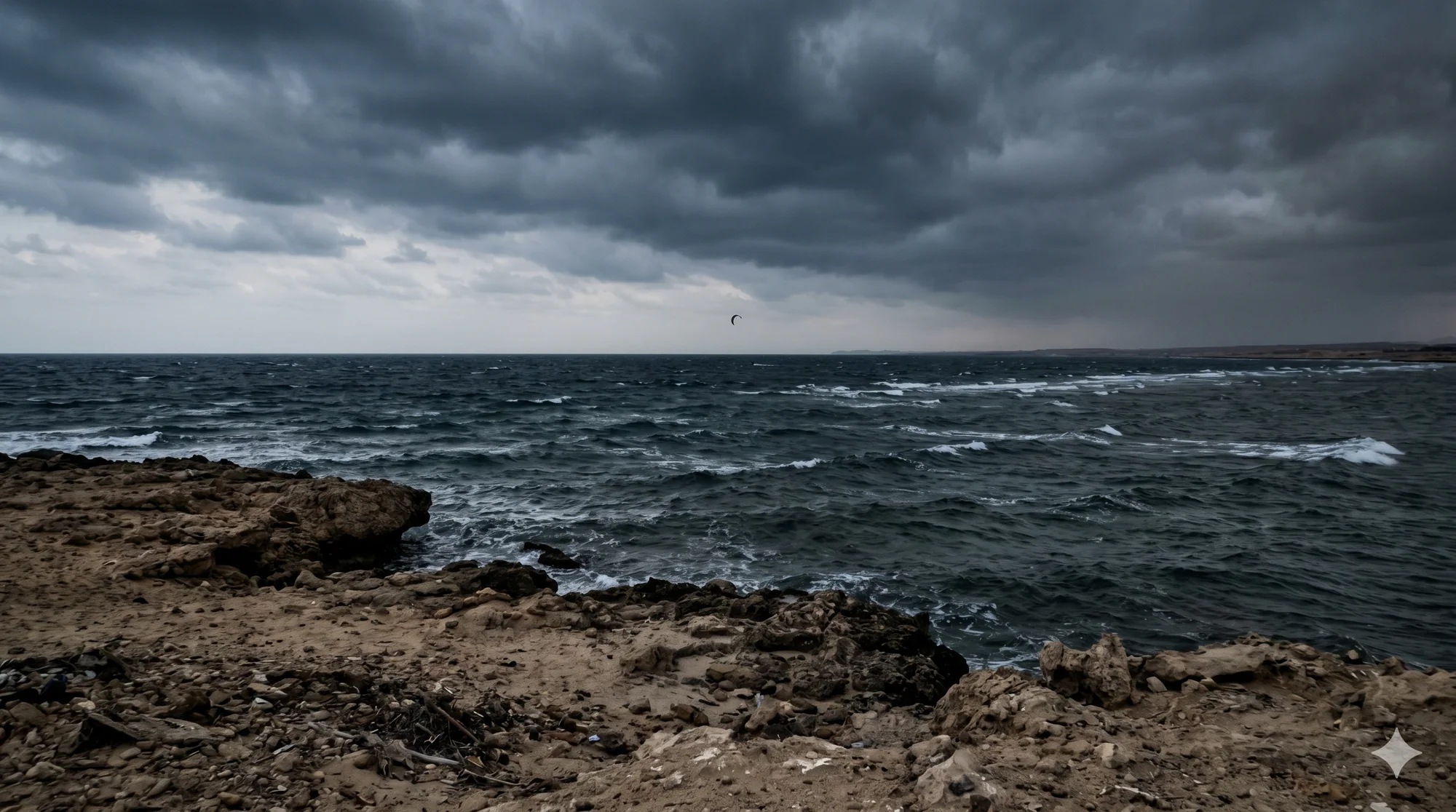
Wind Sports Safety, What Can Go Wrong on the Red Sea
Offshore wind, boat traffic, thermal gusts and the risks of riding unfamiliar water. A frank safety guide for kitesurfers and windsurfers, with pre-launch checklists, self-rescue guidance and the hazards that matter most.
The Red Sea is an exceptional wind sports environment, and the same qualities that make it exceptional, strong, consistent wind; warm, open water; a long coastline far from congested European beaches, also create hazards that are not present on more forgiving coastlines. Every year, kitesurfers and windsurfers get into serious difficulty in Egyptian waters. Some are retrieved safely. Some are not.
This article documents the hazards that matter, not to discourage anyone from riding here, but because riders who understand what can go wrong are the riders who come back. The Red Sea is not uniquely dangerous. It is just unfamiliar to those who come to it for the first time, and unfamiliarity in strong wind conditions carries a cost.
Offshore wind, the primary hazard
The single most dangerous condition in Red Sea wind sports is offshore wind, wind blowing from the land toward the open sea. A rider caught by an offshore wind who loses their kite, breaks equipment, or becomes exhausted is not drifting toward a beach. They are drifting into open water. The Red Sea is a major shipping lane. In summer, rescue response times can be slow. In some areas, there is no organised rescue infrastructure at all.
The prevailing wind is NNW, northerly to north-northwest. On a north-facing beach, this wind is directly onshore. On a south-facing beach, it is directly offshore. The same 25-knot northerly that makes El Gouna's main kite beach ideal can be a death sentence on a poorly chosen launch point two kilometres south. Checking wind direction relative to your specific beach, not just speed, is the most important thing you do before any session.
Stand at the water's edge and wet a finger. Note exactly where the wind is coming from relative to the waterline. If the wind has any component that would carry a drifting rider away from shore, do not launch without a safety boat on the water. No session is worth the alternative. Ask a local center if in doubt, they know which launch directions are safe at their specific beach.
"The wind that blows you offshore does not care how experienced you are. It cares about your direction of drift."
Boat traffic, a shared sea
The Red Sea coastline between Hurghada and Sharm el-Sheikh carries some of the busiest dive boat, ferry and glass-bottom boat traffic in the world. From Hurghada alone, dozens of vessels depart daily for nearby reefs. These boats operate on fixed corridors that pass through areas where kite and windsurf riders also operate. Collisions have occurred. They are not hypothetical.
The kite line, the 20–25 metres of line between a rider and their kite, is invisible from a boat bridge at speed. A boat collision with a kite line does not just affect the rider; the line can cut, drag, or capsize. Established kite centers in El Gouna, Hurghada and Dahab operate within designated water corridors agreed with local maritime authorities. Riding within these corridors is the only mitigation that works, it separates kite traffic from boat traffic.
If you are not certain that the water you are entering is free of boat traffic, do not enter it. In Hurghada especially, the proximity of kite beaches to active dive boat corridors means this check is not optional. Use a licensed center with a designated water zone. The cost of the lesson or session fee buys you separation from a hazard that is otherwise invisible until it is too late.
Thermal gusts and changing conditions
During the thermal wind season (April through September), the Red Sea coast can produce rapid, significant wind acceleration in the early afternoon. A session that begins at 18 knots at 10:00 can be riding at 30+ knots by 13:00. This is not unusual, it is the expected pattern. Riders who launched on a comfortable kite size in the morning can find themselves overpowered within two hours.
The thermal build in summer is not the only source of sudden condition change. Cold fronts tracking through the eastern Mediterranean in late autumn and winter can produce rapid wind direction shifts and speed increases. A forecast that shows 20 knots NNW can become 35 knots NW within a few hours as a depression passes. The timing is not always predictable within the accuracy of consumer forecast tools.
In summer, go down one kite size from what the morning forecast suggests. The thermal build will take care of the rest. In winter, monitor the synoptic chart, tightly packed isobars approaching from the northwest mean a step change in conditions is coming. Leaving the water an hour early is a minor inconvenience. Being overpowered offshore is not.
Self-rescue, what you must be able to do
Every kitesurfer in the Red Sea should be able to perform a reliable self-rescue, without assistance, without another rider nearby, and in conditions worse than what they launched in. This is not a safety-course checkbox. It is the difference between a rider who gets back to shore after equipment failure and one who does not.
The self-rescue technique for kitesurfing involves depowering and collapsing the kite, wrapping the lines, and using the kite as a sail to body-drag or body-board back to shore. In Red Sea conditions, warm water, typically low swell, this is manageable if you have practiced it. It has never been managed successfully for the first time under duress in open water. Practice it in shallow water near shore in light conditions before you need it in the real world.
Know your chicken loop quick release and your safety system, practice triggering both until it is automatic. Know how to collapse and wrap your kite in the water. Know how to body-drag upwind. Carry a small signal device (mirror, whistle, or waterproof phone in an arm pocket) on every session. Tell someone on shore where you are going and when you expect to be back.
The buddy system and local knowledge
Solo sessions are a personal choice that most riders make at some point. On a supervised beach in a protected lagoon with a safety boat in the water, the risks are manageable. On an open beach in an unfamiliar area with offshore wind, they are not. The buddy system, a spotter on shore at minimum, ideally another rider in the water, is the most reliable redundancy available.
Local knowledge is irreplaceable. A rider who has spent three seasons in El Gouna understands which corner of the lagoon the wind wraps around and becomes turbulent, which boat lane runs close to the kite zone, and what the afternoon cloud build over the mountains usually means. This knowledge is not available in any forecast app. It is available in a ten-minute conversation with the center staff or with another rider on the beach. Have that conversation before your first session at any new location.
Book one supervised session with a local center before riding independently, even if you are an experienced rider. You are buying local knowledge and a safety boat, not instruction. Centers in El Gouna, Dahab and Safaga all run supervised sessions for experienced riders. The fee is low. What you learn in that session covers hazards no guide can document.
Windsurfing-specific hazards
Windsurfers face a different risk profile from kitesurfers. A de-rigged windsurf board is not a liability, it is a rescue platform. A rider who cannot water-start or who loses their rig in strong conditions can cling to the board and wait for assistance. The board itself will not drag them offshore. This makes a broken-down windsurfer more recoverable than a broken-down kitesurfer in comparable conditions.
The key windsurfing hazard in the Red Sea is exhaustion. In 28–35 knot conditions, even an experienced rider works hard. Summer heat compounds this, dehydration in a Safaga or El Gouna session in July is a real physiological risk, not just discomfort. Shorten your sessions in extreme heat, carry water on the beach, and do not go back out when you are already tired. The conditions will be the same tomorrow.
Heat exhaustion and dehydration impair judgement before they impair muscle function. By the time you feel seriously thirsty in a summer session, you are already behind. Drink before you launch, stop and drink after 45-60 minutes in the water, and know the signs: headache, reduced concentration, poor decision-making. Getting off the water when you are cognitively impaired is harder than it sounds.
The Atlas documents wind sports safety on the Red Sea as independent factual reference. We have no commercial relationship with any kite or windsurf center. The recommendation to use licensed local centers is based on the genuine safety value of local knowledge and supervised water access, not affiliation. We encourage riders to share incident and near-miss reports through the Atlas so the community can build a more complete picture of where and how things go wrong.
Is it onshore, sideshore, or offshore at your specific beach? Speed is secondary to direction.
Are you launching within a designated kite corridor? Is there active boat traffic near your zone?
Quick release working? Lines clear of tangles? Bar trim correct for conditions? Safety leash attached?
A person on shore knows where you are going and when to raise the alarm if you don't return.
A waterproof case with your phone in an arm pocket, or a whistle and signal mirror, weighs nothing.
Member Comments
Leave a comment
Keep reading, and open the whole Atlas.
A free account unlocks every dive site guide and map, the marine life library, member reports, and the full incident log. Free to join.
Join free to keep reading